


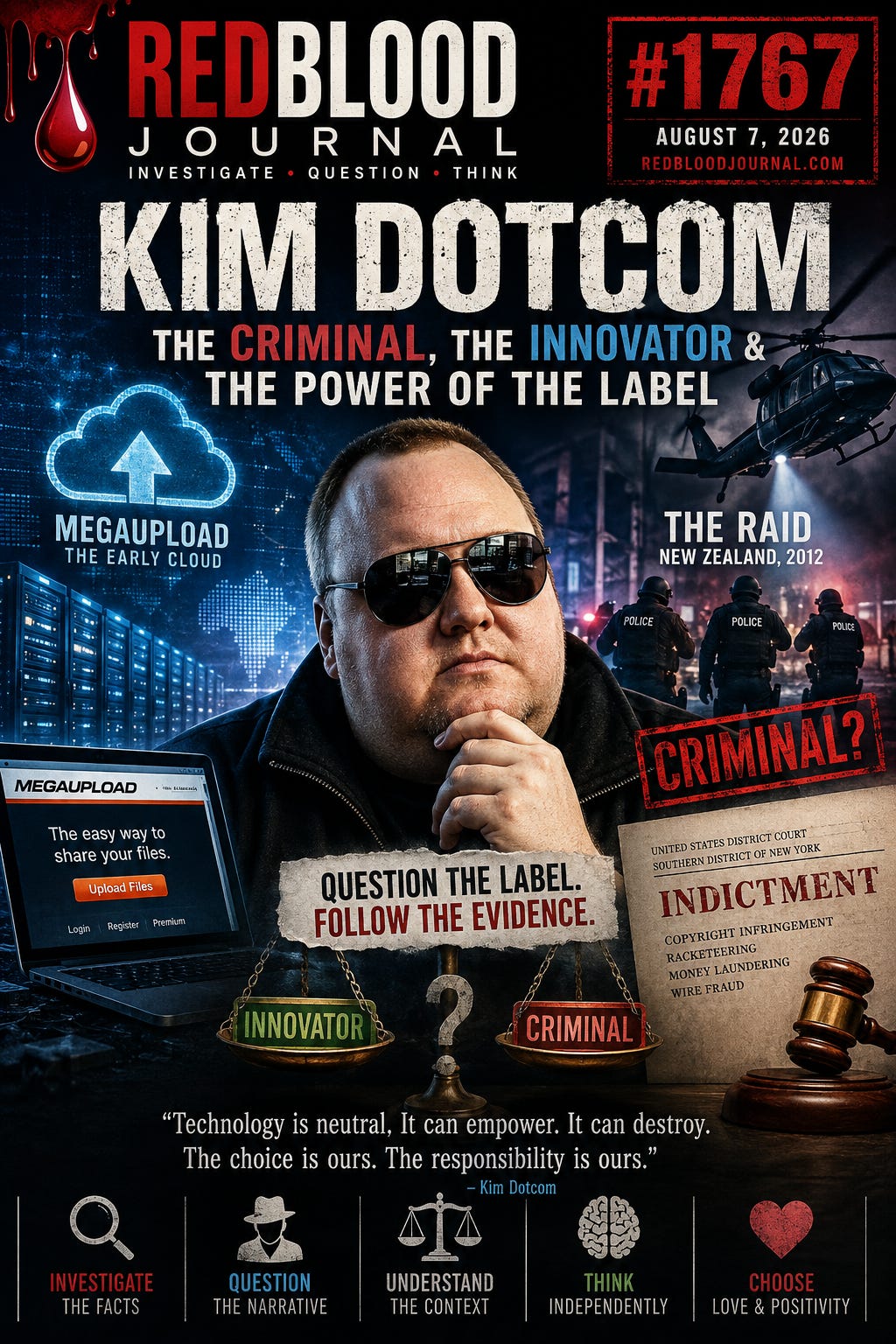
🩸💾 #1767 — Kim Dotcom: The Criminal, the Innovator & the Power of the Label
When Technology Challenges Power, Question the Story Before Accepting the Name
August 7, 2026
RedBloodJournal.com
Some stories begin with a crime.
Others begin with an invention.
The story of Kim Dotcom begins somewhere between the two.
For more than a decade, governments, prosecutors, entertainment companies, journalists, technologists, and Dotcom himself have presented remarkably different versions of the same man.
To U.S. prosecutors, he was the central figure behind a massive criminal copyright enterprise.
To portions of the technology community, he was an early cloud-computing entrepreneur whose platform became the target of industries struggling to adapt to the internet.
To Dotcom himself, the case became something even larger: an example of what can happen when technology threatens established financial and political interests.
The documentary opens with Dotcom describing his experience as if he were trapped inside a Hollywood movie and immediately asking what happened to the principle of being innocent until proven guilty.
That question provides an appropriate starting point.
Not because Kim Dotcom should automatically be considered innocent.
And not because governments should automatically be considered dishonest.
But because before accepting the word criminal, an independent mind should first ask:
What actually happened?
Who Was Kim Dotcom?
Born Kim Schmitz in Germany, Dotcom became fascinated with computers during the early development of the commercial internet.
He described hackers as people who naturally discover weaknesses in systems.
That ability brought him both trouble and opportunity.
His early life included convictions related to computer fraud, something Dotcom himself acknowledges. But his notoriety also helped transform him into a computer-security consultant, creating a strange cycle in which the reputation generated by hacking helped establish his later business career.
From the beginning, therefore, there were already two Kim Dotcoms.
The first was the hacker who had crossed legal boundaries.
The second was the entrepreneur who understood earlier than many people how important computers and networks would become.
Both are part of the story.
Ignoring either produces an incomplete picture.
The Birth of Megaupload
The central idea behind Megaupload was remarkably simple.
Dotcom described wanting to share large video files with friends but discovering that they were too large to send conveniently through email.
His solution was:
Upload the file to a server.
Send someone a link.
Let that person download it.
Today this idea sounds ordinary because cloud storage has become part of everyday life.
At the time, however, it was still emerging.
The documentary describes Megaupload as one of the early consumer cloud-storage services and notes that the underlying technology could store everything from personal files and academic research to music and movies.
Megaupload grew extraordinarily quickly.
More users meant more advertising.
Premium subscriptions generated additional income.
More traffic required more servers and greater bandwidth.
The simple file-sharing idea became a global business.
And that is where the real conflict began.
The Technology Was Neutral — But Was the Business?
A hard drive does not know whether a file is legal.
A server does not understand copyright.
A download link cannot determine whether the person clicking it owns the material being downloaded.
That formed the heart of Dotcom’s defense.
His legal team argued that Megaupload was fundamentally a cloud-storage provider and faced the same problem encountered by services such as Google and YouTube: people can use legitimate technology for legitimate purposes or illegitimate purposes.
But the U.S. government presented a very different argument.
Prosecutors alleged that Megaupload wasn’t merely an innocent storage service being misused by some customers.
They contended that the system provided incentives for users to upload highly desirable copyrighted material—including newly released movies and music—and that infringement therefore became an important part of the company’s economic engine.
That distinction is crucial.
If Megaupload merely supplied technology that some customers abused, the case resembles many other internet-platform disputes.
If management knowingly encouraged infringement because infringement increased revenue, the legal question becomes very different.
That is the battlefield on which much of the case was fought.
Hollywood Meets the Internet
Megaupload emerged during one of the largest disruptions in entertainment history.
Music had already experienced Napster.
Movies were becoming easy to copy as broadband speeds increased.
Perfect digital copies could move around the world without physical manufacturing or distribution.
The old model was losing control over something it had historically controlled:
distribution.
Entertainment companies understandably argued that creators and copyright owners were entitled to payment for their work.
That argument should not simply be dismissed.
Musicians, filmmakers, writers, technicians, small companies, investors, and countless workers depend upon intellectual-property income.
But Dotcom and others saw another side.
They believed the internet was exposing weaknesses in an outdated distribution system dominated by powerful middlemen.
Megaupload even developed a proposed service called Megabox, which Dotcom said would allow artists to sell directly to fans while retaining substantially more revenue. The documentary also discusses plans for a licensed movie service intended to compete with Netflix.
Was this an authentic transition toward legitimate distribution?
Or an attempt to sanitize a business already dependent upon infringement?
Again, the documentary presents both possibilities.
When an Innovator Becomes an Enemy
The conflict eventually extended beyond copyright law into political power.
The documentary discusses the influence of Hollywood lobbying in Washington and includes statements illustrating how aggressively the entertainment industry expected politicians to defend intellectual-property interests.
This does not prove that the criminal prosecution was manufactured by Hollywood.
That conclusion would require stronger evidence.
But it does establish something important:
Powerful economic interests were not neutral observers.
Hollywood had billions of dollars at stake.
Megaupload had millions of users.
Technology was changing the economics of entertainment.
Politicians were being lobbied.
And governments eventually became involved.
That makes questioning the surrounding political environment legitimate.
January 2012: The Raid
The conflict reached its most dramatic moment when New Zealand police raided Dotcom’s mansion while acting upon the U.S. investigation.
Helicopters were used.
Armed tactical officers entered the property.
Assets were seized.
Dotcom was arrested.
The FBI alleged that the Megaupload operation had generated approximately $175 million in criminal proceeds while causing copyright owners at least $500 million in losses.
The scale of the raid became controversial almost immediately.
Critics questioned whether such force was proportionate for allegations centered largely on financial and copyright offenses.
One documentary participant compared the spectacle to operations normally associated with dramatically more dangerous targets and questioned why helicopters and heavily armed units were necessary.
The government side maintained that police planning reflected information about firearms at the residence and associated risk assessments.
Once again, two narratives emerged from the same event.
Then Something Important Happened
New Zealand courts subsequently found serious problems with parts of the operation.
The documentary reports that a High Court judge ruled the search warrants used during the raid invalid.
Questions were also raised over the handling and removal of cloned computer data by U.S. authorities.
This mattered because public perception began changing.
The question was no longer simply:
Was Kim Dotcom guilty?
Another question appeared:
Did government authorities themselves follow the law properly while pursuing him?
Those are two completely separate questions.
A defendant can have committed wrongdoing while authorities simultaneously violate legal procedures.
One does not erase the other.
That distinction is essential to independent thinking.
The Power of the Label
Here lies perhaps the most important lesson of the entire Kim Dotcom story.
Never underestimate anything or anyone.
And never allow a label to replace an investigation.
When governments or media repeatedly introduce someone as a criminal, terrorist, traitor, extremist, pirate, or enemy, the label begins doing psychological work before the evidence has even been examined.
Sometimes the label is accurate.
There are real criminals.
There are real terrorists.
There are real fraudsters.
There are real threats.
But history also contains countless examples in which governments have criminalized dissidents, opposition figures, journalists, whistleblowers, religious minorities, political movements, and other people who challenged existing power.
Authoritarian governments make this especially visible.
Countries such as Iran, North Korea, and Saudi Arabia have all faced extensive international criticism over treatment of political dissidents and government critics.
The purpose of such punishment can extend beyond the individual being punished.
One prosecution can communicate a message to thousands of others:
Do not follow this example.
That is why the criminal label deserves examination wherever it appears—whether issued by an authoritarian regime or a democratic government.
The existence of democratic institutions does not eliminate the possibility of political influence.
But skepticism must work in both directions.
Calling someone a dissident does not prove innocence.
Calling someone an innovator does not erase crimes.
And calling someone a criminal does not eliminate the responsibility to examine the evidence.
Manufacturing Perception
There is another form of power that requires no prison.
It is the power to manufacture perception.
Repeated words create associations.
If the public hears:
hacker
criminal mastermind
pirate
dangerous
millionaire
weapons
often enough, an image begins forming.
The documentary itself explores this question when discussing allegations and language surrounding Dotcom’s raid and how the portrayal influenced New Zealand public opinion.
But the same caution applies to Dotcom’s own self-presentation.
He was an extraordinarily skilled promoter.
Luxury cars.
Huge parties.
Celebrities.
Publicity.
Political campaigns.
Provocative statements.
He manufactured an image too.
Therefore #1767 should not simply ask whether government propaganda shaped public opinion.
It should ask something harder:
Who wasn’t trying to shape public opinion?
Hollywood had a narrative.
The U.S. government had a narrative.
New Zealand politicians had narratives.
The media had narratives.
Kim Dotcom had a narrative.
Each competed for the same territory:
the public mind.
The Extradition Battle
Dotcom’s defense argued that the U.S.-New Zealand extradition framework did not properly cover the copyright conduct alleged and that ordinary internet-service-provider protections should prevent criminal liability merely for providing technology.
The American side argued that Megaupload was not a passive conduit at all.
At the extradition hearing, U.S. representatives cited internal communications that they argued demonstrated awareness of infringement and deliberate tolerance of abuses that fueled business growth.
The defense countered that evidence had been selectively presented and claimed that translations of German-language communications were inaccurate or misleading.
Ultimately, the New Zealand court found sufficient evidence for the defendants to be considered eligible for extradition.
The documentary therefore does not end with Dotcom vindicated.
Nor does it end with a U.S. criminal conviction.
It ends inside an unresolved legal struggle.
What Happened After the Documentary?
This is where #1767 can go beyond the film.
The legal battle continued for years.
New Zealand’s Supreme Court ruled in 2020 that Dotcom and his co-defendants were eligible for surrender.
Two co-defendants, Mathias Ortmann and Bram van der Kolk, later reached arrangements allowing them to face charges in New Zealand. They pleaded guilty and were sentenced there in 2023.
Dotcom sought similar domestic prosecution, but authorities declined.
In August 2024, New Zealand’s Minister of Justice signed the order authorizing Dotcom’s surrender to the United States.
Dotcom challenged that decision.
On July 1, 2026, the New Zealand Court of Appeal dismissed his latest challenge. The court summarized the U.S. allegations as criminal copyright infringement, racketeering, and wire fraud and noted that American authorities continue seeking his extradition.
The case therefore remains extraordinarily relevant today.
Fourteen years after the 2012 raid, the legal battle was still continuing in 2026.
Technology Eventually Changed the Argument
Perhaps the most revealing portion of the documentary arrives near its end.
One participant observes that piracy declined as legitimate digital services became cheaper, easier, and more accessible.
That is important.
Consumers wanted digital music.
They eventually got Spotify and similar services.
Consumers wanted movies on demand.
They got Netflix, streaming services, and digital rentals.
Consumers wanted cloud storage.
They got Google Drive, Dropbox, iCloud, OneDrive, and countless others.
The technology did not disappear.
The legal marketplace adapted to it.
The documentary explicitly raises the possibility that easier and cheaper legitimate access reduced the demand for piracy.
That leads to an uncomfortable historical question:
Were some early internet “pirates” merely criminals?
Or were some of them also signals—sometimes illegal signals—telling established industries what consumers wanted?
The two possibilities are not mutually exclusive.
A person can violate existing law while simultaneously exposing weaknesses in an outdated system.
The Question Behind the Question
The Kim Dotcom case therefore becomes much larger than Megaupload.
Whenever somebody substantially threatens an established system, ask:
What did this person actually do?
Then ask:
What law was allegedly violated?
Then:
Who was harmed?
Then:
Who benefited from stopping them?
Then:
Were government actions proportionate?
Then:
Did the accused receive legitimate due process?
Then:
What information came from prosecutors?
What information came from the defense?
What information came from interested corporations?
What information came from independent sources?
Only after asking those questions should the label be considered.
🩸 The Red Blood Perspective
The greatest mistake would be replacing one form of blind faith with another.
Do not blindly believe the government.
But do not blindly believe the person fighting the government either.
Do not automatically believe Hollywood.
But do not automatically believe the entrepreneur threatening Hollywood.
Do not believe something merely because mainstream media repeats it.
And do not believe the opposite merely because alternative media repeats it.
Investigate.
Kim Dotcom’s own story demonstrates why.
He had genuine previous criminal convictions.
Megaupload carried enormous amounts of copyrighted material.
U.S. prosecutors presented internal communications that they argue reveal knowledge of infringement.
Those facts cannot simply be erased.
But neither can the other side be erased.
Megaupload was also an early large-scale cloud-storage platform.
The raid generated legitimate legal controversy.
New Zealand courts found deficiencies in aspects of the government’s actions.
Hollywood possessed enormous economic and lobbying interests.
And technologies once treated primarily as piracy infrastructure eventually became normal parts of the modern internet.
Therefore the Red Blood conclusion cannot responsibly be:
Kim Dotcom was innocent.
Nor should it simply be:
Kim Dotcom was a criminal.
The deeper conclusion is:
Never allow the label to finish the investigation before the investigation begins.
Governments understand the power of labels.
Corporations understand it.
Political movements understand it.
Media organizations understand it.
And sophisticated individuals such as Kim Dotcom understand it too.
Words are capable of directing thought before evidence gets an opportunity to speak.
The independent mind reverses that process.
Evidence first.
Label second.
Question the accuser.
Question the accused.
Question the media.
Question the government.
Question the opposition.
And most importantly:
Question your own desire to believe whichever side already agrees with you.
That is where critical thinking begins.
🌊 Ocean of Love and Positivity
Never underestimate another human being.
A person may be called a criminal today and remembered differently generations later.
Another may be celebrated as a hero today and judged differently once history has access to evidence unavailable in the moment.
Names change.
Governments change.
Corporations disappear.
Technologies become obsolete.
But the lesson remains.
Every human being deserves to be understood beyond a label.
That does not mean abandoning justice.
It means making justice worthy of its name.
If someone has harmed others, investigate honestly.
If someone has stolen, prove the theft.
If someone has committed fraud, demonstrate the fraud.
If someone is innocent, allow the evidence to reveal that as well.
Punishment should never substitute for truth.
And fear should never substitute for understanding.
The deeper education of life is learning to observe without immediately becoming consumed by either hatred or admiration.
The criminal may teach something.
The judge may teach something.
The government may teach something.
The rebel may teach something.
Even the mistake may become a teacher.
Perhaps that is why difficult people and difficult events repeatedly enter humanity’s classroom.
They force us to examine ourselves.
Do we judge because we understand?
Or because someone taught us whom to judge?
Do we hate because we discovered the truth?
Or because we inherited another person’s fear?
A free consciousness learns to recognize the difference.
Technology will continue changing.
Governments will continue governing.
Corporations will continue protecting their interests.
People will continue challenging systems.
But the person who learns to think independently does not have to become the property of any of them.
Listen.
Question.
Investigate.
Learn.
And when the evidence finally allows a conclusion, reach it without hatred.
Because even justice becomes corrupted when its fuel is revenge.
Knowledge should ultimately make us wiser rather than angrier.
The purpose of questioning the world is not to discover more reasons to hate it.
It is to understand the classroom more clearly while learning to govern the person living inside ourselves.
That is the greater freedom.
In an Ocean of Love and Positivity.
🩸🌊✨ Fantastic!
⚖️
The Kim Dotcom Chronicle: Technology, Power, and Perception
Aug 7, 2026
This text examines the complex legal and cultural legacy of Kim Dotcom, the founder of Megaupload, whose life story sits at the intersection of technological innovation and criminal prosecution. The source details the 2012 raid on his New Zealand estate and the subsequent decade-long battle against extradition to the United States on copyright and fraud charges. It highlights the conflicting narratives between the U.S. government, which views him as a criminal, and his supporters, who see him as a pioneering entrepreneur targeted by the powerful Hollywood lobby. Beyond the specific case, the article serves as a philosophical meditation on the power of labels and how they are used by institutions to shape public perception. Readers are encouraged to practice independent critical thinking by questioning both official government accounts and the self-presented images of the accused. Ultimately, the text argues that the evolution of cloud storage and streaming services demonstrates how once-disruptive technologies eventually become standardized parts of the modern digital economy.


