


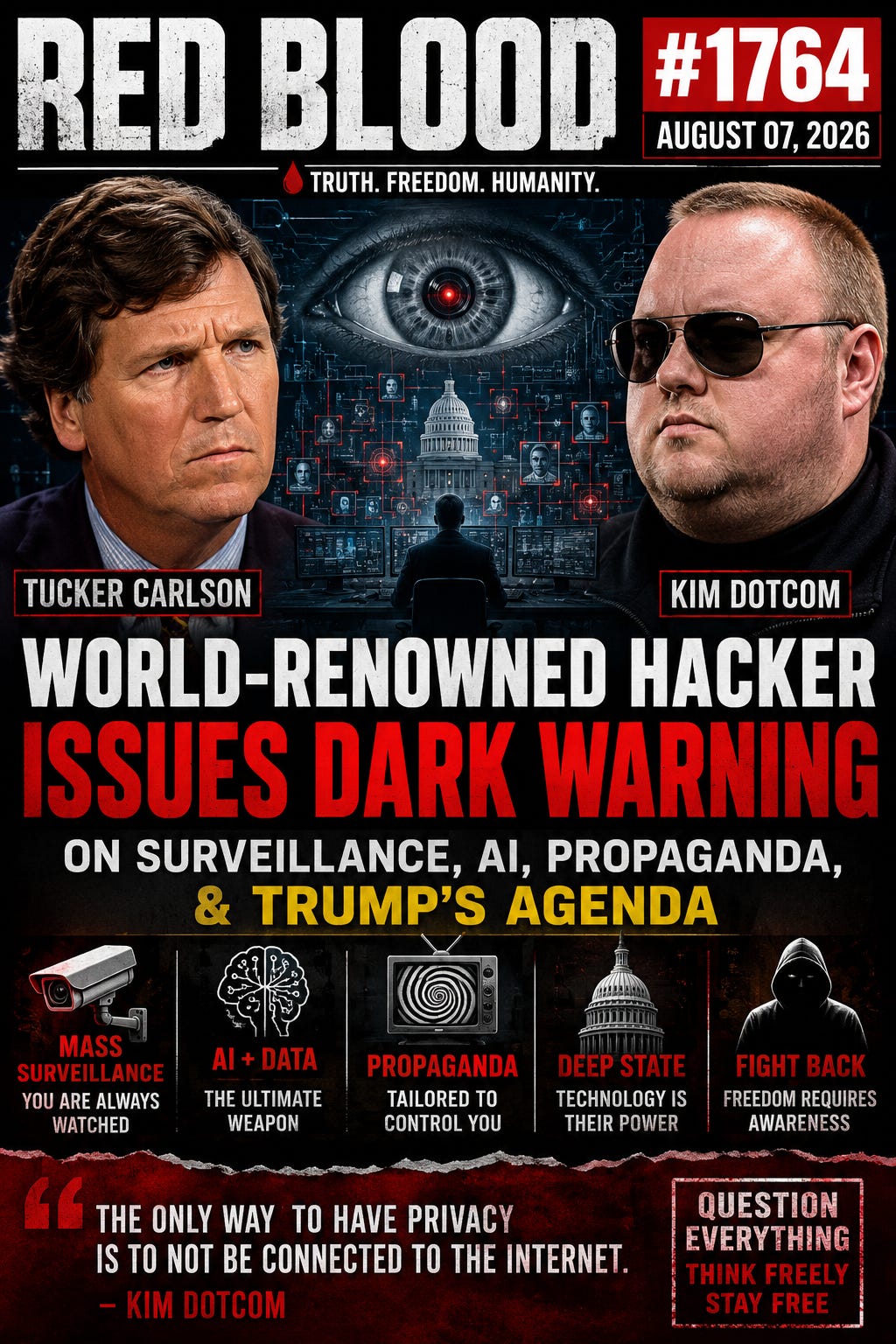
🩸 🌐 #1764 — World-Renowned Hacker Issues Dark Warning on Surveillance, AI, Propaganda & Trump’s Agenda
August 7, 2026
Executive Summary
In this interview, Tucker Carlson speaks with Kim Dotcom, the internet entrepreneur best known for founding Megaupload and for his long legal battle with the United States.
The discussion ranges far beyond technology.
It explores surveillance, artificial intelligence, digital privacy, propaganda, media influence, direct democracy, geopolitics, debt, Ukraine, Iran, NATO, Russia, China, nuclear war, Julian Assange, Donald Trump, and the future of Western civilization.
Much of the interview consists of Kim Dotcom’s personal opinions, predictions, and interpretations, rather than independently verified facts. Throughout, he presents an extremely pessimistic view of the direction of Western governments and technology.
Major Subjects Covered
1. Mass Government Surveillance
Kim Dotcom argues that modern governments already collect enormous amounts of information about virtually everyone.
According to him, governments collect:
phone calls
video calls
internet traffic
browsing habits
purchases
communications
digital identities
He claims this information allows authorities to build behavioral profiles of entire populations.
2. Surveillance Becomes Behavioral Influence
The interview argues that surveillance is not only about gathering intelligence.
Instead, the collected information can allegedly be used to:
categorize citizens
predict behavior
influence opinions
shape public attitudes
increase support for government policies
The discussion compares this concept to targeted advertising performed by large technology companies.
3. There Is No Real Digital Privacy
Kim Dotcom repeatedly claims that true online privacy no longer exists.
He argues that:
phones
computers
communication platforms
internet infrastructure
are ultimately vulnerable to government access.
His conclusion is blunt:
The only completely private communication is staying offline altogether.
4. His Legal Battle with the United States
The interview revisits his long-running legal case.
Kim Dotcom states that:
supporting WikiLeaks
financially supporting Julian Assange
made him a target.
He argues that copyright charges became a vehicle for broader prosecution.
He also discusses the continuing efforts to extradite him from New Zealand.
5. Encryption and Secure Communication
A lengthy section questions whether any messaging applications are genuinely secure.
Kim Dotcom claims that:
Signal
WhatsApp
iMessage
cannot be trusted.
These are presented as his assertions during the interview; no technical evidence is provided within the transcript to substantiate them.
6. Artificial Intelligence
One of the interview’s darker themes concerns AI.
Kim Dotcom predicts that AI will eventually analyze massive surveillance databases, allowing unprecedented insight into individual lives.
His concern is not AI itself, but AI combined with large-scale personal data collection.
7. Propaganda
The conversation claims governments increasingly use information campaigns to shape public opinion.
Kim Dotcom argues that modern propaganda is personalized through digital profiling and also claims that many public narratives should be viewed skeptically. These statements reflect his opinions rather than established fact.
8. Independent Media
Tucker Carlson asks whether independent media can continue operating.
Kim Dotcom predicts increasing pressure on independent voices and expects greater control over information in the future.
9. Direct Democracy
Rather than representative government, Kim Dotcom advocates direct democracy.
He points to Switzerland as an example and argues citizens should vote directly on major issues instead of relying solely on elected politicians.
10. America’s Debt
Another recurring topic is U.S. national debt.
Kim Dotcom argues that:
current debt levels are unsustainable
financial instability will worsen
debt threatens America’s global position
These are presented as his forecasts rather than verified economic conclusions.
11. Ukraine
He predicts:
Russia ultimately prevails militarily
conflict between Russia and Europe continues
tensions could expand
These are speculative forecasts expressed during the interview.
12. Iran
Kim Dotcom predicts:
the United States cannot successfully invade Iran
Iran ultimately prevails in a prolonged conflict
U.S. influence in the region declines afterward
These statements are presented as predictions rather than factual outcomes.
13. Nuclear War
Perhaps the darkest section involves nuclear conflict.
Kim Dotcom expresses concern that escalating geopolitical tensions could eventually lead to nuclear confrontation involving major powers.
These are speculative opinions and should not be interpreted as evidence that such an outcome is expected or inevitable.
14. Donald Trump
The interview concludes with Kim Dotcom’s highly critical assessment of President Donald Trump.
He alleges that Trump:
broke campaign promises
pursued policies contrary to his earlier statements
presents a heightened geopolitical risk
These are Kim Dotcom’s personal political opinions expressed during the interview, not independently verified factual findings.
Central Themes
Across the interview, several recurring themes emerge:
Mass surveillance
Loss of digital privacy
Artificial intelligence
Government influence over information
Propaganda
Independent media
Digital freedom
U.S. debt
Global power shifts
Ukraine
Iran
Nuclear deterrence
Direct democracy
Future geopolitical stability
The Red Blood Perspective
Whether readers agree or disagree with Kim Dotcom’s conclusions, the interview reflects a broader public concern about the relationship between technology, governments, and individual liberty. It blends firsthand experiences, political opinions, technological claims, and geopolitical forecasts into a single narrative. Some topics discussed—such as government surveillance programs and data collection—have documented historical foundations, while many of the broader conclusions and future predictions remain speculative and should be evaluated critically alongside multiple sources.
Critical thinking requires separating verified facts, expert analysis, personal opinion, and prediction. Doing so allows readers to weigh evidence on each issue rather than accepting or rejecting the entire narrative as a whole.
🌊 Ocean of Love and Positivity
Knowledge grows strongest when curiosity is paired with careful evidence. Every claim deserves examination, every source deserves context, and every conclusion benefits from an open but disciplined mind.
In an Ocean of Love and Positivity.
🩸🌊✨ Fantastic!
🌐
The Kim Dotcom Warning: Surveillance, AI, and Geopolitical Collapse
Aug 7, 2026
In this interview, Tucker Carlson discusses a wide range of global crises and technological threats with internet entrepreneur Kim Dotcom. The conversation centers on the erosion of digital privacy, claiming that mass government surveillance and artificial intelligence have eliminated the possibility of secure communication. Dotcom shares his pessimistic outlook on geopolitical stability, predicting the collapse of the U.S. economy due to debt and the potential for nuclear conflict involving Russia and Iran. He further criticizes representative democracy and mainstream media, advocating instead for direct democracy to combat state-sponsored propaganda. Ultimately, the source serves as a platform for Dotcom’s speculative warnings regarding the future of Western civilization and the perceived overreach of government power.
Tucker Carlson August 07, 2026
World-Renowned Hacker Issues Dark Warning on Surveillance, AI, Propaganda, & Trump’s Agenda


