


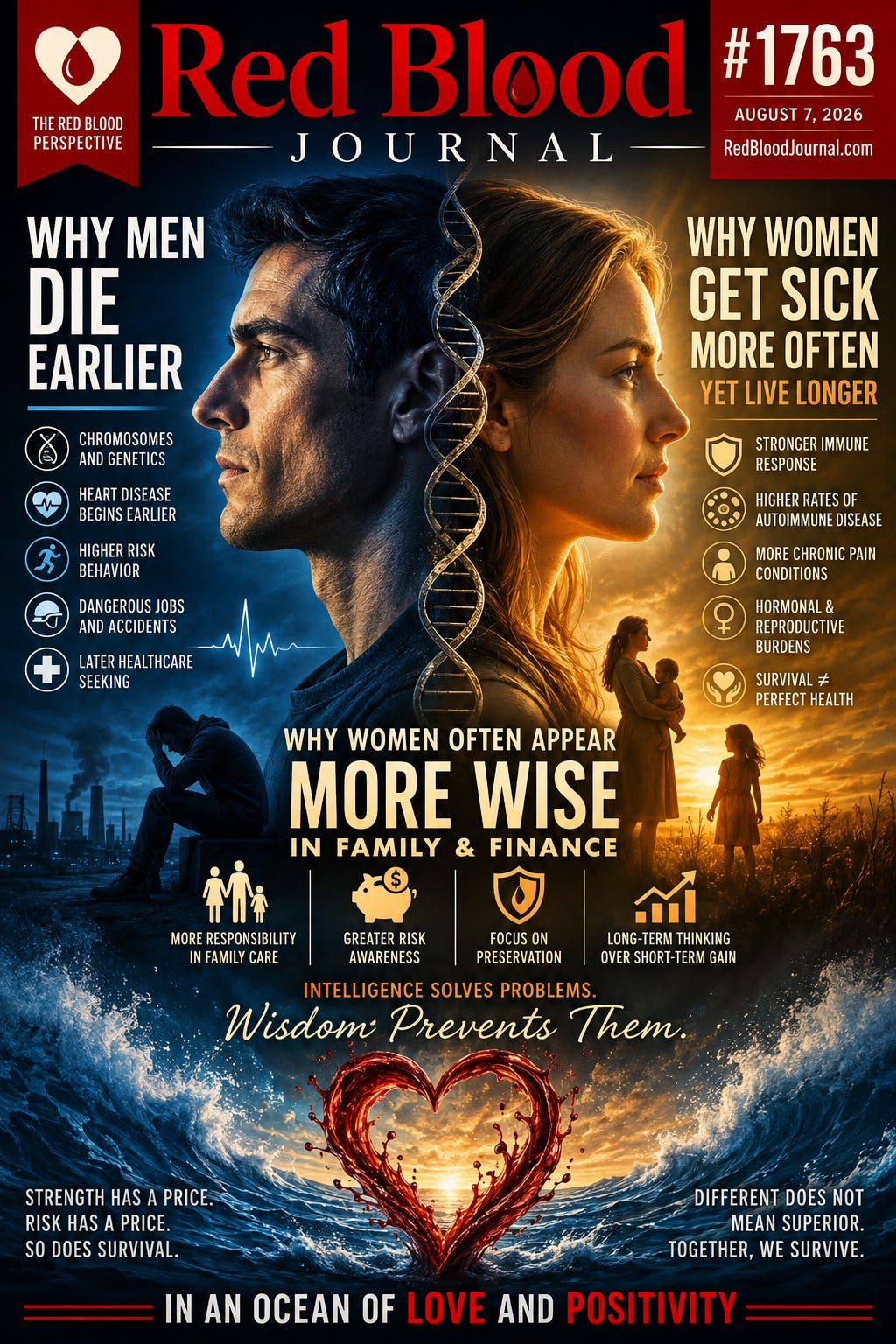
🩸 ♀️♂️ #1763 — The Male–Female Paradox
Why Men Die Earlier, Women Live With More Illness, and the Sexes Often Approach Risk Differently
August 7, 2026
Red Blood Journal
RedBloodJournal.com
Human beings come in two biological sexes that share almost the entire human blueprint—and yet their bodies do not age, become ill, take risks, or die in precisely the same ways.
Three simple questions open a surprisingly deep investigation:
Why do men generally die younger than women?
Why do women appear to experience more chronic illness despite living longer?
And why do women sometimes appear more cautious or long-term-oriented when decisions involve family and money?
At first these questions seem unrelated.
They aren’t.
Together they reveal something important about the difference between strength, survival, illness, risk, reproduction, preservation, and wisdom.
PART I — WHY DOES THE MALE BODY USUALLY DIE FIRST?
Across much of the world, women have a higher average life expectancy than men.
This difference cannot be explained by one cause.
Biology, behavior, occupation, disease, hormones, genetics, environment, and risk all contribute.
The Chromosome Difference
Most women have two X chromosomes.
Most men have one X and one Y.
That matters because the second X chromosome can sometimes provide another functioning copy of a gene when a harmful variant exists on the other X.
Men do not have that same backup for X-linked genes.
This is one possible contributor to differences in vulnerability beginning surprisingly early in life.
The male survival disadvantage isn’t exclusively an old-age phenomenon.
It can be observed at multiple stages of life.
Hormones and the Cardiovascular System
Sex hormones affect far more than reproduction.
Estrogen influences blood vessels, metabolism, inflammation and numerous other biological systems.
Before menopause, women generally develop coronary heart disease later than men.
Men, meanwhile, tend to experience cardiovascular disease earlier.
Because cardiovascular disease remains a major cause of death, even a relatively small difference in when serious disease begins can influence average lifespan considerably.
This does not mean estrogen is a simple anti-aging drug or testosterone is harmful.
Human hormonal biology is considerably more complicated.
Both hormones provide advantages and trade-offs.
The Male Risk Factor
Biology is only part of the story.
Men, on average, have historically been more likely to:
work dangerous occupations,
engage in physical risk-taking,
die through violence,
die through accidents,
smoke heavily,
consume larger amounts of alcohol,
delay seeking medical attention,
and engage in potentially dangerous competition.
Some of these differences are cultural.
Some may have biological influences.
Most probably involve both.
Whatever their origin, the consequences accumulate over a lifetime.
PART II — THEN WHY DO WOMEN SEEM TO GET SICK MORE OFTEN?
Here we encounter one of the strangest apparent contradictions in human health.
Women can live longer while spending more years experiencing certain illnesses or disabilities.
Researchers have studied versions of this phenomenon as a male–female health-survival paradox.
The important distinction is between:
becoming sick
and
dying from sickness.
They aren’t the same measurement.
The Female Immune System
Women generally mount stronger immune responses than men.
That can provide advantages against certain infectious diseases.
But a highly reactive immune system carries a potential price.
Women have substantially higher rates of many autoimmune diseases.
The body’s defense system can become so aggressive that it attacks the body it was supposed to protect.
The same biological characteristic can therefore contain both an advantage and a disadvantage.
That principle appears repeatedly throughout biology.
Survival Is Not the Same as Perfect Health
Suppose two people develop serious health problems.
One survives another 20 years with chronic illness.
The other dies after five.
Who was healthier?
The answer depends entirely upon what is being measured.
The first person experienced more years of illness.
The second experienced earlier mortality.
This helps explain an apparent contradiction:
Women can experience greater burdens from some chronic conditions while nevertheless surviving longer.
The body that complains the longest may sometimes be the body that survives the longest.
PART III — FAMILY, MONEY AND THE QUESTION OF WISDOM
Now we reach the most delicate of the three questions.
Are women actually wiser than men regarding family and finances?
That conclusion would go beyond the evidence.
There are brilliant and foolish people of both sexes.
There are reckless women and extraordinarily cautious men.
Individual variation is enormous.
But researchers have repeatedly found average sex differences in certain forms of risk-taking.
Men generally exhibit greater willingness to accept several kinds of risk.
That difference can have consequences.
Risk Creates Winners—and Losers
Imagine two people with $100,000.
One repeatedly searches for opportunities to double it.
The other concentrates primarily on preventing the $100,000 from disappearing.
During a spectacular bull market, the first person might look like a genius.
During a crash, the second person might suddenly look wise.
Neither approach is automatically superior.
They represent different relationships with risk.
And this distinction matters enormously in family finance.
The Provider and the Preserver
For most of human history, reproduction placed dramatically different biological demands on men and women.
A woman could experience:
pregnancy,
childbirth,
breastfeeding,
physical recovery,
and years of caring for highly dependent offspring.
The biological investment was enormous.
From an evolutionary perspective, protecting offspring and maintaining resources could therefore have carried enormous survival value.
Researchers have proposed various evolutionary explanations for average differences in risk preferences between the sexes.
But these should be understood as hypotheses about population tendencies, not rules governing every modern man or woman.
Culture, education, economic circumstances and individual personality matter tremendously.
Perhaps We Have Been Measuring the Wrong Thing
Modern societies often celebrate visible achievement.
Who earned more?
Who built the bigger company?
Who made the spectacular investment?
Who became powerful?
Who won?
But another kind of accomplishment is much quieter.
Who kept the family together?
Who made sure there was money next month?
Who noticed that something was wrong with a child?
Who remembered the doctor’s appointment?
Who prevented a disastrous financial decision?
Who preserved what already existed?
History notices the person who wins the battle.
It rarely notices the person who prevented the battle from becoming necessary.
Intelligence Is Not Wisdom
This may be the most important distinction of all.
Intelligence is the ability to solve a problem.
Wisdom asks whether the problem needed to be created in the first place.
A highly intelligent investor may develop an extraordinarily sophisticated strategy.
A wiser investor might simply recognize:
I don’t need to take this risk.
The same principle applies to family.
Winning an argument requires ability.
Knowing that winning the argument could damage someone you love requires perspective.
The two aren’t identical.
The Male–Female Paradox
Put the three questions together and an intriguing pattern emerges.
The male body, on average, possesses greater physical strength and exhibits greater risk-taking in several domains.
Yet men die younger.
The female body experiences greater burdens from several chronic and autoimmune conditions.
Yet women live longer.
Men may sometimes pursue greater rewards through risk.
Women may sometimes place greater emphasis on preserving resources and protecting family stability.
None of this establishes that one sex is superior.
It suggests something much more interesting:
Nature rarely gives an advantage without attaching a cost.
Strength has a price.
Risk has a price.
A powerful immune system has a price.
Longevity has a price.
Reproduction has a price.
Even caution has a price because excessive caution can prevent opportunity.
🩸 The Red Blood Perspective
Perhaps humanity makes a mistake whenever it asks:
Which sex is better?
The more useful question is:
What can each learn from the other?
The courage to take a necessary risk can be invaluable.
So can the wisdom to refuse an unnecessary one.
The ability to fight matters.
So does knowing what is worth fighting for.
Creating resources matters.
Preserving them matters just as much.
Physical strength can protect a family.
Patience, foresight and emotional awareness can protect it in entirely different ways.
Human civilization did not survive because men defeated women or women defeated men.
It survived because generations of men and women repeatedly contributed different combinations of strength, intelligence, caution, sacrifice, nurturing, competition and cooperation.
The averages may differ.
The individuals always matter more than the averages.
And perhaps the greatest wisdom is recognizing that difference does not require superiority.
🌊 Ocean of Love and Positivity
A man does not become stronger by proving that a woman is weaker.
A woman does not become wiser by proving that a man is foolish.
When two people stop competing over which one is more important, something extraordinary becomes possible.
One person’s strength can compensate for another’s weakness.
One person’s caution can restrain another’s unnecessary risk.
One person’s courage can overcome another’s hesitation.
And both can learn.
Perhaps that is why the family has survived thousands of years of wars, migrations, disease, famine and economic collapse.
Not because men and women were identical.
But because they were capable of standing beside one another when neither could carry everything alone.
Look inward before judging outward.
Learn the strengths of the other without surrendering your own.
And remember that the purpose of wisdom is not victory over another human being.
It is understanding.
In an Ocean of Love and Positivity.
🩸🌊✨ Fantastic!
⚖️
The Male–Female Paradox: Survival, Risk, and Wisdom
Aug 7, 2026
This text explores the biological and behavioral differences between the sexes, focusing on why men typically face shorter lifespans while women often endure more chronic health issues. The author attributes these patterns to genetic advantages like the second X chromosome and hormonal influences that impact cardiovascular health and immunity. Beyond physical traits, the source examines how varying approaches to risk and preservation influence financial and family stability. It highlights that while men may lean toward competitive risk-taking, women frequently prioritize long-term resource protection and nurturing. Ultimately, the writing argues that these complementary strengths have been essential for human survival and societal progress. The overarching theme is that differences in sex are not about superiority but represent a balance of unique contributions that support the collective good.


