


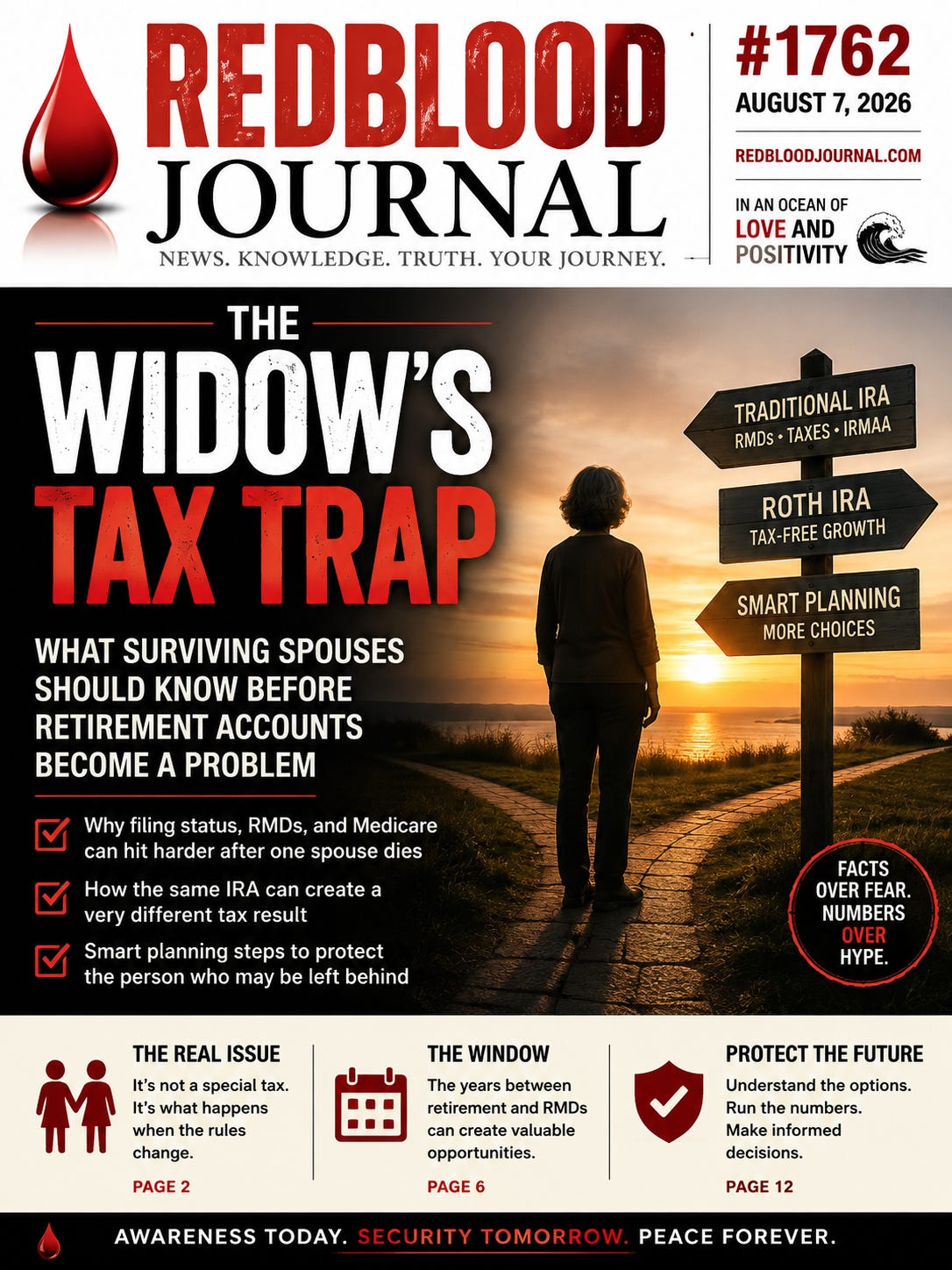
🩸 💰 #1762 — The Widow’s Tax Trap
What Surviving Spouses Should Know Before Retirement Accounts Become a Problem
August 7, 2026
RedBloodJournal.com
There is a retirement tax problem that many married couples never seriously examine until it is too late to plan around it.
It is sometimes called the “widow’s penalty.”
That phrase can sound like another financial-industry scare tactic, and sometimes it is used that way. But underneath the marketing is a legitimate issue worth understanding.
When one spouse dies, the surviving spouse may eventually face substantially narrower federal income-tax brackets, lower Medicare income thresholds, a smaller standard deduction, and continued required withdrawals from traditional retirement accounts.
The survivor may have less household income than before.
But the tax system may give that person far less room before higher tax rates and Medicare surcharges begin.
That is the real issue.
There is no special federal tax officially called the widow’s penalty.
It is the result of several existing tax rules interacting at the same time.
And unlike the advertisements built around it, understanding the problem does not require buying anything.
It requires understanding the numbers.
First, Correct an Important Myth
A surviving spouse does not automatically become a single taxpayer on the day the other spouse dies.
Generally, a married couple can still file a Married Filing Jointly federal return for the year in which one spouse dies, assuming the normal requirements are met.
For example, if a husband dies in August 2026, his surviving wife may generally still file a joint federal tax return for 2026.
The potential tax change usually appears beginning with the following tax year.
There is another exception.
A surviving spouse who has a qualifying dependent child may be able to use Qualifying Surviving Spouse status for up to two additional years and continue receiving tax treatment similar to married filing jointly.
For many older retired couples, however, there is no qualifying dependent child.
That means the surviving spouse will normally move to Single filing status after the year of death.
That is when the mathematics can change substantially.
Why Filing Single Can Hurt
The problem is not necessarily that the survivor keeps exactly the same income.
Usually they do not.
The problem is that income may fall by one amount while the available tax brackets shrink by much more.
Consider the 2026 federal income-tax brackets.
A married couple filing jointly can have approximately $211,400 of taxable income before leaving the 24% federal tax bracket.
A single taxpayer reaches the top of that same bracket at approximately $105,700.
The available bracket space has essentially been cut in half.
The standard deduction also changes.
For 2026, the basic standard deduction is approximately:
Married Filing Jointly: $32,200
Single: $16,100
Older taxpayers can qualify for additional age-related deductions, and current law includes an additional temporary senior deduction subject to income limits.
But the basic structure remains:
One taxpayer generally gets substantially less tax-bracket room than two married taxpayers.
Social Security Usually Falls — But Not by Half
Another common exaggeration is that the surviving spouse continues with almost all of the couple’s previous income.
That is not necessarily true.
Social Security is a good example.
Suppose one spouse receives:
$3,500 per month
and the other receives:
$2,500 per month.
Together they receive:
$6,000 per month
or:
$72,000 per year.
If the higher-benefit spouse dies, the survivor does not normally continue receiving both Social Security checks.
The survivor will generally end up receiving the larger applicable benefit, subject to Social Security’s survivor-benefit rules.
In this simplified example, household Social Security could therefore decline from:
$72,000 per year
to approximately:
$42,000 per year.
That is a substantial loss of income.
But many other expenses remain.
Property tax does not disappear.
Home insurance does not disappear.
Utilities do not fall in half.
Car expenses may continue.
Medical costs may rise.
And retirement accounts remain.
So even though income falls, the survivor can still find themselves with considerable taxable income inside a much narrower tax structure.
The Traditional IRA Becomes Important
Traditional IRAs and traditional 401(k)s contain money on which income tax has generally been deferred.
That tax was not eliminated.
It was postponed.
Money contributed before tax, along with its investment growth, will generally be taxable when eventually withdrawn.
At some point the government requires withdrawals.
These are called:
Required Minimum Distributions — RMDs
For many people retiring today, RMDs generally begin at age 73.
Under current law, the applicable RMD age eventually increases to 75 for younger generations.
The amount that must be withdrawn depends largely on:
the retirement account balance at the end of the previous year,
the taxpayer’s age,
and the IRS life-expectancy table.
The percentage withdrawn generally increases as the taxpayer becomes older.
The important point is this:
An RMD is taxable income whether the retiree needs the money or not.
That becomes particularly important when a surviving spouse inherits or takes ownership of substantial traditional retirement assets.
The Same IRA Can Produce a Different Tax Result
Imagine a married couple with a large traditional IRA.
While both are alive, the household might receive:
Social Security.
A pension.
Investment income.
IRA withdrawals.
Perhaps part-time income.
All of that flows onto a married filing jointly return.
After one spouse dies, some income disappears.
But not necessarily enough.
The pension may continue fully or partially.
The larger Social Security benefit may continue.
Investment income continues.
The retirement account continues.
And the RMD continues.
Now those taxable dollars may be entering a single taxpayer’s much narrower brackets.
That is the genuine widow-tax problem.
Medicare Creates Another Layer
Federal income tax is only part of the calculation.
Medicare premiums can also increase when income rises above certain levels.
The Medicare surcharge is known as:
IRMAA
Income-Related Monthly Adjustment Amount
For 2026, the first Medicare IRMAA income threshold is approximately:
Married Filing Jointly: $218,000
Individual: $109,000
Again, the individual threshold is essentially half the married threshold.
That means a surviving spouse can cross into higher Medicare premiums with substantially less household income than the couple previously could.
And Medicare generally looks back at income reported on a prior tax return when calculating these surcharges.
This creates another reason retirees should think several years ahead instead of examining only this year’s tax bill.
Social Security Taxation Can Also Interact With Withdrawals
Social Security itself can become partially taxable.
Depending on the taxpayer’s other income, as much as 85% of Social Security benefits can be included in taxable income.
That does not mean Social Security is taxed at an 85% tax rate.
It means up to 85% of the benefits may become part of taxable income.
Traditional IRA withdrawals can contribute to reaching those thresholds.
So one additional dollar withdrawn from a traditional account can sometimes create more than one effect.
It can:
increase ordinary taxable income,
make more Social Security taxable,
and potentially increase Medicare premiums.
This is why retirement tax planning can become much more complicated than simply asking:
“What tax bracket am I in?”
Where Roth Conversions Enter the Picture
One possible planning tool is a Roth conversion.
A Roth conversion moves money from a traditional IRA or other eligible pretax retirement account into a Roth account.
The converted amount generally becomes taxable income in the year of conversion.
In return, qualified Roth IRA withdrawals can later be tax-free.
And unlike traditional IRAs, the original Roth IRA owner generally does not face lifetime required minimum distributions.
That can reduce future taxable RMDs.
For some married couples, that can also reduce the amount of taxable retirement income eventually left to the surviving spouse.
But this is where financial advertising frequently goes too far.
A Roth conversion is not automatically beneficial.
Converting money means voluntarily paying tax today.
The real question is:
Is paying tax today better than paying tax later?
Sometimes the answer is yes.
Sometimes it is no.
Why the Years After Retirement Can Matter
There is often an unusually useful period in retirement planning.
It may occur after someone stops working but before several other income sources begin.
For example:
Employment income ends.
Social Security has not yet begun.
RMDs have not yet begun.
The retiree may temporarily find themselves in a relatively low federal tax bracket.
Those years can sometimes provide an opportunity to convert portions of a traditional IRA to Roth at relatively modest tax rates.
This is commonly called a:
Roth Conversion Window
But there is no universal age or amount.
For one household the right conversion might be substantial.
For another it may be small.
For another, converting nothing may be best.
Roth Conversions Have Their Own Traps
It would be misleading to warn people about future taxes without mentioning that a Roth conversion itself can create immediate tax problems.
A conversion increases taxable income in the year it occurs.
That can:
push income into a higher federal tax bracket,
increase state income taxes,
make additional Social Security taxable,
increase future Medicare IRMAA premiums,
reduce deductions tied to income,
affect Affordable Care Act subsidies for retirees younger than Medicare age,
and alter capital-gains taxation.
There is another important rule.
Since changes enacted beginning in 2018, Roth conversions generally cannot be undone through recharacterization.
In earlier years someone could convert an IRA and later reverse the conversion under certain circumstances.
That option no longer exists for Roth conversions.
So converting too much money in one year can create an unnecessarily large tax bill.
The $150,000 Question
Financial advertisements sometimes present examples in which a couple supposedly saves:
$100,000
$150,000
or even:
$300,000
through Roth conversions.
Such savings are possible.
But the number is meaningless without the assumptions behind it.
Take a couple with a $900,000 traditional IRA.
Whether Roth conversions save them $150,000 cannot be determined merely from the account balance.
A serious calculation would need to know:
their ages,
current income,
Social Security benefits,
pension income,
investment income,
expected retirement date,
expected Social Security starting ages,
expected investment returns,
future withdrawals,
state of residence,
future tax rates,
Roth conversion amounts,
RMD projections,
Medicare premiums,
life expectancy assumptions,
and which spouse dies first.
Change those assumptions and the answer changes.
A $150,000 savings estimate can therefore be perfectly legitimate in one modeled scenario and completely wrong for another household.
The number should never be accepted without seeing the mathematics behind it.
The Biggest Variable Nobody Knows
There is another uncertainty that retirement projections sometimes hide.
No one knows exactly what future Congresses will do with tax rates.
Today’s tax brackets are not guaranteed forever.
Neither are deductions.
Neither are Medicare thresholds.
Neither are retirement-account rules.
A Roth conversion is partly a decision about exchanging an unknown future tax rate for a known tax rate today.
That can be valuable.
But certainty does not exist.
A twenty-year retirement projection displayed to the dollar can create an illusion of precision that reality simply cannot provide.
There Are Other Tools Besides Roth Conversions
Roth conversions get much of the attention because they are easy to advertise.
But they are not the only possible strategy.
Depending on circumstances, retirees may also consider:
Strategic traditional IRA withdrawals before RMD age
Instead of waiting until RMDs force withdrawals, some retirees deliberately withdraw money during lower-income years.
Qualified Charitable Distributions
Eligible IRA owners who already make charitable donations may sometimes send money directly from an IRA to qualified charities under QCD rules, potentially reducing taxable RMD income.
Social Security timing
The age at which Social Security begins affects household income, survivor benefits, and the size of the low-income window available for tax planning.
Pension survivor elections
Some pensions allow choices concerning how much income continues to a surviving spouse.
Those decisions may significantly affect the widow-tax calculation.
Taxable-account withdrawals
Living temporarily from savings or taxable accounts can sometimes create room inside lower tax brackets for strategic Roth conversions.
Estate planning
Retirement planning should also consider what happens after both spouses die.
Children and other non-spouse beneficiaries generally face different inherited retirement-account rules.
One More Important Question: Where Will You Live?
State taxation matters.
California, for example, generally taxes traditional IRA withdrawals and Roth conversions as income.
Other states may impose lower income taxes.
Some states have no individual income tax.
A conversion performed before moving from one state to another can therefore produce a very different result than a conversion performed afterward.
Retirement tax planning is not simply federal tax planning.
Location matters.
What Couples Can Actually Do
No sales pitch is necessary.
A married couple with significant retirement savings can simply begin by collecting the numbers.
Write down:
Current traditional IRA and 401(k) balances.
Current Roth balances.
Expected Social Security benefits.
Pension income.
Other recurring income.
Current taxable investment income.
Expected retirement dates.
Expected Social Security starting dates.
RMD starting ages.
Current federal tax bracket.
State income-tax situation.
Then ask one question:
What happens to the survivor?
Recalculate the household with only one spouse alive.
Remove the Social Security benefit that disappears.
Adjust any pension survivor benefit.
Change the tax filing status.
Apply individual Medicare IRMAA thresholds.
Continue the IRA and its RMD.
That simple exercise can reveal whether a future problem actually exists.
The Red Blood Perspective
The valuable lesson in the so-called widow’s penalty is not that everyone should rush into a Roth conversion.
It is something simpler.
Marriage hides certain tax risks because two people share one tax return.
For decades a couple may naturally think of retirement assets as household assets.
Then one person dies.
The assets may remain largely intact.
But the tax structure surrounding those assets changes.
That is the part worth planning for.
The mistake is not owning a traditional IRA.
The mistake is not owning a Roth IRA.
The mistake is making irreversible financial decisions without understanding what happens under more than one future scenario.
Run the married numbers.
Then run the survivor numbers.
Run the numbers with Roth conversions.
Run them without conversions.
Run an early-death scenario.
Run a long-life scenario.
Run different investment returns.
And never accept a six-figure savings claim unless the assumptions producing that number are visible.
There is no magic retirement account.
There is no universal Roth conversion strategy.
There is no special financial product that eliminates uncertainty.
There are only choices, probabilities, taxes, time, and mathematics.
Understanding those before a crisis arrives is far more valuable than discovering them afterward.
🌊 Ocean of Love and Positivity
Money is useful when it provides security.
Planning is useful when it reduces fear.
But neither should become another source of anxiety.
The purpose of understanding retirement taxes should not be to spend the final decades of life worrying about every dollar that government may eventually collect.
The purpose is awareness.
Make informed decisions.
Protect the person who may someday have to continue the journey alone.
Then return attention to the things no tax table can measure:
time,
health,
peace,
relationships,
and the life being lived today.
In an Ocean of Love and Positivity.
🩸🌊✨ Fantastic!
📉
Navigating the Widow’s Tax Trap in Retirement Planning
Aug 7, 2026
The source examines the “widow’s tax trap,” a financial challenge where a surviving spouse faces higher tax rates and increased Medicare costs on a reduced household income. Because tax brackets and standard deductions shrink when moving from joint to single filing status, inherited retirement accounts and mandatory withdrawals can create a significant tax burden. The text clarifies that while income often drops after a partner’s death, the taxable thresholds fall more sharply, potentially triggering surcharges like IRMAA. To mitigate these risks, the author suggests evaluating strategies such as Roth conversions, strategic withdrawals, and charitable giving during a couple’s lifetime. Ultimately, the article emphasizes that proactive mathematical planning is essential to protect a survivor’s financial security before a crisis occurs.


