


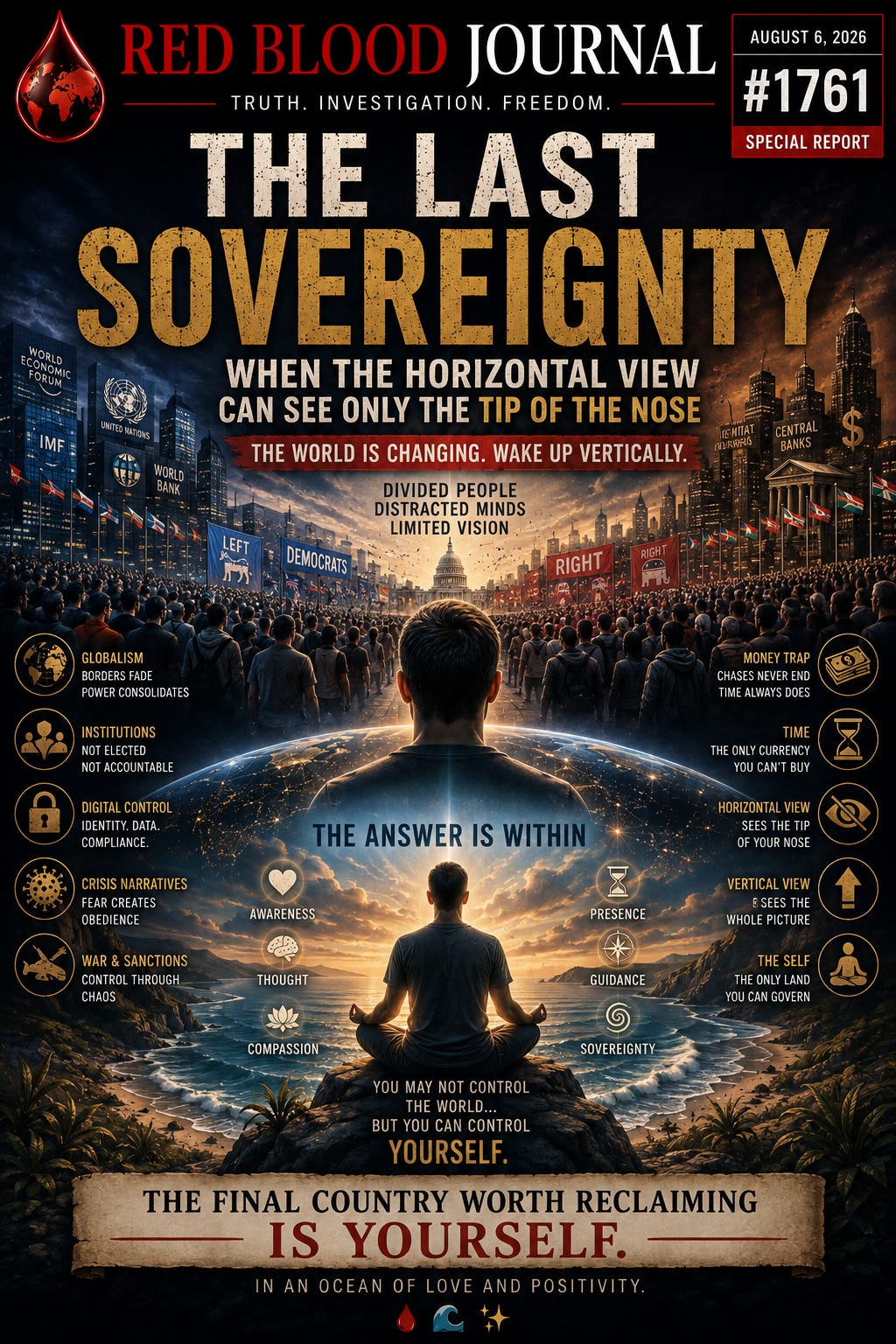
🩸 🌊 👁️ #1761 — The Last Sovereignty
When the Horizontal View Can See Only the Tip of the Nose
August 6, 2026
🩸 RedBloodJournal.com 🩸
The people waiting for Iran to be returned to its “rightful owners” may be asking a question that is already becoming obsolete.
And Iran is not unique.
Who are the rightful owners of England?
Who are the rightful owners of America?
Who owns France, Germany, China, Russia, or any other country on Earth?
The democratic answer is simple:
The people.
But that answer becomes increasingly complicated when ordinary people possess limited influence over many of the institutions shaping their lives.
After examining globalization, international institutions, political networks, immigration, economic integration, COVID-era emergency powers, digital systems, war, energy corridors, and the continuing tension between national sovereignty and international governance, a larger possibility comes into view.
Perhaps the struggle is no longer simply about which political faction controls each country.
Perhaps the deeper struggle is over where political authority itself is moving.
The Dream of Nationalism
For centuries, nationalism offered people a straightforward political idea:
This is our country.
These are our borders.
These are our laws.
Our government answers to us.
Globalization complicates every part of that formula.
Money crosses borders.
Corporations cross borders.
Information crosses borders.
Supply chains cross borders.
Migration crosses borders.
Diseases cross borders.
Technology crosses borders.
Wars disrupt economies thousands of miles away.
Governments increasingly cooperate through international institutions because many modern problems cannot be contained inside national boundaries.
That does not prove that a secret world government has already been constructed.
But it raises a legitimate question:
How much sovereignty can a nation retain when almost everything affecting it has become international?
The United Nations Is Not Yet a World Government
The United Nations resembles certain elements people associate with global governance, but the distinction matters.
The UN does not currently govern humanity as a sovereign world state.
Its member countries remain sovereign.
Yet the structure of the Security Council reveals something important about international power.
Five countries possess permanent seats and veto power:
United States.
United Kingdom.
France.
Russia.
China.
That arrangement does not prove that five countries secretly control humanity.
It demonstrates something simpler and undeniable:
International power is not distributed equally.
Even an institution established around international cooperation contains an explicit hierarchy.
Look at Politics
People are encouraged to believe that everything depends upon elections.
Trump.
Biden.
Republican.
Democrat.
Conservative.
Liberal.
Left.
Right.
Every election is presented as though civilization itself depends upon which side wins.
Yet administrations change while many deeper structures continue.
Debt continues.
International institutions continue.
Military alliances continue.
Corporate influence continues.
Financial systems continue.
Technological integration continues.
Global supply chains continue.
The administrative machinery continues.
There is insufficient evidence to claim that Biden and Trump were deliberately installed by globalists to confuse the population.
But there is another possibility worth considering.
Political polarization itself can keep populations looking horizontally.
One side watches the other.
Republicans watch Democrats.
Democrats watch Republicans.
Nationalists watch immigrants.
Countries watch neighboring countries.
Religions watch other religions.
And almost everyone watches everyone except the institutions where enormous concentrations of economic and political power reside.
The Horizontal View
Imagine standing inside an enormous crowd.
Everyone is the same height.
Everyone looks horizontally.
What can they see?
The person immediately ahead.
The person beside them.
Perhaps several rows farther away.
But mostly:
the tip of their own nose.
Now rise vertically above the crowd.
Suddenly the entire arrangement becomes visible.
The divisions become visible.
The roads become visible.
The walls become visible.
The exits become visible.
And perhaps most importantly:
the structure itself becomes visible.
That is the difference between horizontal thinking and vertical thinking.
Iran Is Part of the Lesson
The Iranian waiting for Iran to change may spend an entire lifetime waiting.
The American waiting for America to return to some idealized past may do the same.
The British citizen waiting for Britain to become yesterday’s Britain may also wait indefinitely.
Governments change.
Flags remain.
Leaders change.
Political slogans change.
Yet the individual continues aging.
That is the part almost nobody discusses.
While populations argue over who owns countries, time continues taking ownership of them.
The Money Trap
The same horizontal perspective appears economically.
People spend enormous portions of their lives chasing money.
More income.
A larger house.
A newer automobile.
A bigger investment account.
Greater status.
More possessions.
They imagine that accumulating enough wealth will eventually purchase freedom.
For a tiny minority, enormous wealth genuinely produces extraordinary influence.
For most people, however, the pursuit itself consumes the one resource that can never be replaced:
TIME.
A person can lose money and earn it again.
A person can lose property and purchase another.
A person can lose status and rebuild it.
But nobody can purchase yesterday.
The Greatest Currency Was Never Money
Perhaps this is the final illusion.
Human beings were taught to measure wealth using something humanity invented.
Money.
Yet existence gave everyone another currency before money existed.
Time.
Every person receives a limited amount.
Nobody knows exactly how much remains.
And every morning another portion disappears permanently.
The billionaire loses twenty-four hours.
The poor man loses twenty-four hours.
The president loses twenty-four hours.
The king loses twenty-four hours.
The difference is what each person does with those hours.
What Can Actually Be Controlled?
This is where the investigation finally turns inward.
A person may not control:
Washington.
Tehran.
London.
Beijing.
The United Nations.
Central banks.
Corporations.
Wars.
Presidents.
Prime ministers.
Markets.
International institutions.
But there remains territory over which an individual can exercise enormous authority:
THE SELF.
Attention.
Thought.
Reaction.
Compassion.
Curiosity.
Time.
The decision to hate or understand.
The decision to consume or create.
The decision to follow or question.
The decision to spend another decade chasing something—or finally ask why it is being chased.
That territory may ultimately be more valuable than every border drawn on Earth.
🩸 The Red Blood Perspective
Perhaps humanity’s greatest mistake is believing freedom begins by controlling everything outside itself.
People wait for another election.
Another revolution.
Another leader.
Another government.
Another economic system.
Another promised restoration.
Iranian nationalists wait for Iran.
American nationalists wait for America.
British nationalists wait for Britain.
Others wait for their own version of yesterday to return.
Perhaps yesterday is not returning.
The international system may continue becoming more interconnected.
National sovereignty may weaken in some areas and strengthen in others.
Global governance may expand.
It may fracture.
Or something entirely different may emerge.
Nobody can honestly know the final outcome.
But one conclusion requires no prediction:
A human being who cannot govern himself will always search for someone else to govern the world for him.
Look horizontally and the argument never ends.
Left against right.
Nation against nation.
Religion against religion.
Poor against rich.
Citizen against immigrant.
Look inward and another question appears:
How much of my short existence am I willing to surrender fighting over things I cannot control?
Perhaps the greatest sovereignty was never sovereignty over territory.
Perhaps it was sovereignty over oneself.
🌊 Ocean of Love and Positivity
The world may reorganize itself a hundred times.
Borders may move.
Governments may rise.
Governments may disappear.
Currencies may collapse.
New currencies may replace them.
Technology may transform civilization beyond recognition.
But none of those changes determines whether an individual lives with hatred or love, fear or curiosity, bitterness or peace.
Do not surrender an entire lifetime chasing ownership of the world.
Experience it.
Learn from it.
Question it.
Love within it.
And above all:
Remember that the only moment humanity has ever truly possessed is the one happening now.
The final country worth reclaiming may not appear on any map.
It is yourself.
In an Ocean of Love and Positivity.
🩸🌊✨ Fantastic!
👁️
The Last Sovereignty: Reclaiming the Self in a Globalized World
Aug 6, 2026
The provided text argues that the traditional concept of national sovereignty is fading as globalization and international institutions shift political power away from individual citizens. While populations are distracted by horizontal conflicts like partisan politics and border disputes, they often overlook the vertical structures of economic and technological control that transcend national boundaries. The author suggests that chasing material wealth or political restoration is a trap that consumes a person’s most precious resource: time. Instead of seeking freedom through external government changes, individuals should focus on internal sovereignty and self-governance. Ultimately, the source encourages readers to prioritize personal agency and present-moment awareness over global struggles they cannot influence. This perspective promotes reclaiming mastery over the self as the only true form of independence in an increasingly interconnected world.


