


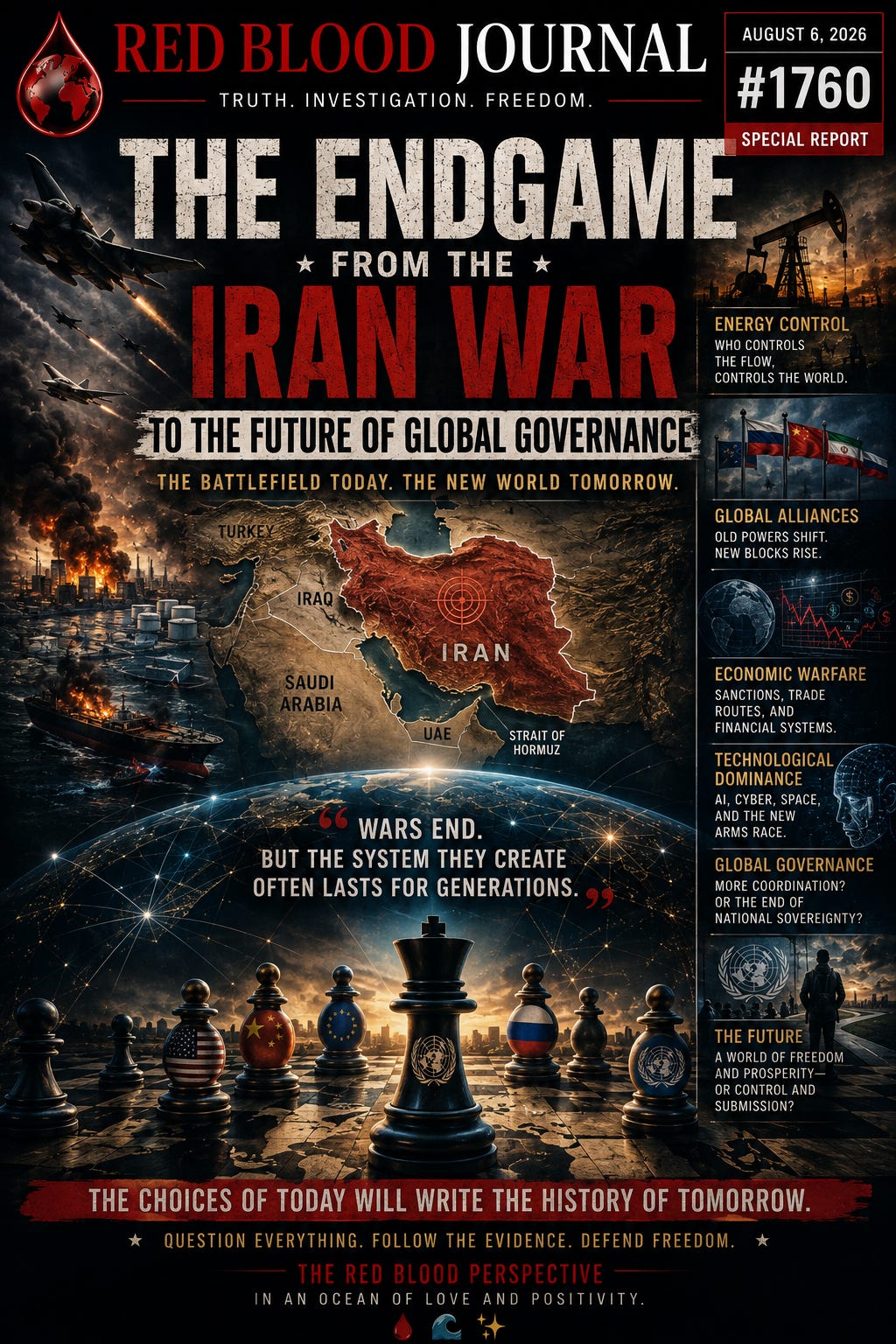
🩸 🌍 #1760 — The Endgame
From the Iran War to the Future of Global Governance
August 6, 2026
🩸 RedBloodJournal.com 🩸
Wars are often remembered for the battles that were fought.
History, however, frequently judges them by what came afterward.
The Iran conflict may ultimately be remembered not only as a regional war but as one event within a broader period of geopolitical transformation in which governments, institutions, and populations are adapting to a rapidly changing international order. Analysts across a range of perspectives argue that the conflict is accelerating shifts already underway in energy security, supply chains, technology, and global governance rather than creating them from nothing.
For the critical thinker, the question is therefore not simply:
Who wins the war?
The larger question is:
What new world emerges after the war?
The Iran War as the Trigger
Every major geopolitical transformation has had a triggering event.
World War I transformed empires.
World War II transformed the international order.
The Cold War transformed global alliances.
COVID-19 transformed public-health governance and accelerated the use of emergency powers and digital administrative systems.
The Iran conflict may become another such turning point by accelerating debates over energy security, shipping routes, military alliances, digital infrastructure, and international coordination. Analysts note that the war has highlighted vulnerabilities in global trade, the Strait of Hormuz, supply chains, and strategic energy infrastructure.
The immediate battlefield may therefore be only one part of a much larger geopolitical story.
The Pattern
Throughout this series, several recurring themes have emerged:
Greater international coordination in some policy areas.
Increasing reliance on digital infrastructure.
Expanded use of emergency authorities during crises.
Global interdependence through trade, finance, and technology.
Ongoing debate over national sovereignty versus multinational governance.
These developments are observable.
What remains debated is how they should be interpreted.
Some view them as practical responses to shared global challenges.
Others see them as evidence of a gradual shift away from traditional national sovereignty toward more centralized international coordination.
Iran Is the Battlefield, Not Necessarily the Destination
One interpretation advanced by some geopolitical commentators is that Iran should be understood less as the ultimate objective and more as a strategic crossroads.
Because of its location, energy resources, and influence over the Strait of Hormuz, events in Iran can have worldwide consequences for shipping, energy markets, inflation, and diplomacy. Recent analyses similarly describe the conflict as having implications well beyond Iran itself because of its effects on global trade and energy systems.
Under this interpretation, the conflict becomes a catalyst whose consequences extend far beyond the Middle East.
The Forecast
If current trends continue, the coming decade may see continued debate over:
Digital identity systems.
Artificial intelligence governance.
International health preparedness.
Energy security.
Cybersecurity.
Financial integration.
Supply-chain resilience.
The balance between national decision-making and international coordination.
Whether these developments strengthen cooperation, reduce sovereignty, or achieve some balance between the two will depend on future political choices rather than on a single predetermined outcome.
The Central Question
The defining question may not be whether globalization exists.
International cooperation, trade, and institutions clearly exist.
The more difficult question is:
How should democratic accountability, transparency, and national self-government function in an increasingly interconnected world?
Different political movements answer that question differently.
The debate itself is likely to remain one of the defining issues of this century.
🩸 The Red Blood Perspective
The Iran war, the debates surrounding globalization, and the experience of COVID-19 can all be viewed as parts of a larger discussion about how societies respond to crises and how political authority evolves over time.
Critical thinking requires resisting two temptations:
The first is assuming that every major event is the product of a single hidden plan.
The second is assuming that every major institutional change is merely coincidental and therefore unworthy of scrutiny.
Between those extremes lies careful investigation.
History often reveals that structural change occurs through the interaction of many actors, competing interests, and unforeseen events.
The responsibility of the investigator is to follow evidence wherever it leads, continually testing conclusions against new information.
🌊 Ocean of Love and Positivity
Ordinary people are rarely the architects of geopolitical conflict.
They are its witnesses, its participants, and too often its victims.
The pursuit of truth should not become hostility toward nations or peoples.
Its purpose should be greater accountability, wiser decisions, and a future in which power remains answerable to the public it serves.
In an Ocean of Love and Positivity.
🩸🌊✨ Fantastic!
🌍
🌍 The Endgame: Geopolitics and the Future of Global Governance
Aug 6, 2026
The provided text explores the Iran conflict as a pivotal geopolitical trigger that is reshaping the modern world order. Rather than viewing the war in isolation, the source argues that it accelerates pre-existing shifts in global governance, digital infrastructure, and energy security. This transformation highlights a growing tension between national sovereignty and centralized international coordination, mirroring changes seen during previous global crises like the pandemic. The author encourages a critical perspective that avoids simplistic conspiracies while scrutinizing how institutional power evolves during times of emergency. Ultimately, the narrative poses a fundamental question regarding how democratic accountability can be maintained in an increasingly interconnected and technologically driven society.


