


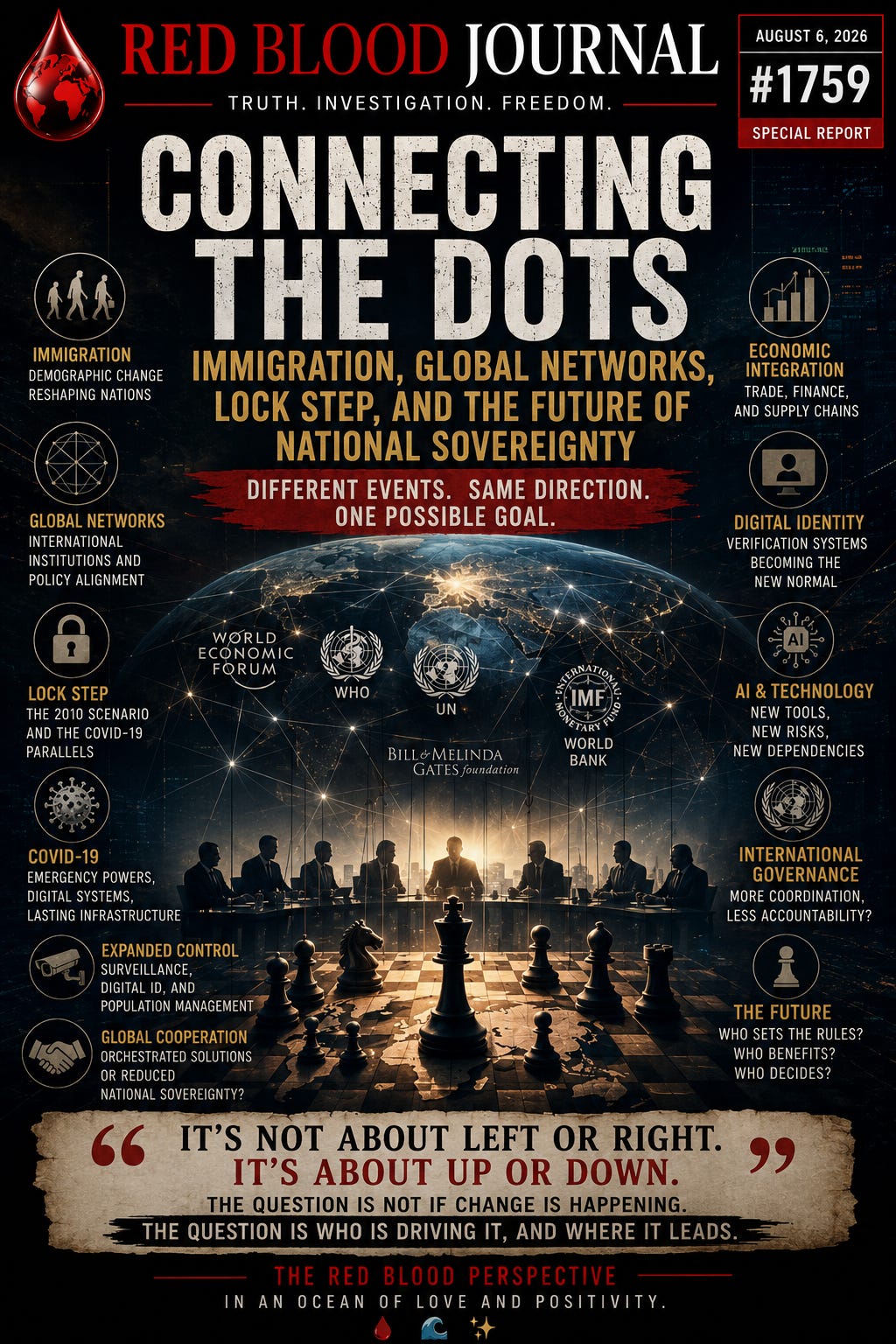
🩸 🌐 #1759 — Connecting the Dots
Immigration, Global Networks, Lock Step, and the Future of National Sovereignty
August 6, 2026
🩸 RedBloodJournal.com 🩸
Every generation inherits its defining political question.
For the twentieth century, it was often communism versus capitalism.
For the twenty-first century, another question has emerged:
Who ultimately governs the future of nations?
Is political power still primarily exercised through sovereign nation-states?
Or is increasing influence being exercised through transnational institutions, multinational corporations, financial networks, international organizations, and global policy forums?
This report does not begin with conclusions.
It begins with observations.
Observation One
Western countries have experienced significant demographic, economic, and political change over the past several decades.
Immigration has reshaped many societies.
Political representation has become increasingly diverse.
These developments are well documented.
The important investigative question is not the background of elected officials.
It is whether policy priorities across different countries increasingly converge despite changes in governments.
Observation Two
Many international organizations openly advocate greater international cooperation in areas such as:
Trade
Climate policy
Public health
Financial regulation
Digital governance
Technology standards
Supporters describe this as solving problems that cross national borders.
Critics argue that it can reduce national sovereignty by shifting influence toward institutions that are not directly accountable to national electorates.
This debate is real.
Observation Three
The Rockefeller Foundation’s 2010 Lock Step scenario imagined a future pandemic accompanied by expanded government authority, greater surveillance, and broader public acceptance of emergency restrictions.
A decade later, COVID-19 produced policies that in several respects resembled elements of that scenario.
The similarities are documented.
Whether those similarities resulted from common emergency planning, institutional foresight, or something more coordinated remains debated.
Observation Four
During COVID-19, many governments adopted emergency measures that temporarily expanded executive authority and introduced new public-health infrastructures.
Some measures expired.
Others left lasting administrative or technological systems.
This has prompted continuing debate about how democracies should balance emergency response with civil liberties and accountability.
Connecting the Dots
One interpretation is that these developments represent independent responses to changing global conditions.
Another interpretation is that they reflect the growing influence of international networks whose preferred policy direction emphasizes greater coordination across borders.
Both interpretations deserve examination.
The crucial question is not whether cooperation between nations exists.
It clearly does.
The question is whether democratic accountability keeps pace as policymaking becomes more interconnected.
The Forecast
If current trends continue, future debates are likely to focus on:
National sovereignty versus international coordination.
Digital identity and verification systems.
Artificial intelligence and governance.
Cross-border regulation of technology.
International health preparedness.
Migration policy.
Financial integration.
Data governance.
These issues are likely to remain central regardless of which political parties hold office.
The Red Blood Perspective
The strongest investigations are built on evidence rather than assumptions.
Patterns can suggest important questions, but patterns alone do not establish intent.
Likewise, official explanations should not be accepted without scrutiny simply because they come from respected institutions.
A free society depends on citizens willing to examine evidence critically, distinguish documented facts from interpretation, and hold all centers of power accountable—whether national or international.
The future may not be decided by choosing between nationalism and global cooperation alone.
It may instead depend on ensuring that whichever institutions exercise power remain transparent, accountable, and subject to public oversight.
🌊 Ocean of Love and Positivity
Healthy societies are strengthened when disagreement leads to investigation instead of hostility.
The search for truth should unite people in demanding accountability from powerful institutions while recognizing the shared humanity of ordinary citizens across every nation.
In an Ocean of Love and Positivity.
🩸🌊✨ Fantastic!
🌐
🌐 The Architecture of Global Governance and National Sovereignty
Aug 6, 2026
This source examines the modern tension between national sovereignty and the rising influence of global networks, posing critical questions about who truly governs the future. It highlights how international institutions and multinational corporations may be shaping policy priorities across borders, potentially bypassing traditional democratic accountability. By referencing the Rockefeller Foundation’s “Lock Step” scenario, the text explores whether global responses to crises like the pandemic represent coordinated efforts to expand centralized authority. The author argues that regardless of political leadership, nations are increasingly bound by integrated systems of digital governance and financial regulation. Ultimately, the report calls for citizens to maintain critical scrutiny of both national and international power structures to ensure transparency. It concludes that the preservation of a free society depends on demanding oversight and accountability from the entities managing these interconnected global trends.


