


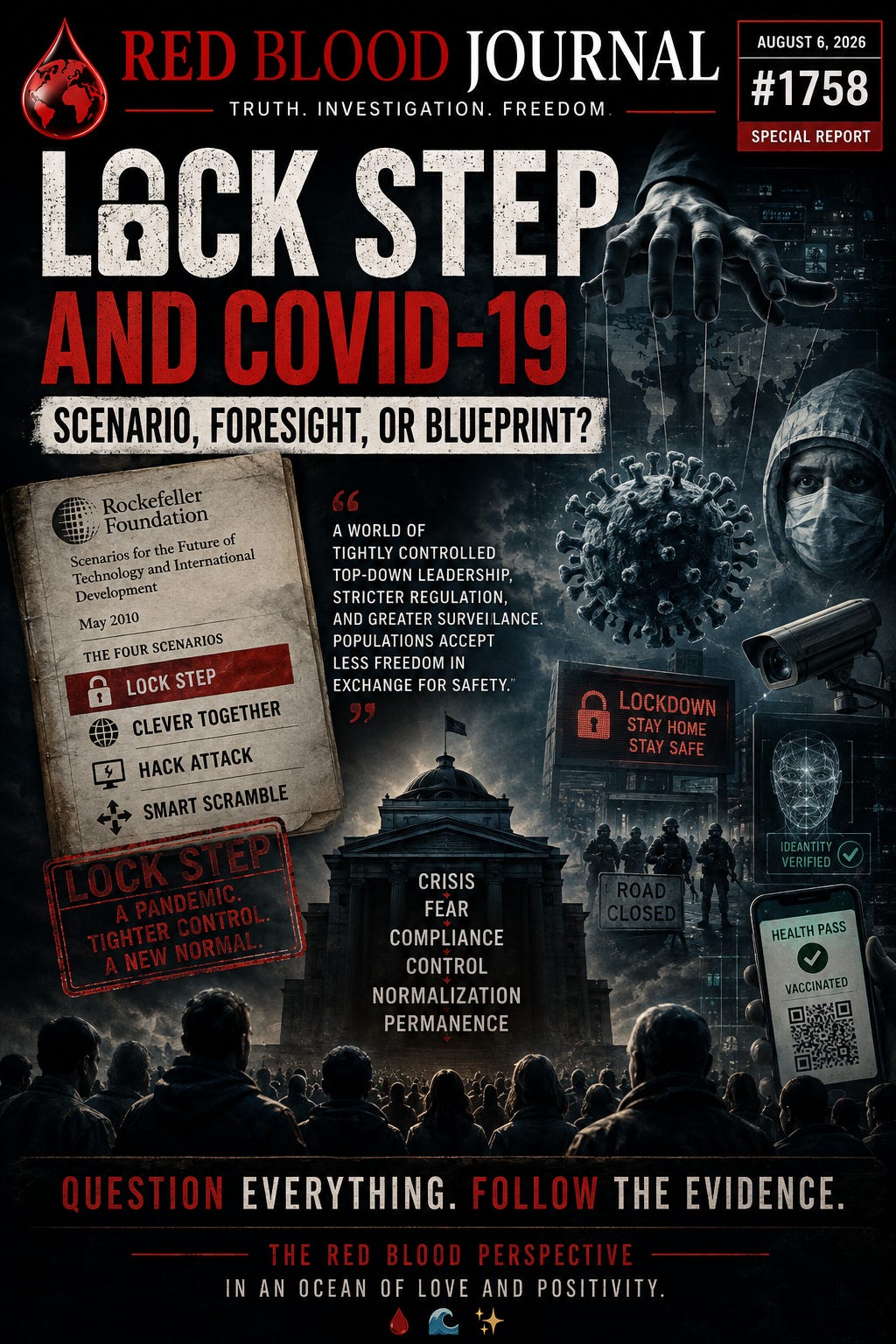
🩸 🔒 #1758 — Lock Step and COVID-19
Scenario, Foresight, or Blueprint?
August 6, 2026
🩸 RedBloodJournal.com 🩸
In 2010, ten years before governments locked down cities, restricted travel, closed businesses, introduced digital health certificates, and expanded emergency powers, the Rockefeller Foundation published a report containing a scenario called “Lock Step.”
The document was real.
The pandemic scenario was real.
The language describing tighter government control was real.
The question is not whether the document existed.
The question is what its extraordinary resemblance to the COVID-19 era means.
Was it merely a scenario?
Was it institutional foresight?
Or did it reveal how powerful organizations already understood that a pandemic could become an opportunity to reorganize society, expand authority, and condition populations to accept greater control?
What Was Lock Step?
The official title of the 2010 Rockefeller Foundation report was:
Scenarios for the Future of Technology and International Development
It contained four imagined futures designed to explore how technology, government, economics, and international development might evolve.
One scenario was called Lock Step.
The Rockefeller Foundation later acknowledged that this scenario described a fictional pandemic beginning in 2012, infecting approximately 20 percent of the world and killing eight million people within seven months.
The scenario imagined governments imposing strict controls to contain the outbreak.
It described:
International travel restrictions
Government quarantines
Mandatory protective measures
Greater state authority
Biometric identification
Increased surveillance
Tighter control over movement
Public acceptance of top-down leadership
Restrictions continuing beyond the immediate emergency
The scenario portrayed a world in which populations initially welcomed strong government intervention because they were frightened and wanted protection.
That point deserves attention.
Fear did not merely produce obedience.
Fear produced a demand for control.
Not “Operation Lockstep”
The original Rockefeller document did not call itself Operation Lockstep.
The official name of the scenario was Lock Step.
The word “operation” was later added by critics who interpreted the document as something more than academic scenario planning.
That distinction matters.
Calling it an operation implies an implementation plan.
The public document itself presents it as a hypothetical future.
However, labeling it hypothetical does not automatically make its contents irrelevant.
Institutions use scenario planning precisely because they want to anticipate events, prepare responses, shape strategies, and identify opportunities before a crisis arrives.
The legitimate investigative question is therefore not simply:
Was Lock Step called a plan?
The stronger question is:
Did the institutions that studied these scenarios later promote policies resembling the scenarios they had already examined?
Then Came COVID-19
COVID-19 was first identified in late 2019.
The World Health Organization declared it a Public Health Emergency of International Concern on January 30, 2020, and characterized it as a pandemic on March 11, 2020.
Within months, much of the world entered a political and social environment that appeared strikingly similar to parts of Lock Step.
Governments introduced:
Stay-at-home orders
Business closures
School closures
Border restrictions
Quarantine requirements
Contact-tracing systems
Testing mandates
Mask requirements
Limits on public assembly
Emergency executive orders
Digital vaccination records
Proof-of-status requirements for travel or entry
Not every country used every measure.
Not every measure lasted equally long.
But the broad pattern was unmistakable: a global health emergency dramatically expanded the role of governments in everyday life.
The Digital Certificate System
In March 2021, the European Commission proposed a Digital Green Certificate showing whether a person had been vaccinated, tested negative, or recovered from COVID-19.
The EU Digital COVID Certificate later became an interoperable system used across Europe. Its legal framework covered vaccination, testing, and recovery certificates.
The regulation took effect on July 1, 2021, and expired on June 30, 2023. The European Commission states that the infrastructure became a worldwide standard connected with countries across several continents.
In July 2023, the World Health Organization adopted the EU certification framework as the foundation for a broader global digital health certification network.
Supporters viewed this as a practical system for verifying health records and restoring international travel.
Critics saw something else:
The creation of an international digital infrastructure capable of linking a person’s health status to movement across borders.
The system may have been introduced for public health, but the underlying infrastructure demonstrated what was technologically and politically possible.
Rockefeller’s COVID-19 Action Plan
The Rockefeller Foundation did not remain merely an observer during COVID-19.
In April 2020, it released a National COVID-19 Testing Action Plan calling for a large, coordinated testing system intended to support the reopening of the American economy.
The plan advocated:
Dramatically expanded testing
Workplace monitoring
Early identification of outbreaks
Contact tracing
Public-private coordination
National testing infrastructure
Federal and state cooperation
The Foundation described the purpose as creating a state-led testing program that could support reopening through workforce monitoring, outbreak detection, diagnostic testing, and home testing.
It later promoted scaling testing to hundreds of millions of tests per month and proposed executive actions for the federal government.
The Rockefeller Foundation says it committed more than $1 billion to COVID-19 response efforts during the first three years of the pandemic.
None of this proves that the 2010 scenario was secretly activated.
But it demonstrates that the institution which had previously examined a fictional pandemic-and-control scenario later became materially involved in shaping pandemic-response recommendations.
That is a documented relationship worthy of scrutiny.
Prediction or Familiar Playbook?
Defenders of the Lock Step report argue that infectious-disease outbreaks were already well-known risks.
They point to previous outbreaks such as SARS, avian influenza, and H1N1.
From this view, anticipating:
quarantines,
travel controls,
masks,
government authority,
testing,
tracking,
and public resistance
did not require inside knowledge.
These were predictable elements of any serious pandemic scenario.
That is a reasonable explanation.
But it does not eliminate every question.
A scenario can be both plausible forecasting and a reflection of the preferred governing philosophy of the institutions producing it.
The central issue is not whether intelligent planners could foresee a pandemic.
The issue is whether crisis planning gradually became crisis opportunity.
The Consolidation-of-Power Argument
Critics argue that COVID-19 allowed governments, corporations, technology platforms, pharmaceutical companies, and international institutions to acquire powers that would have faced far greater resistance under ordinary conditions.
During the emergency:
Executive authority expanded
Legislatures were sometimes bypassed
Technology platforms restricted disputed speech
Employment became linked to health compliance in some sectors
Travel became linked to medical status
Public gatherings were restricted
Small businesses absorbed severe losses
Major corporations expanded their market share
Digital monitoring became normalized
International policy coordination increased
The argument is not necessarily that every government official belonged to one secret committee.
Large systems rarely work that simply.
A shared ideology, common institutional interests, synchronized incentives, professional networks, and imitation between governments can produce similar policies without a single command center.
Coordination can be formal.
It can also emerge through shared institutions, shared experts, shared funding, shared technology, and shared assumptions.
The Population Was Not the Architect
Ordinary people did not write Lock Step.
They did not design vaccine-passport systems.
They did not create international health-data networks.
They did not decide which businesses were essential.
They did not determine which medical opinions could remain visible online.
They did not design the emergency powers under which they were governed.
The population experienced the policies.
The institutions designed and administered them.
That does not establish criminal intent.
But it establishes where accountability should be directed.
The relevant examination is not of frightened citizens trying to protect their families.
It is of the institutions that gained authority, money, data, political influence, or permanent infrastructure during the emergency.
Where the Evidence Stops
The resemblance between Lock Step and COVID-19 is documented.
The Rockefeller Foundation’s later participation in COVID-response planning is documented.
The worldwide introduction of restrictions, digital certificates, testing systems, emergency powers, and surveillance tools is documented.
What has not been publicly established is a direct chain of evidence proving that:
COVID-19 was deliberately created to implement Lock Step;
governments received secret instructions to follow the 2010 scenario;
the Rockefeller Foundation controlled the global pandemic response; or
Lock Step was a formal operational blueprint adopted by world governments.
Those conclusions require direct evidence such as communications, directives, agreements, testimony, or financial records showing intentional implementation.
Without such evidence, the case rests primarily upon:
similarities,
institutional continuity,
common policy interests,
subsequent Rockefeller involvement,
and the extraordinary accuracy of parts of the scenario.
That evidence is sufficient to raise questions.
It is not sufficient by itself to close the case.
Scenario, Foresight, or Blueprint?
Three interpretations remain possible.
Scenario
Lock Step was simply a legitimate foresight exercise that imagined predictable government responses to a severe pandemic.
Foresight
The report accurately identified how governments and populations would behave under fear, demonstrating the sophistication of elite institutional planning.
Blueprint
The scenario reflected policies that powerful networks already considered desirable and later helped normalize or implement when a real crisis created the opportunity.
The first interpretation is supported by the report’s stated purpose.
The second is supported by the extraordinary similarities.
The third remains an allegation requiring stronger direct evidence.
However, critical investigation should not dismiss the third possibility merely because institutions deny it.
Nor should it declare the allegation proven merely because events looked similar.
The honest position is to continue following the documentary trail.
The Larger Warning
The greatest lesson of Lock Step may not be whether it predicted COVID-19.
The greater lesson may be how quickly free populations can become governed by emergency logic.
During fear, temporary measures appear reasonable.
During prolonged fear, temporary measures become systems.
Systems produce databases.
Databases produce infrastructure.
Infrastructure creates future capabilities.
The emergency may end.
The capability remains.
That is how power consolidates—not necessarily through a dramatic announcement, but through gradual normalization.
One restriction at a time.
One certificate at a time.
One database at a time.
One crisis at a time.
🩸 The Red Blood Perspective
Lock Step should neither be ignored as meaningless fiction nor falsely presented as conclusive proof of a global operation.
It should be studied as an authentic document produced by an influential foundation that imagined a pandemic leading to greater top-down authority and technological control.
Ten years later, substantial parts of that imagined environment became reality.
The Rockefeller Foundation then participated openly in proposing testing, tracing, monitoring, and coordinated pandemic-response systems.
That does not, by itself, prove conspiracy.
But it does establish a factual basis for investigation.
The question is not whether every parallel proves intent.
The question is why citizens are discouraged from examining the parallels at all.
A free society does not fear questions.
Power fears questions.
🌊 Ocean of Love and Positivity
The people of the world were not one another’s enemies during COVID-19.
They were frightened families, workers, patients, doctors, business owners, students, and neighbors attempting to survive an unfamiliar crisis.
The search for truth must not become hatred toward populations.
It must become accountability for institutions.
Truth should not be used to divide humanity.
Truth should return authority to humanity.
In an Ocean of Love and Positivity.
🩸🌊✨ Fantastic!
👁️
Lock Step and COVID-19: Institutional Foresight or Blueprint?
Aug 6, 2026
This text examines the Rockefeller Foundation’s 2010 report, which featured a hypothetical pandemic scenario titled “Lock Step“ that mirrors many global responses to COVID-19. The source highlights how this fictional exercise predicted increased government authority, surveillance technology, and restricted travel a decade before these measures were implemented worldwide. While critics view the document as a blueprint for social control, the text notes that no direct evidence proves the pandemic was a manufactured event intended to execute the plan. Instead, it suggests that the extraordinary resemblance between the scenario and reality warrants a serious investigation into how institutions utilize crises to consolidate power. Ultimately, the author argues that the infrastructure built during emergencies, such as digital health certificates, often becomes a permanent fixture of society. The overview concludes by emphasizing that institutional accountability is essential for maintaining a free society in the face of expanded state influence.


