


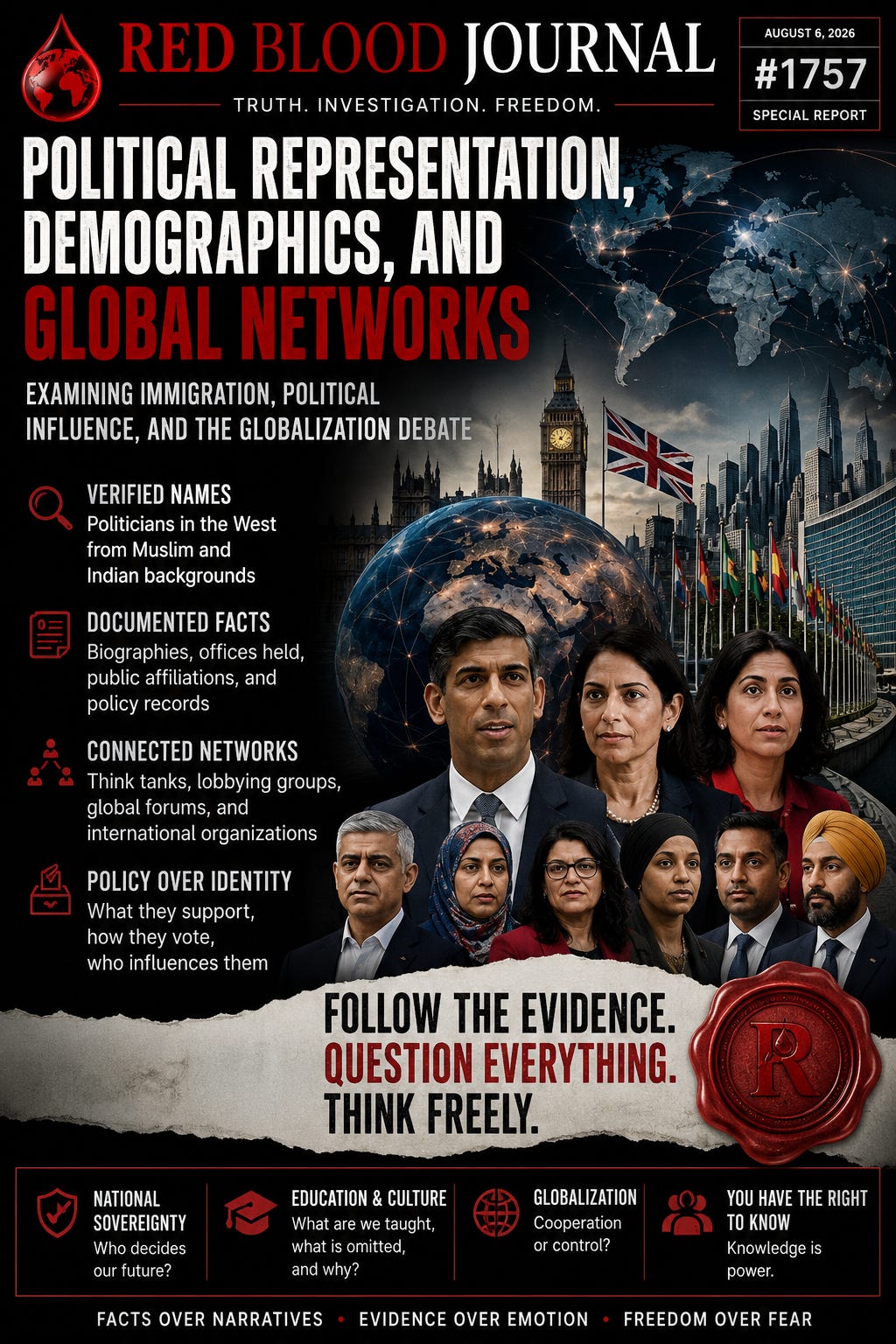
🩸 🌍 #1757 — Political Representation, Demographics, and Global Networks
Examining Immigration, Political Influence, and the Globalization Debate
August 6, 2026
🩸 RedBloodJournal.com 🩸
Over the past several decades, many Western nations have undergone significant demographic changes through immigration and globalization. At the same time, political institutions have become increasingly diverse, with elected officials coming from a wide range of ethnic, religious, and cultural backgrounds.
Some observers view this as evidence of successful integration in multicultural democracies. Others argue that it reflects broader political, economic, and cultural changes that deserve closer examination.
For the critical thinker, the important question is not who someone is, but what ideas they support, which organizations they are connected to, and whose interests their policies ultimately serve.
England as a Case Study
The United Kingdom has experienced decades of immigration that have reshaped many of its communities and political institutions.
Today, Parliament and local governments include politicians from Muslim, Indian, Pakistani, African, Caribbean, Middle Eastern, and many other backgrounds. Examples include:
Rishi Sunak
Priti Patel
Suella Braverman
Shabana Mahmood
Sadiq Khan
Naz Shah
Zarah Sultana
Their political views vary considerably. Some advocate stricter immigration policies, while others support more expansive immigration or multicultural policies. Their backgrounds alone do not determine their political positions.
Similar Trends Across the West
Comparable demographic changes have occurred in:
United States
Canada
France
Germany
Netherlands
Belgium
Sweden
Australia
Examples include:
United States
Kamala Harris
Ro Khanna
Raja Krishnamoorthi
Pramila Jayapal
Ami Bera
Shri Thanedar
Ilhan Omar
Rashida Tlaib
André Carson
Canada
Jagmeet Singh
Anita Anand
Harjit Sajjan
Ahmed Hussen
Europe
Cem Özdemir (Germany)
Ahmed Aboutaleb (Netherlands)
These individuals represent a wide spectrum of political ideologies, parties, and policy priorities.
The Question Is Not Ethnicity
A critical thinker should avoid assuming that people with similar ethnic or religious backgrounds necessarily share the same political goals.
Instead, more productive questions include:
Which policies do they consistently support?
Which organizations are they affiliated with?
Who funds their campaigns?
Which international forums do they participate in?
What legislation have they introduced or supported?
Do patterns emerge across parties or countries?
These questions focus on evidence rather than identity.
The Globalization Debate
The term globalism is often used in different ways.
Supporters argue that greater international cooperation through trade, diplomacy, and multinational institutions can improve prosperity and address global challenges.
Critics argue that some forms of globalization can reduce national sovereignty by shifting influence toward multinational organizations, large corporations, financial institutions, or international bodies whose decision-making is less directly accountable to national electorates.
Determining whether such influence exists in specific cases requires documented evidence rather than assumptions.
Education and Culture
Another area of debate concerns education.
Some argue that modern education increasingly emphasizes:
Global citizenship
Multiculturalism
International cooperation
Diversity and inclusion
Others view these changes as preparing students for an interconnected world rather than replacing national identity.
Because education systems differ widely between countries and even regions, broad conclusions require careful examination of curricula, governance, and policy documents.
Investigating Influence
If one wishes to investigate whether political decisions are shaped by broader networks rather than solely by voters, useful sources of evidence include:
Campaign finance records
Lobbying disclosures
Parliamentary voting records
Membership in international organizations
Think tank affiliations
Public speeches and policy papers
Corporate and nonprofit funding
Government ethics disclosures
These sources provide a stronger foundation for analysis than demographic characteristics alone.
Questions for Critical Thinkers
Rather than beginning with conclusions, an investigation might ask:
Are similar policy priorities appearing across multiple Western countries?
If so, what institutions, ideas, or incentives help explain those similarities?
Which organizations, donors, or international networks are publicly associated with those policies?
Where is the evidence strongest, and where does it remain speculative?
These questions encourage readers to distinguish between documented facts, observable patterns, and interpretation.
🩸 The Red Blood Perspective
Political influence should be evaluated by actions, policies, affiliations, and evidence, not by ethnicity, religion, or national origin. Democracies are strengthened when citizens critically examine how decisions are made, who benefits from them, and what evidence supports competing explanations. Careful investigation requires separating verified facts from inference while remaining open to new information.
🌊 Ocean of Love and Positivity
Seeking truth requires curiosity, intellectual honesty, and a willingness to question assumptions—including our own. When evidence guides the discussion instead of identity, disagreements can become opportunities for understanding rather than division.
🩸🌊✨ Fantastic!
🔍
Analyzing Global Political Networks and Demographic Shifts
Aug 6, 2026
This text examines the evolving demographic landscape of Western political institutions and the various interpretations of these shifts. While modern governments feature increasingly diverse representatives, the author argues that a leader’s policy positions and institutional affiliations are far more significant than their ethnic or religious background. The source highlights how globalization and international networks influence national governance, prompting a debate between supporters of global cooperation and defenders of national sovereignty. Rather than focusing on identity, the article encourages a data-driven approach to political analysis by investigating campaign funding, lobbying, and voting records. Ultimately, the text advocates for critical thinking to distinguish between documented political influence and mere demographic change. This perspective seeks to move the public discourse away from identity politics toward a rigorous evaluation of evidence and accountability.


