


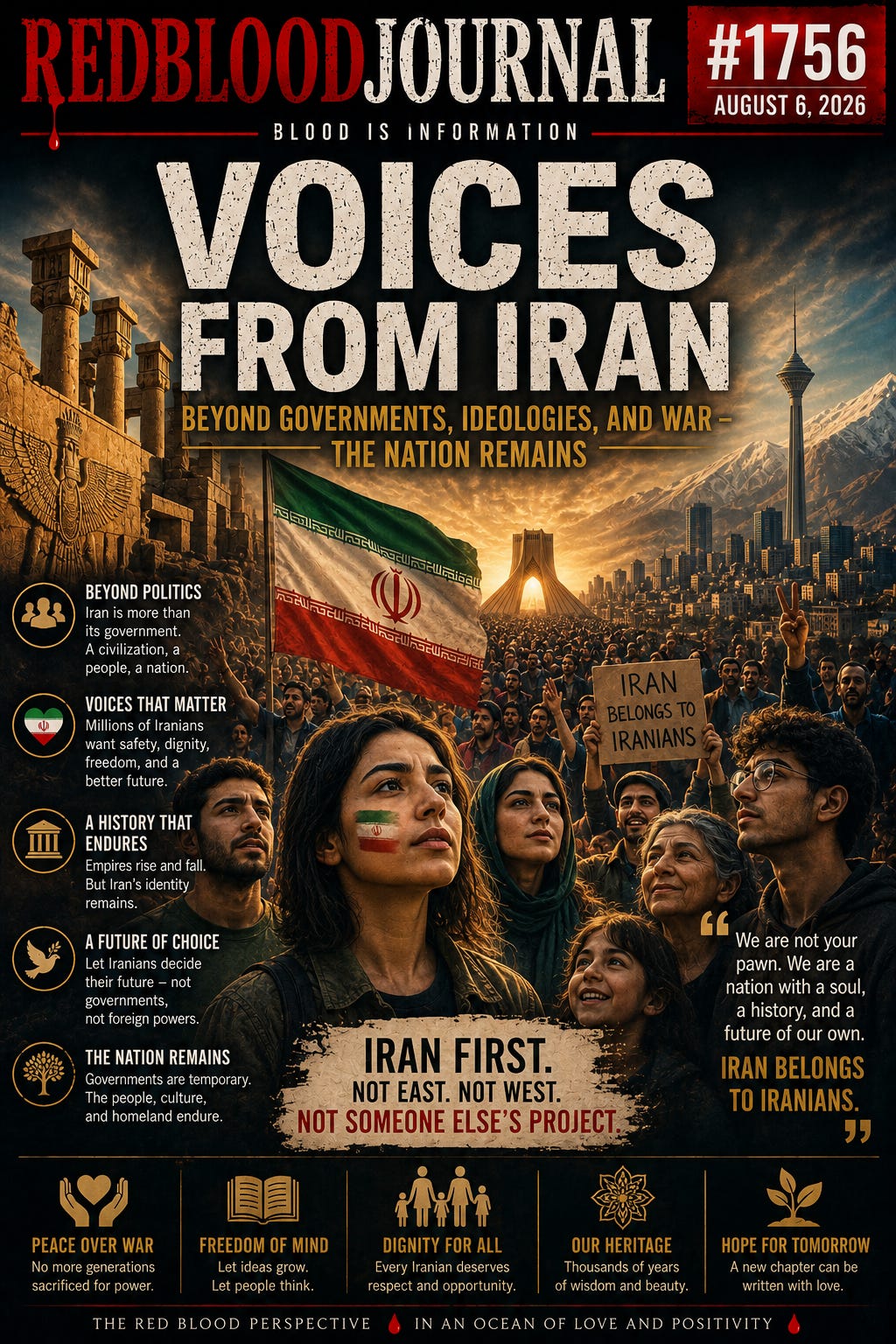
🩸 🇮🇷 #1756 — Voices from Iran
Beyond Governments, Ideologies, and War — The Nation Remains
August 6, 2026
🩸 RedBloodJournal.com 🩸
After discussing political factions, nuclear weapons, foreign governments, intelligence interests, negotiations, sanctions, and war, the closing portion of the source changes direction.
The language becomes less geopolitical and more emotional.
It turns toward Iran itself.
The closing material emphasizes national identity, freedom, patriotism, dissatisfaction with the Islamic Republic, and hope for a different future.
That change in perspective raises an important question:
When everyone is discussing what governments want from Iran, who is listening to what Iranians want from Iran?
Iran Is More Than Its Government
One of the easiest mistakes in geopolitical analysis is confusing a country with the government currently controlling it.
Iran and the Islamic Republic are not synonymous.
Iran represents a civilization, geography, language, culture, history, and population extending far beyond the lifespan of the political system established in 1979.
Governments are chapters.
The nation is the book.
The closing portion of the source reflects this distinction by moving away from political institutions and toward the identity and future of Iran itself.
When Ordinary People Become Invisible
Consider how Iran is normally discussed internationally.
Washington talks about nuclear weapons.
Israel talks about security.
Russia talks about strategic partnership.
China talks about trade and energy.
European governments discuss sanctions and diplomacy.
Iran’s political factions discuss survival and power.
Military planners discuss targets.
Intelligence agencies discuss capabilities.
But somewhere underneath all those conversations are millions of ordinary people.
They wake up.
They work.
They raise children.
They worry about money.
They fall in love.
They dream about the future.
They want safety.
And most will never sit at the tables where decisions affecting their lives are made.
That is the human dimension easily lost when nations become pieces on geopolitical maps.
The Price of Political Survival
Governments naturally seek survival.
Political factions seek influence.
Military organizations seek strategic advantage.
Foreign powers seek national interests.
None of that is unusual.
The danger begins when preserving a political structure becomes more important than preserving the people and country the structure supposedly exists to serve.
A government can replace destroyed equipment.
A military can purchase another aircraft.
A ministry can rebuild an office.
But a family cannot replace a dead child.
A civilization cannot easily replace destroyed heritage.
A generation cannot recover years lost to war.
This is why the question should never be merely:
Who wins the confrontation?
The deeper question is:
What survives the victory?
Patriotism Does Not Belong to One Political System
Governments frequently attempt to define patriotism around themselves.
Supporting the government becomes supporting the country.
Criticizing the government becomes attacking the country.
But those concepts are not necessarily the same.
A person can deeply love Iran while opposing the Islamic Republic.
Another can believe the Islamic Republic protects Iran.
Another may support monarchy.
Another may favor a secular republic.
Another may reject every existing political faction.
These disagreements do not automatically determine who loves Iran more.
Patriotism belongs to the people—not exclusively to the government.
Iran Before 1979
Iran did not begin with the Islamic Revolution.
Its civilization reaches backward thousands of years.
Persian literature, architecture, philosophy, science, music, poetry, art, and cultural identity existed through numerous dynasties and political systems.
Each government eventually became history.
Iran remained.
That perspective matters enormously when discussing the country’s future.
Today’s political crisis can feel permanent when viewed from inside today’s news cycle.
Viewed against Iranian history, however, today’s political order becomes another chapter in a much longer story.
Foreign Powers Will Pursue Their Interests
The previous reports examined competing foreign interests surrounding Iran.
That competition should not be surprising.
The United States will pursue American interests.
Russia will pursue Russian interests.
China will pursue Chinese interests.
Britain will pursue British interests.
Israel will pursue Israeli interests.
Every government has an obligation to consider its own strategic position.
The question for Iranians therefore becomes:
Who pursues Iran’s interests?
Not the interests of one political faction.
Not the interests of one ideology.
Not the interests of one foreign alliance.
Iran’s interests.
The Danger of Becoming Someone Else’s Battlefield
Iran’s geography has always given it enormous strategic importance.
It connects regions.
It possesses significant energy resources.
It sits beside the Persian Gulf.
It influences the Caucasus, Central Asia, the Middle East, and South Asia.
That geography can be an enormous advantage.
But it can also make Iran the battlefield where larger powers compete.
The challenge for any future Iranian government will therefore be maintaining relationships with competing powers without becoming subordinate to any of them.
Friendship is not submission.
Alliance is not ownership.
Cooperation is not surrender.
A truly independent Iran would need the confidence to say:
Iran first—not East, not West, not someone else’s geopolitical project.
The Generation That Comes Next
Political leaders frequently make decisions whose consequences will be experienced by people not yet old enough to vote.
Debt survives administrations.
Destroyed infrastructure survives wars.
International hostility survives presidents.
Political trauma survives revolutions.
That means today’s Iran is not merely deciding today’s politics.
It is determining what kind of country future Iranians will inherit.
Will they inherit another battlefield?
Another ideological struggle?
Another generation of sanctions?
Or could they inherit something different?
A nation confident enough in itself that disagreement no longer requires destruction?
The Red Blood Perspective
The first reports in this series examined the chessboard.
#1749 examined the internal struggle.
#1750 examined war versus negotiation.
#1751 examined the nuclear question.
#1752 examined allegations of foreign influence.
#1753 examined Washington.
#1754 examined changing American politics.
#1755 asked who will shape Iran’s future.
But there is something dangerous about viewing history exclusively as a chessboard.
Chess pieces do not feel pain.
People do.
Chess pieces do not have children.
People do.
Chess pieces do not remember destroyed neighborhoods.
People do.
And chess pieces do not inherit the consequences of today’s decisions.
Future generations do.
Perhaps the most important voice in the entire discussion is therefore the easiest one to overlook:
the ordinary Iranian.
Not the politician.
Not the general.
Not the intelligence officer.
Not the foreign strategist.
The citizen.
The closing material of the source ultimately returns to patriotism, freedom, national identity, and hope.
That may provide the simplest test for every proposed future:
Does it serve Iran’s people?
If monarchy serves the people, let the people decide.
If a republic serves the people, let the people decide.
If another political structure is proposed, let the people examine it.
The principle is more important than the label:
Iran should belong to Iranians.
Foreign governments can advise.
Political movements can campaign.
Leaders can propose.
But ultimately, legitimacy should come from the people who must live with the consequences.
Iran has survived kings.
Iran has survived invasions.
Iran has survived revolutions.
Iran has survived ideological transformations.
Iran has survived foreign interference.
And Iran will almost certainly outlive today’s political struggle.
Because governments are temporary.
A nation’s identity can endure.
Ocean of Love and Positivity
The most hopeful future for Iran is not one in which one faction destroys another.
It is one in which Iranians no longer need to destroy one another to disagree.
A future where political opponents remain fellow citizens.
Where patriotism does not require ideological obedience.
Where young Iranians inherit opportunity instead of another war.
Where Iran can maintain friendships around the world without surrendering its independence to anyone.
And where the enormous cultural inheritance of Persia becomes something upon which to build rather than merely something to remember.
Governments come and go.
Leaders come and go.
Ideologies come and go.
The people remain.
The culture remains.
Iran remains.
In an Ocean of Love and Positivity.
🩸🌊✨ Fantastic!
🇮🇷
🇮🇷 Iran: The People Beyond the Politics
Aug 6, 2026
This text highlights a crucial distinction between the transient nature of governments and the enduring identity of a nation. While global discourse often focuses on geopolitical maneuvering, nuclear ambitions, and foreign interests, the source advocates for prioritizing the needs of ordinary Iranian citizens. It argues that true patriotism is independent of political systems, emphasizing that the country’s rich cultural heritage predates and will outlast any specific regime. Ultimately, the narrative calls for a future where Iranians possess the agency to determine their own destiny without becoming a battlefield for foreign powers. The overarching message is one of hope and national resilience, suggesting that the people and their culture are the only permanent fixtures in a changing political landscape.


