


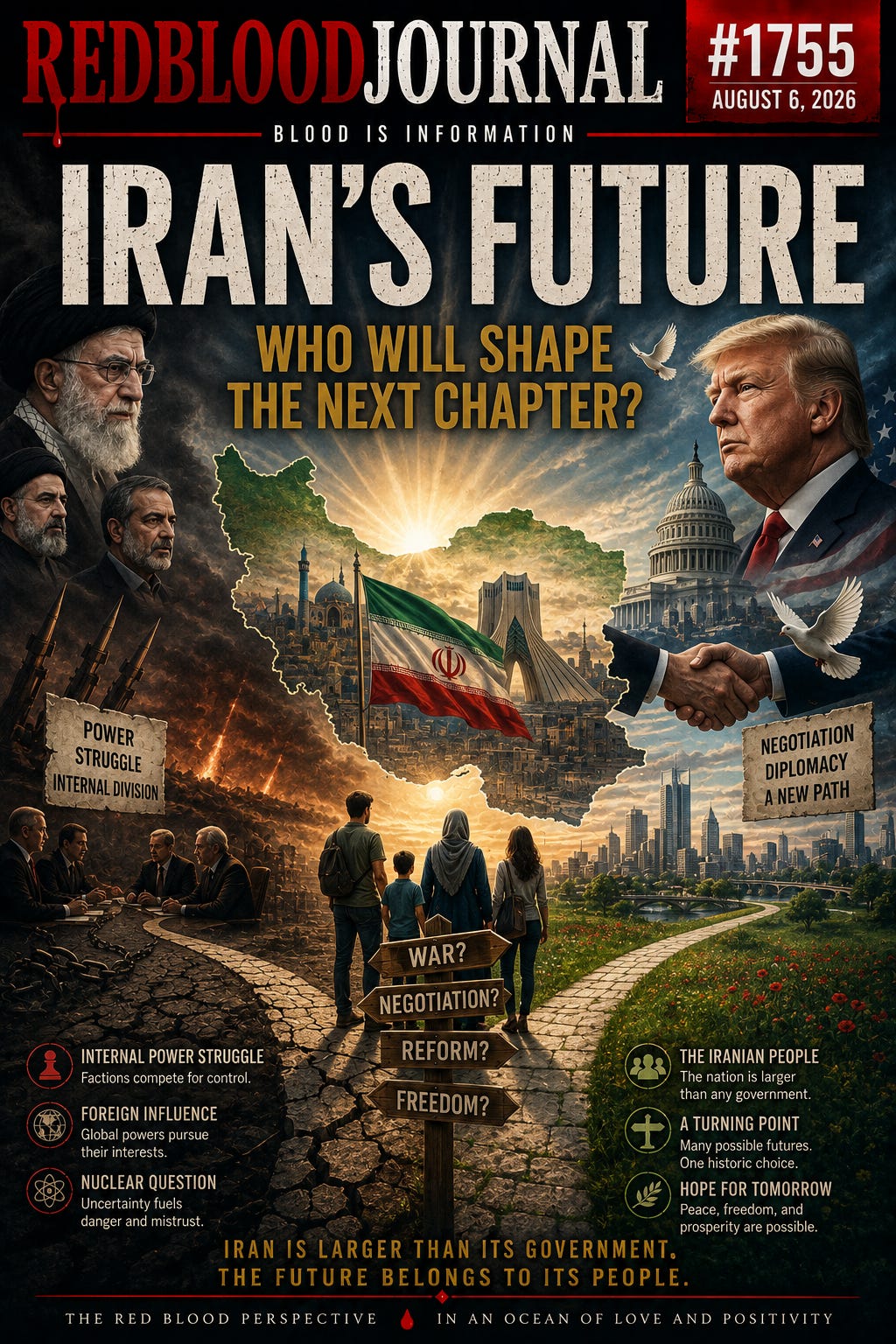
🩸 🇮🇷 #1755 — Iran’s Future
Who Will Shape the Next Chapter?
August 6, 2026
🩸 RedBloodJournal.com 🩸
After examining Iran’s internal power struggle, the nuclear question, foreign influence, negotiations with Washington, and the possibility of military escalation, one larger question remains:
Where does Iran go from here?
The transcript does not provide a definitive answer.
Instead, it portrays a nation standing at an unusually complicated intersection—where internal political competition, foreign pressure, military confrontation, negotiations, succession questions, and public frustration may all influence what comes next.
The future of Iran may therefore depend on something much larger than who wins the next political battle.
It may depend on whether Iran itself ultimately becomes more important than the survival of any particular faction.
The Islamic Republic Is Not Iran
One distinction must remain clear.
Iran is a nation.
The Islamic Republic is a political system governing that nation.
Governments change.
Political systems change.
Ideologies change.
But nations can survive them all.
The transcript’s closing discussion increasingly shifts attention away from individual political personalities and toward the larger question of Iran’s national future.
That distinction becomes especially important when political survival and national survival no longer necessarily point in the same direction.
The Battle Inside the System
As examined in #1749, the transcript depicts growing competition among political factions inside the Islamic Republic.
Hardliners, reform-oriented figures, clerical networks, presidential factions, security institutions, and possible succession interests appear to be maneuvering within the same political structure.
If that portrayal is accurate, Iran’s next transformation may not begin with an opposition movement outside the government.
It could begin with a fracture inside it.
Political systems often appear solid from the outside while becoming increasingly divided internally.
The important question is therefore not simply whether disagreement exists.
It is whether the system can continue containing that disagreement.
The Succession Question
Hovering above everything is the future of leadership.
The transcript’s discussion of Mojtaba Khamenei and competing centers of influence demonstrates why succession matters so much.
A leadership transition could preserve the existing structure.
It could strengthen one faction.
It could produce internal confrontation.
Or it could create an opening for a broader political transformation.
At this stage, none of those outcomes can responsibly be treated as predetermined.
But succession represents one of the most important variables in Iran’s future.
Negotiation Could Change the Equation
As examined in #1750, another path runs through diplomacy.
If negotiations between Washington and Tehran produce a meaningful settlement, Iran could potentially enter a period of reduced external pressure.
That could change domestic politics as well.
Sanctions, military pressure, regional confrontation, and international isolation have influenced Iranian politics for decades.
Reduce those pressures and the internal political equation may also change.
But diplomacy carries risks for factions whose political power has developed during confrontation.
Peace does not benefit every political institution equally.
War Could Change Everything Faster
The opposite possibility is military escalation.
War has the ability to compress decades of political evolution into weeks.
A major conflict could strengthen the existing government through nationalism.
It could weaken it.
It could fracture institutions.
It could trigger outside intervention.
Or it could produce consequences that none of the participants intended.
This is why the distinction between defending Iran and defending a particular government becomes so important.
Iran’s cities, infrastructure, cultural heritage, economy, and population belong to generations extending far beyond today’s political leadership.
The Iranian people ultimately pay the price when geopolitical competition becomes physical destruction.
The Nuclear Question
Report #1751 examined the transcript’s numerous allegations surrounding Iran’s nuclear capabilities.
If uncertainty surrounding those capabilities continues, the nuclear question will remain one of the most dangerous variables affecting Iran’s future.
Strategic ambiguity can deter enemies.
But ambiguity can also produce miscalculation.
One government may believe it is creating deterrence while another interprets the same actions as preparation for attack.
When nuclear weapons enter the calculation, misunderstanding becomes extraordinarily dangerous.
The Foreign Powers
Report #1752 examined allegations and interpretations concerning British, American, Russian, and other foreign interests surrounding Iran.
History provides ample reason for Iranians to examine foreign involvement carefully.
But there is another danger.
If every domestic development is interpreted exclusively through foreign influence, the Iranian people themselves disappear from the analysis.
Foreign governments have interests.
Iranian political factions have interests.
But so do approximately ninety million Iranians.
Their interests are not automatically identical to either.
Washington’s Decision
As examined in #1753, Washington remains capable of dramatically influencing what happens next.
Trump can negotiate.
He can increase economic pressure.
He can threaten military action.
He can pursue regional agreements.
And events themselves may force decisions that neither Washington nor Tehran originally intended.
But Washington cannot ultimately determine what Iranian society wants Iran to become.
Foreign governments can influence history.
They cannot permanently substitute themselves for a nation.
The Iranian People
This may be the most important variable of all.
Governments frequently dominate historical narratives because governments control armies, ministries, television networks, diplomatic institutions, and official documents.
But nations are larger than governments.
Iran existed before the Islamic Republic.
Iran existed before the Pahlavi monarchy.
Iran existed before many of the modern borders, institutions, and ideologies surrounding it today.
The closing portions of the transcript move increasingly toward this concept of national identity, freedom, patriotism, and hope for Iran’s future.
And perhaps that is where the question of Iran’s future ultimately belongs.
Not:
Which faction wins?
Not:
Which foreign government wins?
Not even:
Which ideology wins?
But:
What allows Iran and its people to win?
The Red Blood Perspective
The previous reports examined the pieces individually.
#1749: the internal power struggle.
#1750: negotiation versus escalation.
#1751: the nuclear question.
#1752: foreign influence.
#1753: Washington’s role.
#1754: America’s changing domestic politics.
Now the pieces can be placed on the same board.
Iran appears in the transcript as the meeting point of several powerful forces simultaneously.
Internal factions are competing.
Foreign governments are maneuvering.
Military forces are preparing.
Diplomats are negotiating.
Leadership succession remains uncertain.
And ordinary Iranians continue living beneath all of it.
The greatest mistake would be assuming that one hidden hand controls every piece.
History is usually more complicated.
Governments act.
Intelligence agencies act.
Political factions act.
Foreign powers act.
Economic interests act.
And populations eventually act as well.
Their interests sometimes overlap and sometimes collide.
That collision is where history changes direction.
Iran may therefore be approaching not one predetermined future, but a junction of possible futures.
War is one.
Negotiated coexistence is another.
Internal consolidation is another.
Political transformation is another.
And an entirely unexpected outcome remains possible.
The critical thinker should therefore resist prophecy.
Watch the pressure points.
Watch succession.
Watch negotiations.
Watch the military.
Watch foreign involvement.
But above all:
Watch the Iranian people.
Because governments may control today’s institutions.
Foreign powers may influence today’s battlefield.
But ultimately, the longest chapter belongs to the nation that remains after today’s rulers and today’s geopolitical struggles have passed into history.
Ocean of Love and Positivity
Iran’s future does not have to be written only through conflict.
Nations can rediscover themselves.
Political systems can evolve.
Enemies can negotiate.
Generations can choose differently from those that preceded them.
Whatever political structure eventually emerges, the most positive future would be one in which ordinary Iranians can live safely, think freely, build families, create prosperity, preserve their ancient culture, and determine their country’s direction without becoming pieces on someone else’s geopolitical chessboard.
Iran is larger than its government.
Iran is larger than foreign powers.
Iran is larger than today’s crisis.
In an Ocean of Love and Positivity.
🩸🌊✨ Fantastic!
🇮🇷
🇮🇷 Iran at the Intersection: The National Future of Iran
Aug 6, 2026
The provided text examines the multidimensional crisis currently facing Iran, distinguishing between the survival of the ruling political system and the enduring identity of the Iranian nation. It suggests that the country’s trajectory will be shaped by internal factional fractures and a looming leadership succession, rather than just external pressures. While foreign diplomacy and nuclear tensions remain critical variables, the narrative emphasizes that military escalation could rapidly accelerate institutional collapse or change. Ultimately, the source argues that the will of the Iranian people is the most significant factor, as they exist independently of the ideologies and geopolitical struggles of their current leaders. The overview concludes that Iran is at a historic crossroads where the interests of the population may eventually diverge from those of the governing elite.


