


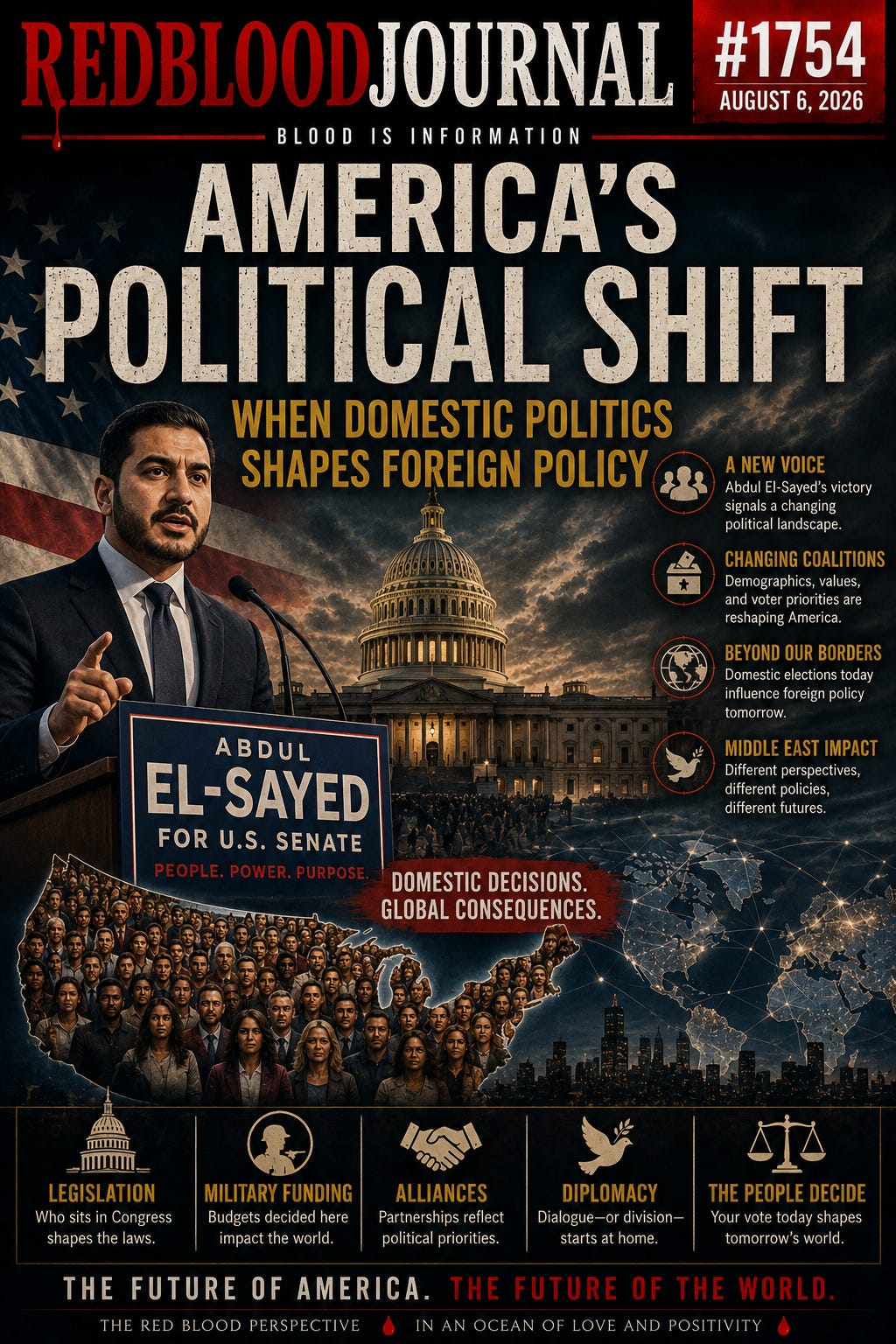
🩸 #1754 — America’s Political Shift
When Domestic Politics Shapes Foreign Policy
August 6, 2026
🩸 RedBloodJournal.com 🩸
While much of the transcript focuses on Iran and the Middle East, it also turns briefly toward a political development inside the United States that, according to the source, could have broader geopolitical implications.
The discussion centers on the reported victory of Abdul El-Sayed in a U.S. Senate primary and explores what that result could mean for American politics, Middle East policy, and changing voter demographics.
This report summarizes the perspective presented in the transcript. The observations and interpretations described below are based on the source and should not be understood as independently verified conclusions.
A Symbolic Election
The transcript presents the election result as more than a local political contest.
Instead, it portrays it as part of a broader shift occurring within American politics, where changing demographics and evolving voter priorities increasingly influence foreign policy discussions.
The source argues that elections at the state level can eventually affect national debates regarding international alliances and diplomatic priorities.
Changing Political Coalitions
According to the transcript, political parties are adapting to demographic changes within the United States.
The source suggests that growing participation from diverse communities may gradually reshape electoral strategies and public policy.
Whether these changes ultimately produce significant shifts in U.S. foreign policy remains uncertain, but the transcript presents them as developments worth observing.
Domestic Politics and International Affairs
The transcript emphasizes that domestic elections often have consequences beyond national borders.
Members of Congress influence:
foreign aid,
military appropriations,
sanctions,
diplomatic initiatives,
and international alliances.
As a result, changes in congressional representation can eventually influence how the United States approaches conflicts abroad.
Middle East Policy
Within the transcript, the election is discussed primarily through the lens of Middle East policy.
The source notes that different American political movements hold differing views regarding:
U.S.–Israel relations,
diplomacy,
regional security,
and America’s long-term role in the Middle East.
These differing perspectives form part of the broader political debate described in the transcript.
Looking Beyond One Election
The transcript ultimately presents this election not simply as the success of one candidate, but as an indicator of broader political trends.
Whether those trends continue or prove temporary will depend upon future elections, public opinion, and the evolving priorities of American voters.
The Red Blood Perspective
History often shows that foreign policy begins at home.
Governments negotiate abroad only after political coalitions are built domestically. Elections determine who writes legislation, oversees military spending, approves treaties, and influences diplomatic priorities.
The transcript reviewed here presents one Senate race as part of a larger discussion about America’s evolving political landscape. While the broader conclusions remain matters of political interpretation, the underlying observation is well established: domestic political change can gradually reshape a nation’s role on the world stage.
For critical thinkers, watching electoral trends can sometimes provide early insight into future foreign policy long before official strategies are announced.
Ocean of Love and Positivity
Democracy is a continual conversation shaped by ideas, participation, and public debate. Understanding political change begins with observing events carefully, questioning assumptions, and evaluating evidence with an open mind.
In an Ocean of Love and Positivity.
🩸🌊✨ Fantastic!
🗳️
🗳️ The Domestics of Diplomacy:
America’s Shifting Political Landscape
Aug 6, 2026
This report examines how domestic electoral results in the United States serve as a catalyst for broader geopolitical transformations. By focusing on a specific Senate primary victory, the text illustrates the growing influence of shifting voter demographics and local political movements on national discourse. It argues that internal party changes and new leadership directly impact foreign policy decisions, including military spending, international alliances, and diplomatic strategy. The source specifically highlights how these internal American trends could potentially reshape Middle East relations and regional security priorities. Ultimately, the analysis suggests that observing state-level political trends provides essential foresight into the future of global diplomacy. This perspective emphasizes that a nation’s international role is fundamentally dictated by the domestic coalitions formed at the ballot box.


