


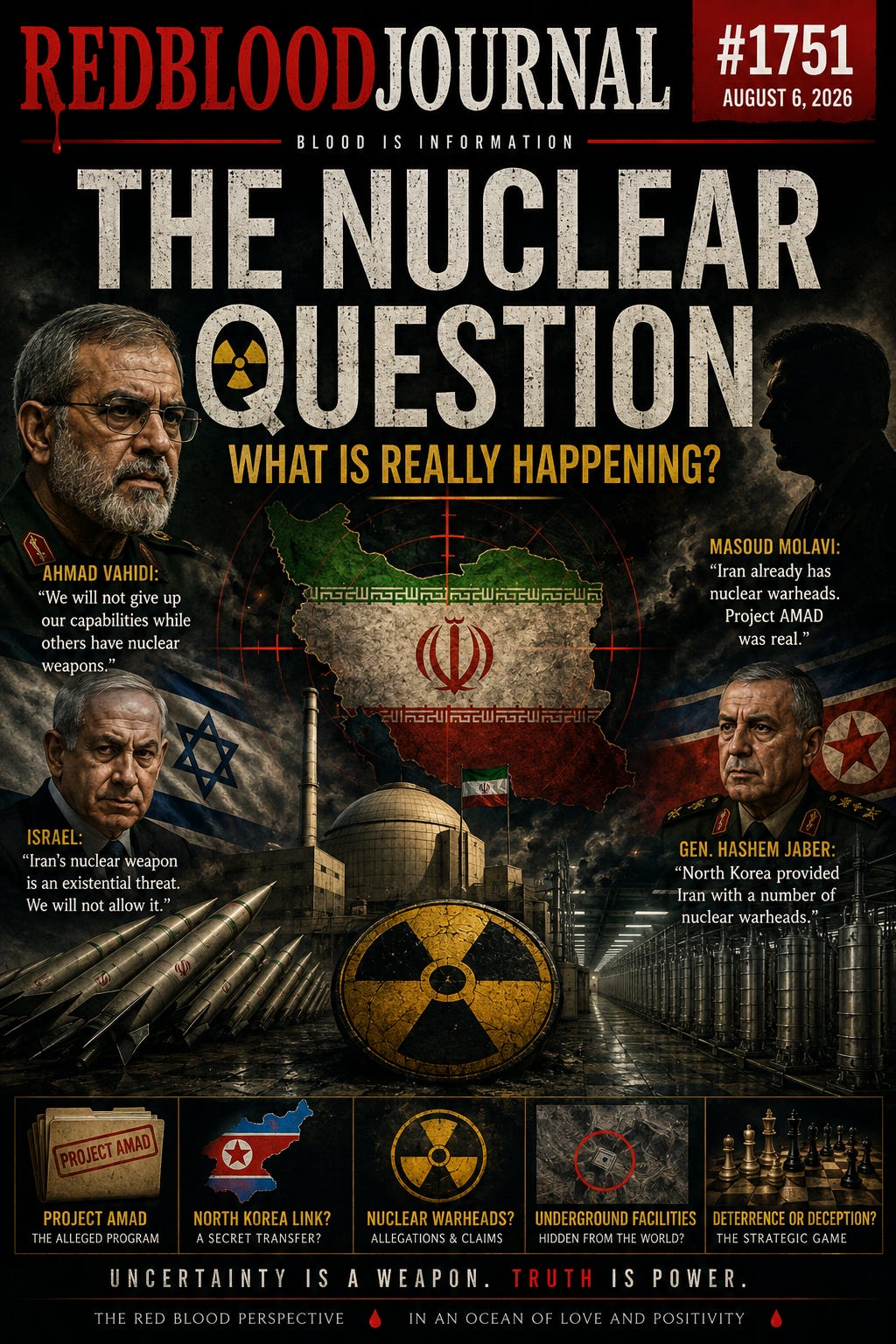
🩸 #1751 — The Nuclear Question
What Is Really Happening?
August 6, 2026
🩸 RedBloodJournal.com 🩸
Few issues have shaped Middle Eastern geopolitics more profoundly than the question of Iran’s nuclear program.
For decades, governments, intelligence agencies, international organizations, and analysts have debated the extent of Iran’s nuclear capabilities, its intentions, and the implications for regional security.
The transcript examined in this report brings together numerous statements, allegations, reactions, and competing narratives surrounding that question.
Many of the claims discussed remain contested and are presented here as they appear in the source rather than as independently verified facts.
Ahmad Vahidi’s Reported Statements
A major portion of the transcript centers on remarks attributed to Ahmad Vahidi.
According to the transcript, statements attributed to him suggest that Iran would not negotiate away strategic capabilities while other regional powers continue to possess nuclear weapons.
These reported remarks generated immediate political reactions and are presented by the transcript as unusually direct compared with previous public messaging.
Israel’s Response
The transcript then discusses reactions attributed to Israeli officials.
It describes statements emphasizing that Israel views the prospect of an Iranian nuclear weapon as an unacceptable security threat and that protecting Israel’s security remains a central objective regardless of diplomatic negotiations.
The transcript presents these responses as evidence of how closely regional actors monitor Iranian public statements.
Competing Interpretations
Throughout the transcript, several possibilities are raised.
Among them are claims that:
Iran is approaching nuclear capability.
Iran already possesses nuclear weapons.
Iran seeks only strategic deterrence.
Public statements are intended primarily as political messaging.
Negotiations may be tactical rather than substantive.
The transcript does not establish which interpretation is correct, instead presenting multiple competing narratives.
Masoud Molavi’s Allegations
A significant section focuses on the late Masoud Molavi, who is described as a former insider with knowledge of sensitive government programs.
The transcript recounts allegations attributed to him concerning:
Project AMAD,
underground facilities,
nuclear testing,
scientific personnel,
and claims that Iran had already acquired several nuclear warheads.
These allegations are presented as Molavi’s assertions and are not independently substantiated within the transcript.
The North Korea Claim
Another major topic is an interview involving retired Lebanese General Hashem Jaber.
According to the transcript, he claims that Iran obtained a limited number of nuclear warheads from North Korea rather than developing them domestically.
The transcript presents this as an allegation that, if true, would significantly alter conventional discussions regarding Iran’s nuclear timeline.
The transcript itself provides no independent verification for this claim.
Project AMAD
The transcript also revisits allegations surrounding Project AMAD, discussing:
explosive testing,
underground research,
scientific personnel,
and claims regarding weapons-related activities.
These discussions are presented through interviews and reported allegations rather than documentary confirmation within the source.
Why the Nuclear Question Matters
Whether Iran possesses nuclear weapons, is pursuing them, or is using strategic ambiguity remains one of the defining geopolitical questions in the Middle East.
The transcript suggests that uncertainty itself may serve as a strategic tool.
If opponents remain unsure of a nation’s actual capabilities, deterrence can exist even without public confirmation.
Conversely, uncertainty can also increase the risk of miscalculation by regional actors.
The Red Blood Perspective
Nuclear policy is rarely shaped solely by technology.
It is shaped by politics, intelligence, diplomacy, military planning, public messaging, and strategic ambiguity.
The transcript reviewed here reflects that complexity. It combines official statements, personal testimony, intelligence-related allegations, political reactions, and speculation into a broader narrative concerning Iran’s nuclear future.
Many of the specific claims remain disputed and require independent verification. Nevertheless, the report illustrates how competing narratives themselves influence international politics. Governments make decisions not only based on confirmed facts, but also on what they believe—or fear—may be true.
For critical observers, distinguishing verified information from reported allegations remains essential when evaluating one of the world’s most consequential security questions.
Ocean of Love and Positivity
Critical thinking is strongest when evidence, uncertainty, and competing interpretations are clearly separated. The search for understanding begins by asking careful questions before accepting confident conclusions.
In an Ocean of Love and Positivity.
🩸🌊✨ Fantastic!
☢️
☢️ The Nuclear Question: Assessing Iran’s Strategic Ambiguity
Aug 6, 2026
This report examines the complex and contested narratives surrounding the status of Iran’s nuclear program and its impact on Middle Eastern security. It analyzes provocative claims from various figures, including allegations that Iran may have already acquired functional warheads through covert means or foreign partnerships. The text contrasts these explosive reports with official Israeli warnings and the strategic importance of military deterrence through ambiguity. Rather than confirming specific facts, the source highlights how geopolitical uncertainty and intelligence-related rumors influence international diplomacy. Ultimately, the document emphasizes the necessity of critical thinking when navigating the conflicting information that shapes global perceptions of nuclear proliferation.


