


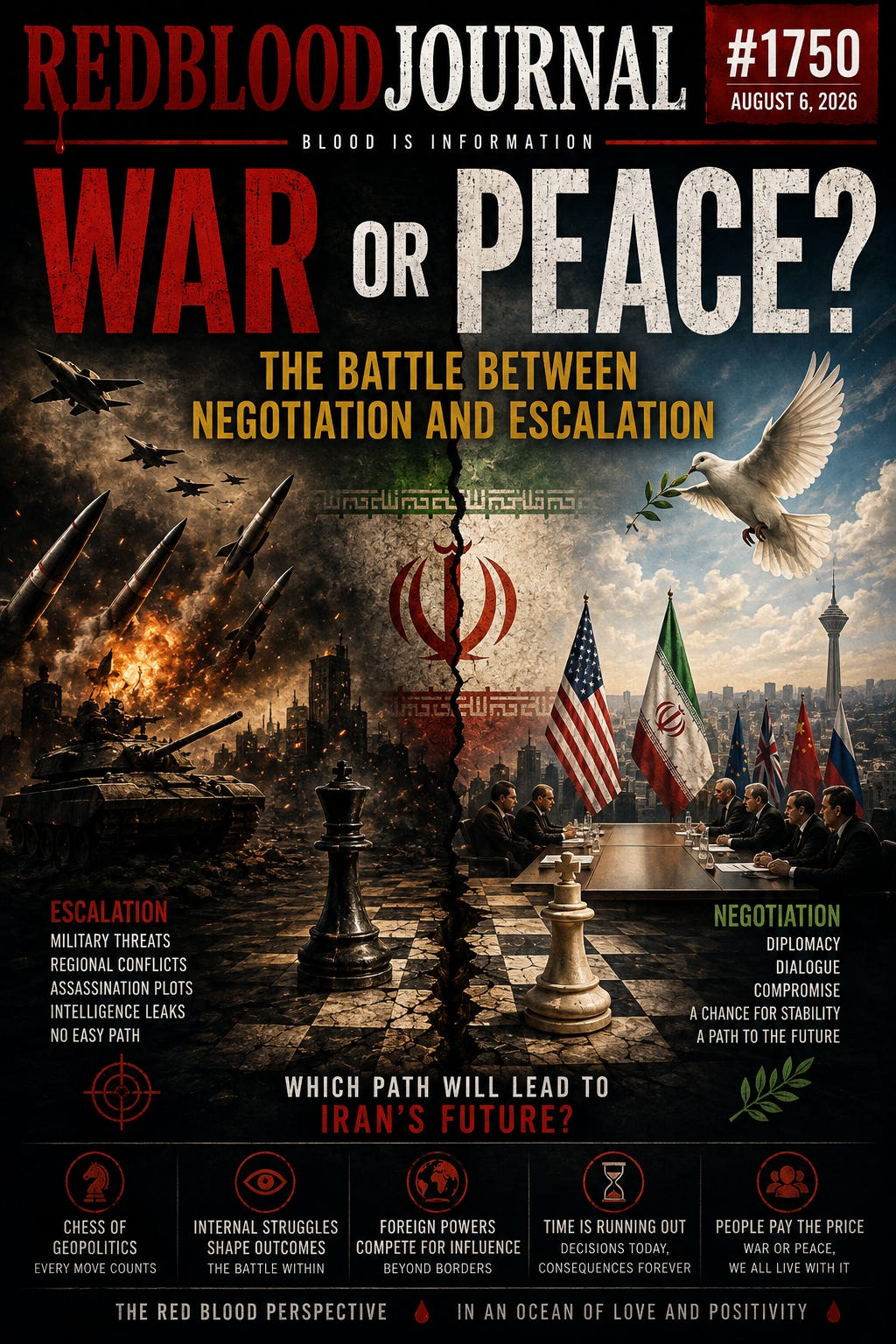
🩸 ⚖️ #1750 — War or Peace?
The Battle Between Negotiation and Escalation
August 6, 2026
🩸 RedBloodJournal.com 🩸
The transcript presents a picture of competing strategies unfolding simultaneously around Iran’s relationship with the United States and the broader Middle East.
Rather than describing a single unified policy, it portrays multiple political and ideological camps—inside both Iran and the United States—advocating different paths toward the future.
Some voices favor negotiation.
Others argue that military confrontation is inevitable.
The transcript suggests that the struggle between these competing approaches may be just as significant as the negotiations themselves.
Trump’s Negotiation Strategy
According to the transcript, Donald Trump publicly maintains that negotiations with Iran continue while simultaneously warning that military action remains an available option.
The source describes a strategy combining diplomatic engagement with public displays of military readiness.
It also references reports of intelligence leaks within the administration and mentions a reported assassination threat directed at Trump, framing these events as occurring alongside sensitive negotiations.
Competing Voices Inside Iran
The transcript argues that Iran itself is not speaking with one voice.
Instead, it portrays competing factions attempting to influence the country’s direction.
One current appears willing to explore negotiations with Washington.
Another emphasizes confrontation, resistance, and strategic deterrence.
Rather than describing disagreement between nations alone, the transcript presents disagreement within the Iranian political system itself.
Hassan Rouhani’s Criticism
Former President Hassan Rouhani is presented as criticizing those he characterizes as advocates of continued conflict.
According to the transcript, he identifies several groups that, in his view, benefit politically or ideologically from maintaining tensions rather than pursuing compromise.
The discussion includes references to:
ideological motivations,
economic interests surrounding sanctions,
and religious interpretations connected to expectations of future events.
These are presented as his political arguments rather than independently verified conclusions.
The Negotiation Camp
The transcript repeatedly refers to officials and political figures who are portrayed as believing that diplomacy remains possible.
This camp argues that reducing tensions could preserve stability and improve Iran’s international position.
Whether such negotiations are progressing successfully is left unresolved.
The Confrontation Camp
In contrast, another current presented in the transcript argues that negotiations merely provide time for opponents while weakening Iran’s strategic position.
Supporters of this view advocate maintaining military preparedness and resisting outside pressure.
The transcript portrays this disagreement as extending beyond policy into a broader contest over Iran’s future identity and leadership.
Regional Escalation
The transcript also references reports of heightened regional tensions, including discussion surrounding Bahrain and the possibility of wider confrontation.
These developments are presented as examples of how events beyond Iran’s borders may influence domestic political debates regarding diplomacy versus military action.
A Contest Beyond Diplomacy
One of the broader themes emerging from the transcript is that negotiations themselves may represent only one layer of a larger political struggle.
Public statements, military signaling, media messaging, and internal political competition all appear interconnected.
Whether diplomacy ultimately succeeds or fails may depend not only on discussions across negotiating tables, but also on which political factions gain influence inside their respective governments.
The Red Blood Perspective
History often remembers the treaties that were signed or the wars that were fought.
Less visible are the internal debates that shaped those outcomes.
Governments rarely function as single voices. They are often coalitions of competing institutions, political movements, military establishments, and ideological groups, each seeking to influence national policy.
The transcript examined here presents such a landscape, portraying negotiation and confrontation not simply as foreign policy options but as competing visions of national strategy. While the specific claims require careful verification, the broader observation is that internal political divisions can play a decisive role in determining whether diplomacy advances or conflict escalates.
For critical observers, understanding those internal dynamics may be as important as following the official negotiations themselves.
Ocean of Love and Positivity
Critical thinking requires distinguishing between verified events, political rhetoric, reported claims, and strategic messaging. In periods of heightened international tension, careful analysis is often more valuable than immediate conclusions.
In an Ocean of Love and Positivity.
🩸🌊✨ Fantastic!
⚖️
⚖️ The Iranian Crossroads:
Diplomacy and the Path to Conflict
Aug 6, 2026
The provided text explores the internal power struggles within both the United States and Iran as they navigate a volatile period of diplomatic tension. It suggests that foreign policy is not a singular path but a clash of factions, where some leaders pursue negotiation while others advocate for military escalation. The source highlights how former officials like Hassan Rouhani and current figures like Donald Trump manage competing domestic pressures, ranging from economic interests to strategic deterrence. Ultimately, the document argues that the outcome of these international relations depends heavily on which political camp wins the internal debate within their respective governments. This perspective emphasizes that domestic instability and ideological disagreements are often the primary drivers behind the threat of regional war.


