


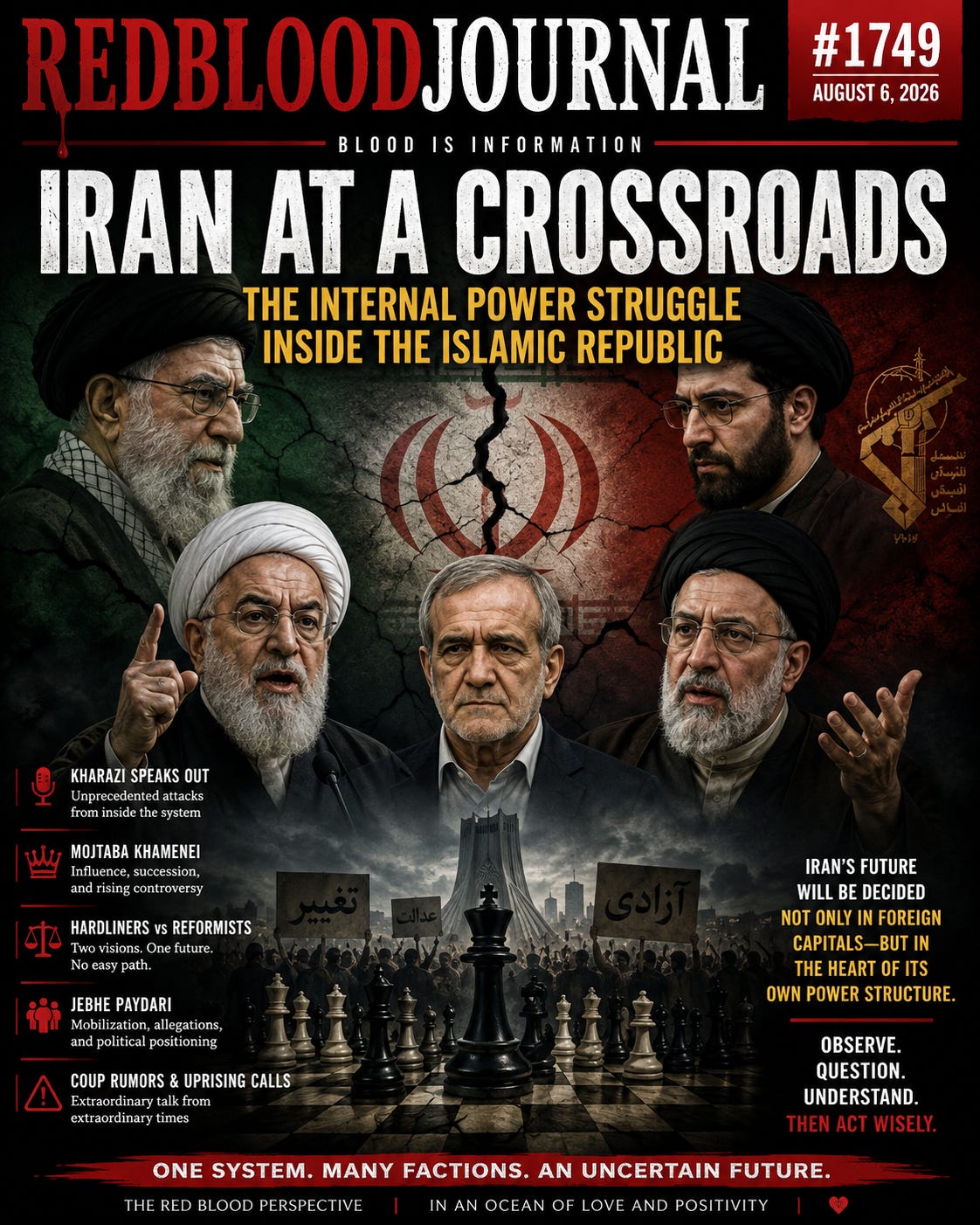
🩸 🇮🇷 #1749 — Iran at a Crossroads
The Internal Power Struggle Inside the Islamic Republic
August 6, 2026
🩸 RedBloodJournal.com 🩸
For decades, the Islamic Republic has projected an image of centralized authority, discipline, and unity. Publicly, disagreements among senior officials have generally remained limited, carefully managed, or confined behind closed doors.
The transcript examined in this report presents a markedly different picture.
It portrays a political system experiencing increasingly visible internal divisions, with competing factions openly challenging one another, questioning the legitimacy of rival centers of power, and making accusations that would have been considered extraordinary in previous years.
Mohammad Bagher Kharazi’s Public Statements
A central focus of the transcript is the appearance of cleric Mohammad Bagher Kharazi, who delivers unusually harsh criticism of senior figures associated with the Islamic Republic.
According to the transcript, he:
criticizes individuals surrounding the Supreme Leader,
attacks President Masoud Pezeshkian,
questions influential political figures,
characterizes elements of the leadership as corrupt,
and argues that the current political system requires fundamental change.
The transcript presents these remarks as highly unusual because they originate from someone described as having long-standing connections to the establishment rather than from an external opposition figure.
The Question of Mojtaba Khamenei
Another recurring subject is Mojtaba Khamenei.
The transcript discusses:
reports regarding his influence,
his relationship with senior political figures,
speculation concerning future leadership,
and claims that different factions are attempting either to strengthen or weaken his political position.
The material does not establish these claims as verified facts but presents them as part of the political narrative under discussion.
Reformists vs. Hardliners
Throughout the transcript, two broad political currents emerge.
One favors continued negotiations and diplomatic engagement.
The other argues for confrontation and resistance.
Rather than presenting a unified government, the transcript depicts an internal struggle between competing visions for Iran’s future.
The Role of Jebhe Paydari
Special attention is given to the Jebhe Paydari (Steadfast Front).
The transcript describes allegations that members of this current are organizing politically, preparing supporters, and positioning themselves for a future struggle over power.
It also discusses accusations made by opponents who fear that hardline factions could attempt to reshape the political landscape through extraordinary measures.
Calls for Political Mobilization
One of the most controversial portions of the transcript involves calls for supporters to organize and gather from cities across Iran.
The discussion frames these remarks as unprecedented because they appear to advocate coordinated political action originating from within circles traditionally associated with the establishment itself.
An Increasingly Visible Divide
Taken together, the transcript portrays multiple fault lines:
political loyalty versus ideological loyalty,
reform versus resistance,
negotiation versus confrontation,
institutional continuity versus restructuring,
competing visions of succession.
Whether these disagreements represent ordinary political competition or something more significant is left unresolved by the source.
The Red Blood Perspective
Political systems often appear strongest immediately before internal disagreements become visible to the public.
History shows that major political transitions frequently begin not with external pressure, but with growing divisions among those already inside the system.
The transcript reviewed here presents a narrative in which those internal disagreements are becoming increasingly public. While many of the claims remain contested and require independent verification, the broader observation is that public disputes among influential insiders appear more visible than in previous years.
For observers seeking to understand Iran’s future, the most significant developments may not come solely from foreign capitals or military events, but from the evolving balance of power within the Islamic Republic itself.
Ocean of Love and Positivity
Critical thinking begins by separating verified facts, reported claims, and informed speculation. Careful observation, patience, and a willingness to question assumptions remain essential when analyzing rapidly changing political events.
In an Ocean of Love and Positivity.
🩸🌊✨ Fantastic!
🇮🇷
🇮🇷 Cracks in the Islamic Republic: Iran’s Internal Power Struggle
Aug 6, 2026
This report examines the escalating internal power struggles within the Islamic Republic of Iran, suggesting that traditional displays of unity are fracturing. It highlights unprecedented public criticism from establishment insiders like Mohammad Bagher Kharazi, who has openly challenged the legitimacy of the presidency and the supreme leadership’s inner circle. The text explores the vocal divide between reformist factions seeking diplomacy and hardline groups, such as the Jebhe Paydari, who advocate for domestic mobilization and resistance. Furthermore, the source notes significant speculation regarding Mojtaba Khamenei’s influence and the future of leadership succession. By detailing these competing visions for the state, the material argues that the nation’s trajectory may be determined more by these domestic rifts than by external pressures. Ultimately, the narrative frames these visible political fault lines as a potential turning point for the regime’s stability.


