


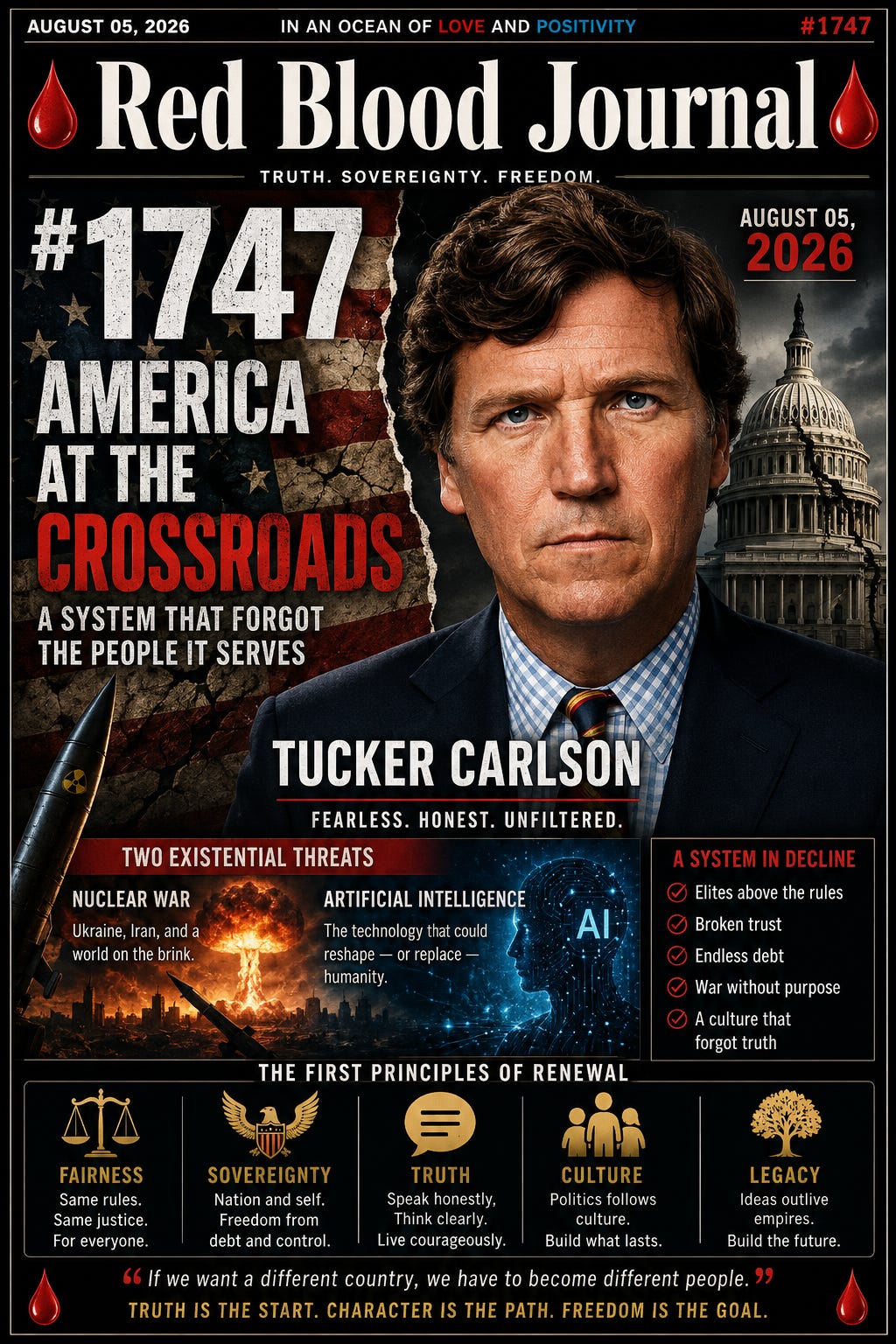
🩸 #1747 — Tucker Carlson August 05, 2026
America at the Crossroads: Fairness, Sovereignty, and the Search for Truth
August 5, 2026
🩸 RedBloodJournal.com 🩸
Overview
This report summarizes the central themes presented during Tucker Carlson’s August 5, 2026 broadcast. The summary reflects the arguments and perspectives expressed in the program itself rather than independently verifying or endorsing each claim.
The broadcast argues that the United States is entering a period of systemic transition. According to Carlson, many American institutions have gradually shifted away from serving the public and increasingly serve those who control them. He suggests this trend has weakened public trust while creating a growing separation between governing institutions and ordinary citizens.
A System That No Longer Serves Its Original Purpose
Carlson begins by defining the purpose of leadership:
A preacher should serve the spiritual well-being of the congregation.
A president should protect the interests of the nation’s citizens.
From this foundation, he argues that many American institutions now prioritize their own preservation and interests over the people they were created to serve. He points to examples such as political elites, bureaucracies, and institutions that appear to operate under different standards than the general public.
Two Existential Threats
The program identifies two developments Carlson believes deserve far greater public attention:
1. Escalating Global Conflict
He argues that the wars involving Ukraine and Iran are becoming increasingly interconnected, raising the possibility of a much wider international conflict involving nuclear powers.
According to the broadcast, political leadership has failed to seriously confront the risks associated with these escalating tensions.
2. Artificial Intelligence
Carlson also describes artificial intelligence as another civilization-level challenge.
He notes that many of the warnings are coming from AI developers themselves, who acknowledge the technology could dramatically reshape employment, decision-making, and potentially create unforeseen risks.
His criticism is directed less at AI itself than at what he sees as the absence of serious national discussion and preparation.
A Political System Nearing Its Limits
One of the recurring themes throughout the broadcast is that America’s current political system is losing legitimacy.
Carlson argues that:
The two major political parties often differ rhetorically while remaining largely aligned on major issues such as foreign policy, spending, and government expansion.
Public frustration continues to grow because many voters feel increasingly disconnected from national decision-making.
New political movements or additional parties may eventually emerge as public confidence declines.
Politics Follows Culture
Rather than viewing elections as the primary solution, Carlson argues that lasting political change follows cultural change.
According to this perspective:
Laws alone cannot create moral societies.
Shared values shape institutions.
Citizens ultimately determine the direction of a nation.
He suggests that meaningful reform begins with changing what society collectively values rather than simply electing different leaders.
Truth as the Foundation
One of the central philosophical themes of the program is the importance of speaking openly and honestly.
Carlson argues that:
Every lasting civilization is remembered primarily through its ideas.
Honest speech precedes meaningful reform.
Governments throughout history have often attempted to control language before exercising broader forms of control.
From this viewpoint, truth becomes the starting point for societal renewal.
The First Principles of Renewal
The broadcast introduces what Carlson describes as foundational principles for rebuilding the country.
Among those discussed in this portion are:
Fairness
Every citizen should be subject to the same rules regardless of wealth, status, or political influence.
He argues that unequal justice destroys confidence in institutions and points to high-profile cases, including Jeffrey Epstein, as examples of why many Americans believe different standards exist for different people.
Sovereignty
Carlson expands sovereignty beyond national independence to include individual freedom.
His discussion includes:
National independence from outside influence.
Personal autonomy.
Opposition to excessive debt.
Freedom from coercion.
Financial independence as an element of personal liberty.
He argues that excessive personal and national debt reduce genuine independence and create long-term dependency.
Debt as a Form of Control
Another major topic is debt.
Carlson argues that:
Excessive debt weakens both individuals and governments.
High-interest lending creates long-term dependence.
Financial systems increasingly reward borrowing while penalizing debt-free living.
He frames debt not only as an economic issue but also as a question of personal sovereignty.
Overall Message
The central message of the broadcast is that America is entering a transition period in which existing institutions are losing public confidence.
Rather than focusing solely on elections or policy changes, Carlson argues that renewal begins with restoring:
Fairness
Equal treatment under the law
National sovereignty
Personal responsibility
Cultural consensus
Honest public discourse
Whether one agrees with these conclusions or not, the program presents them as the foundation for rebuilding public trust and preventing further institutional decline.
🩸 The Red Blood Perspective
Critical thinking requires distinguishing between reporting, opinion, and evidence.
This broadcast presents a comprehensive worldview that connects political institutions, foreign policy, debt, technology, and cultural values into a single narrative. Some arguments are based on observable political developments, while others are interpretive judgments and predictions. The role of a critical thinker is neither to accept nor reject such claims automatically, but to examine evidence, compare competing perspectives, and continually ask whether actions align with the stated mission of institutions.
When governments, media, or influential voices make significant claims, the pursuit of truth is strengthened by independent verification rather than assumption.
🌊 Ocean of Love and Positivity
Every civilization faces moments when people question its direction. Those moments can become periods of division—or opportunities for reflection and renewal.
Regardless of political beliefs, societies grow stronger when citizens seek truth with humility, debate respectfully, protect equal justice, and remember that lasting change begins with individual character. A culture built on honesty, compassion, responsibility, and respect for one another creates a stronger foundation than fear or resentment ever can.
May every search for truth also strengthen wisdom, understanding, and our shared humanity.
In an Ocean of Love and Positivity.
🩸🌊✨ Fantastic!
🇺🇸
America at the Crossroads: Sovereignty, Truth, and Institutional Renewal
1 source·Aug 5, 2026
This report outlines a broadcast by Tucker Carlson regarding the current societal and political decline in the United States. The text argues that major institutions have abandoned their original purposes, leading to a significant loss of public trust and institutional legitimacy. Carlson identifies global warfare and the rapid rise of artificial intelligence as two primary existential threats that leaders are failing to address. To counter this decay, the source emphasizes the need for cultural renewal based on foundational principles like fairness, national sovereignty, and honest discourse. Ultimately, the document suggests that personal independence and a return to shared values are essential for navigating this era of systemic transition.


