


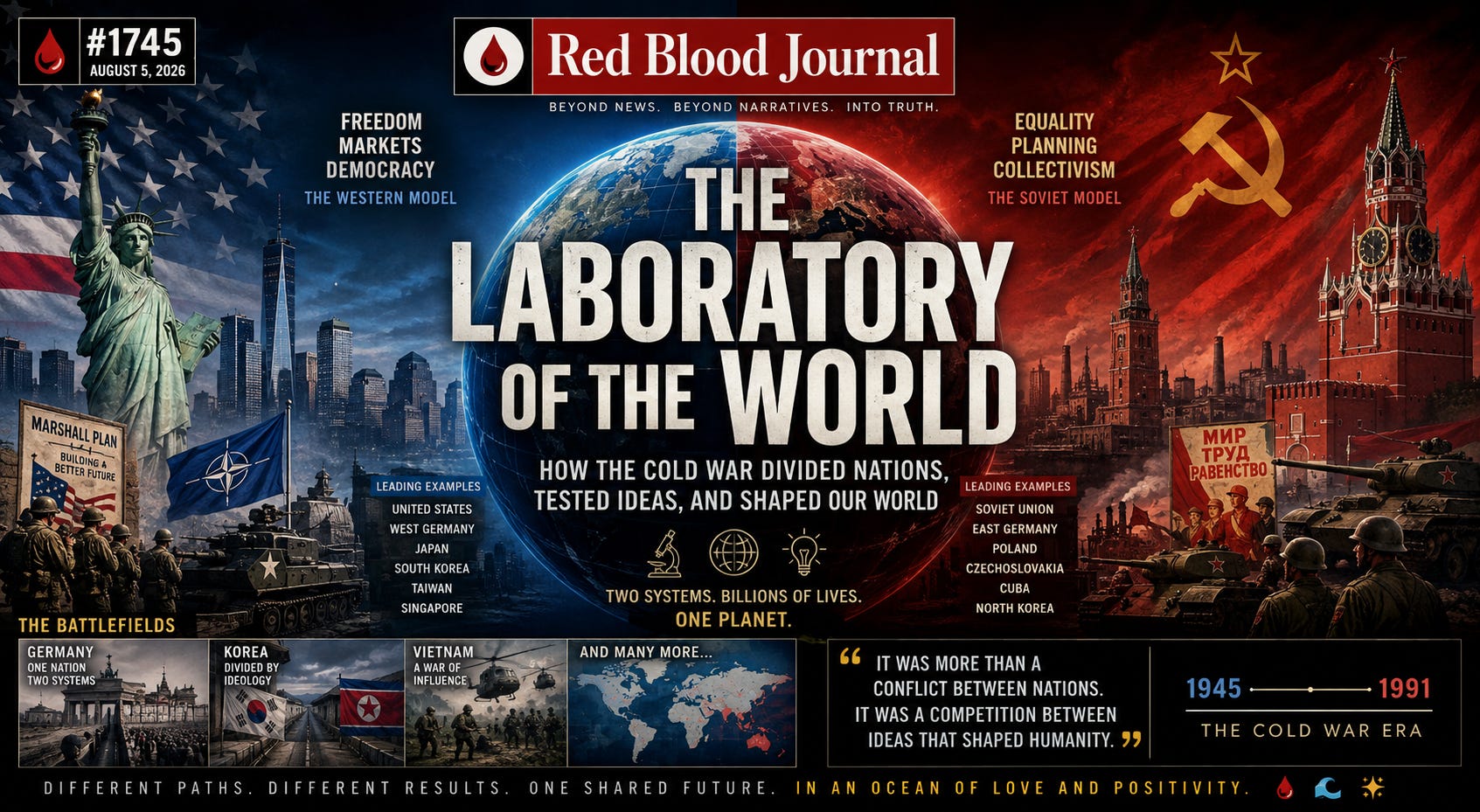
🩸 🌍 🧪 #1745 — The Laboratory of the World
How the Cold War Turned Nations into Competing Models
August 5, 2026
RedBloodJournal.com
When World War II ended, much of Europe lay in ruins, old empires were fading, and two new superpowers emerged above all others.
The United States.
The Soviet Union.
From 1945 until the collapse of the USSR in 1991, the world entered a period historians call the Cold War. Although the two superpowers rarely fought each other directly, they competed across nearly every other field imaginable—economics, military strength, technology, intelligence, ideology, culture, and diplomacy.
Viewed from a broader historical perspective, the Earth became something resembling a laboratory.
Not necessarily because both sides consciously agreed to conduct one, but because billions of people found themselves living under two competing visions of how society should be organized.
One emphasized private enterprise and market capitalism.
The other emphasized state ownership and central planning.
Each claimed its system represented humanity’s future.
Laboratory One: The Western Model
The United States became the leading example of liberal democracy and market capitalism.
Its closest allies included:
West Germany
Japan
South Korea
Taiwan
Canada
Western Europe
Australia
These nations generally emphasized:
Private ownership
Competitive markets
Consumer economies
Political pluralism (with varying degrees of success)
International trade
Their economic growth during the post-war decades became one of the strongest arguments for the Western model.
Laboratory Two: The Soviet Model
The Soviet Union offered an entirely different vision.
Its sphere of influence included:
East Germany
Poland
Czechoslovakia
Hungary
Bulgaria
Romania
Cuba
Mongolia
The Soviet model emphasized:
State ownership
Central economic planning
One-party political systems
Collective production
Strategic military coordination
Supporters argued this system would eliminate inequality and place national resources under public control.
Critics argued it often produced shortages, bureaucracy, political repression, and reduced economic flexibility.
The Tip of the Spear
Some countries became the clearest demonstrations of the competing systems.
Germany
One nation.
Two governments.
Two economies.
West Germany became one of the world’s strongest industrial economies.
East Germany became the industrial showcase of the Eastern Bloc.
Few comparisons were as direct.
Korea
The Korean Peninsula became another defining example.
North Korea developed under Soviet and Chinese influence.
South Korea developed with extensive American support.
Today, the contrast between the two remains one of the most striking geopolitical comparisons in modern history.
Vietnam
Vietnam became one of the Cold War’s most violent proxy conflicts.
North Vietnam aligned with communist allies.
South Vietnam received American support.
The conflict illustrated how ideological competition often unfolded through regional wars rather than direct superpower confrontation.
Beyond Economics
The competition extended far beyond money.
Both systems sought to prove superiority in:
Education
Science
Space exploration
Military capability
Healthcare
Industrial production
Intelligence operations
Global influence
Every Olympic medal...
Every moon mission...
Every technological breakthrough...
Every alliance...
became part of a broader contest for prestige and influence.
The End of One Experiment
The dissolution of the Soviet Union in 1991 marked the end of the bipolar world.
Many concluded that market-oriented economies had demonstrated greater long-term economic adaptability.
Others argued that different historical conditions, leadership decisions, institutions, and external pressures made simple comparisons difficult.
The debate did not disappear.
Instead, it evolved.
Today, countries such as China combine significant market activity with centralized political authority, creating hybrid systems that differ from both the classic Soviet and traditional Western models.
The Red Blood Perspective
History often appears as a sequence of battles between armies.
Yet another perspective sees it as a competition between ideas.
The Cold War was not only a military standoff. It was also a contest over which political, economic, and social model could deliver security, prosperity, technological progress, and legitimacy.
Viewing the period as a global “laboratory” is a metaphor rather than an established historical conclusion, but it highlights how millions of ordinary people experienced the consequences of decisions made by competing superpowers.
Whether one sees these developments as strategic competition, ideological rivalry, or something more, one lesson remains constant: societies are shaped not only by the systems they adopt, but by the people who live within them and the freedoms and responsibilities they exercise.
Ocean of Love and Positivity
Every generation inherits ideas from those before it.
The greatest opportunity is not merely to choose between competing systems, but to learn from history’s successes and failures with humility and wisdom.
A future built on curiosity, accountability, compassion, and peaceful cooperation may ultimately prove more enduring than one built solely on rivalry.
In an Ocean of Love and Positivity.
🩸🌊✨ Fantastic!
🧪
🧪 The Laboratory of the World: Ideological Rivalry in the Cold War
Aug 5, 2026
The provided text frames the Cold War as a massive global experiment where the United States and the Soviet Union competed to prove the superiority of their respective societal structures. While the Americans championed market capitalism and liberal democracy, the Soviets promoted central planning and state ownership as the ideal path for humanity. This intense rivalry manifested in divided nations like Germany and Korea, which served as direct case studies for comparing the two conflicting ideologies. Beyond mere economics, the struggle for prestige influenced every facet of life, including scientific innovation, space exploration, and cultural achievements. Although the dissolution of the USSR ended this specific bipolar era, the source suggests that the lessons learned from these competing models continue to shape modern hybrid systems. Ultimately, the text encourages a historical perspective that values wisdom and peaceful cooperation over the destructive nature of global power struggles.


