


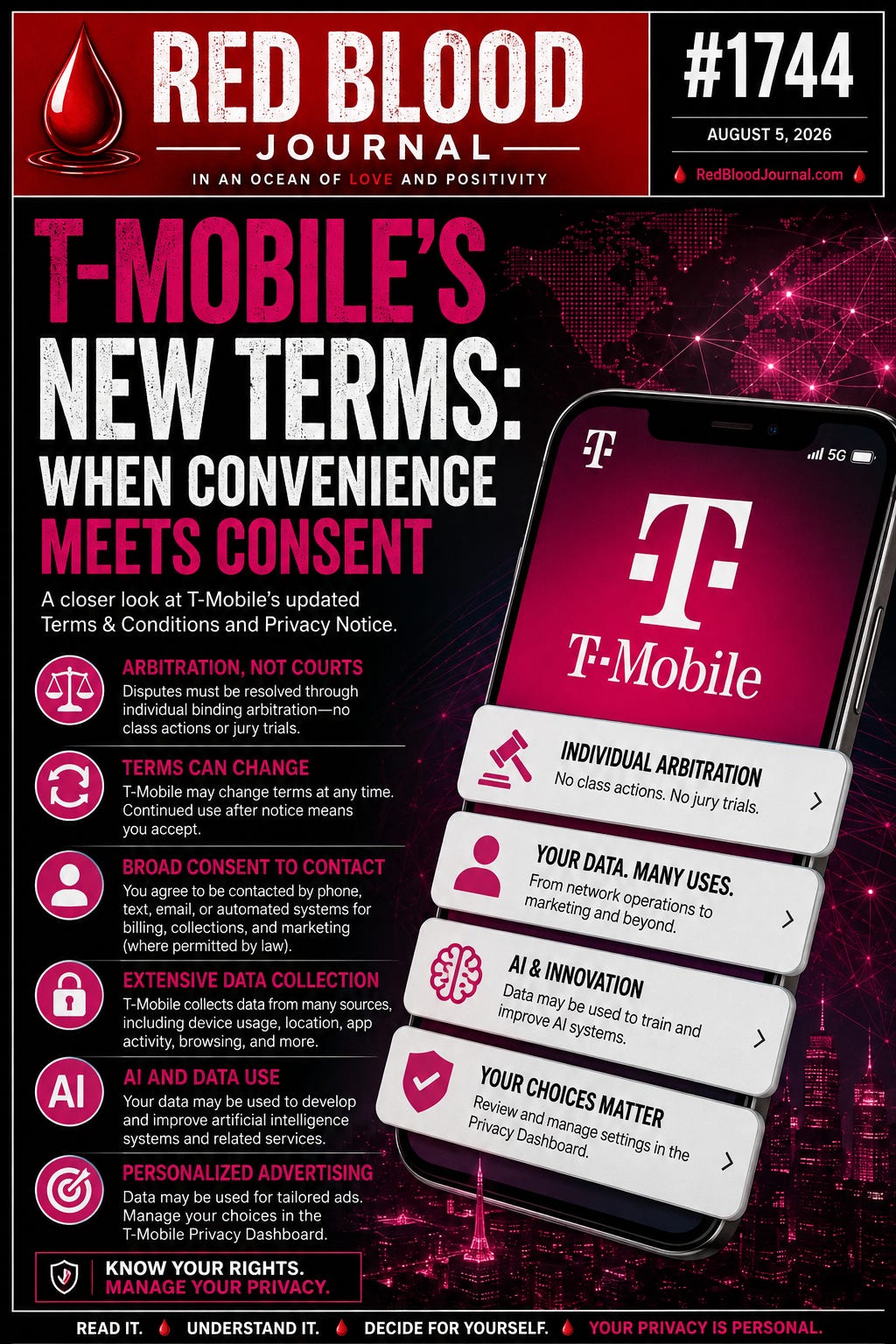
🩸 📱 #1744 — T-Mobile’s New Terms: When Convenience Meets Consent
Reading the Fine Print Behind America’s Wireless Giant
August 5, 2026
🩸 RedBloodJournal.com 🩸
Every day, millions of Americans tap “Accept.”
A software update.
A new application.
A phone carrier agreement.
Most never read beyond the first sentence.
Yet behind that single button may exist hundreds of pages defining the relationship between customers and one of America’s largest wireless providers.
T-Mobile recently updated its Terms & Conditions and Privacy Notice, with the new Terms becoming effective on September 1, 2026. Like many modern digital agreements, these documents extend far beyond making phone calls and paying a monthly bill.
T-Mobile Is More Than a Wireless Carrier
According to its updated documents, T-Mobile’s relationship with customers includes:
Wireless communication
Smartphones and connected devices
Device financing
Billing services
Marketing programs
Privacy policies
Network management
Data collection
Artificial intelligence
Advertising platforms
Arbitration procedures
The agreement reflects how today’s wireless providers have evolved into technology companies that manage enormous amounts of customer information.
T-Mobile’s Arbitration Requirement
One of the most significant sections of T-Mobile’s Terms & Conditions concerns dispute resolution.
Customers generally agree that disputes with T-Mobile will be resolved through individual binding arbitration rather than through class-action lawsuits or jury trials.
Supporters argue arbitration can reduce legal costs and resolve disputes more quickly.
Critics argue it limits consumers’ legal options and their ability to pursue collective legal action.
Rather than hiding this provision, T-Mobile places it prominently within its updated agreement.
Continued Use Means Acceptance
T-Mobile also explains that it may modify certain terms of service over time.
For changes that materially affect customers, the company states it will generally provide advance notice.
However, if customers continue using T-Mobile’s services after those changes become effective, that continued use generally constitutes acceptance of the updated agreement.
This model has become increasingly common across technology companies and online services.
How Much Data Does T-Mobile Say It Collects?
One of the longest sections of T-Mobile’s Privacy Notice focuses on data collection.
The company explains that it may collect information including:
Account information
Device information
Network diagnostics
Application usage
Location information
Billing history
Customer service interactions
Marketing preferences
Device identifiers
Usage analytics
According to the Privacy Notice, different categories of information are used for different purposes, including operating the wireless network, fraud prevention, product development, customer support, and advertising programs.
T-Mobile and Artificial Intelligence
Among the newer additions, T-Mobile states that personal data may also be used to develop and improve artificial intelligence systems and related services.
As AI becomes increasingly integrated into customer service, network optimization, and software development, companies are beginning to describe these practices more explicitly within their privacy policies.
Personalized Advertising
The Privacy Notice also describes T-Mobile’s advertising programs.
Depending on customer choices and applicable settings, some information may be used to create audience groups, deliver more personalized advertising, and measure advertising effectiveness.
The company also states that customers can manage many of these preferences through T-Mobile’s Privacy Dashboard, allowing individuals to opt out of certain advertising-related programs.
Reading Before Clicking
Nothing within T-Mobile’s updated agreement necessarily stands alone in today’s technology industry.
Many wireless carriers, internet companies, financial institutions, and digital platforms include similar provisions regarding privacy, arbitration, artificial intelligence, and personalized advertising.
The broader lesson is not simply about T-Mobile.
It is about the modern digital relationship between companies and consumers.
Every update deserves attention.
Every permission carries meaning.
Every customer benefits from understanding exactly what they agree to before pressing “Accept.”
The Red Blood Perspective
T-Mobile’s updated Terms & Conditions and Privacy Notice remind us that a wireless provider today offers far more than cellular connectivity. The relationship now includes digital identity, privacy settings, advertising choices, dispute resolution, and evolving technologies such as artificial intelligence. Whether a customer agrees with every provision or not, understanding those terms is an important part of making informed decisions in the digital age.
Ocean of Love and Positivity
Knowledge creates freedom. Reading an agreement before accepting it is not about distrust—it is about understanding. Whether someone chooses to remain with T-Mobile, change privacy settings, or select another provider, informed decisions strengthen personal responsibility. Technology continues to advance, but awareness allows individuals to remain in control of how they participate in that connected world.
In an Ocean of Love and Positivity.
🩸🌊✨ Fantastic!
📱
📱 T-Mobile’s Digital Contract: The Evolution of Consumer Consent
Aug 5, 2026
This source examines the updated service terms and privacy policies introduced by T-Mobile set to take effect in late 2026. The company has expanded its scope beyond basic cellular service to include data collection for artificial intelligence, personalized advertising, and device financing. A central component of these new rules is a mandatory arbitration clause, which requires customers to settle legal disputes individually rather than through class-action lawsuits. The text highlights that continued use of the service constitutes a legal agreement to these evolving conditions. Ultimately, the report serves as a reminder for consumers to carefully review digital contracts to understand how their personal information and legal rights are being managed. This overview emphasizes that staying informed is essential for maintaining control over one’s digital identity in a connected world.


