


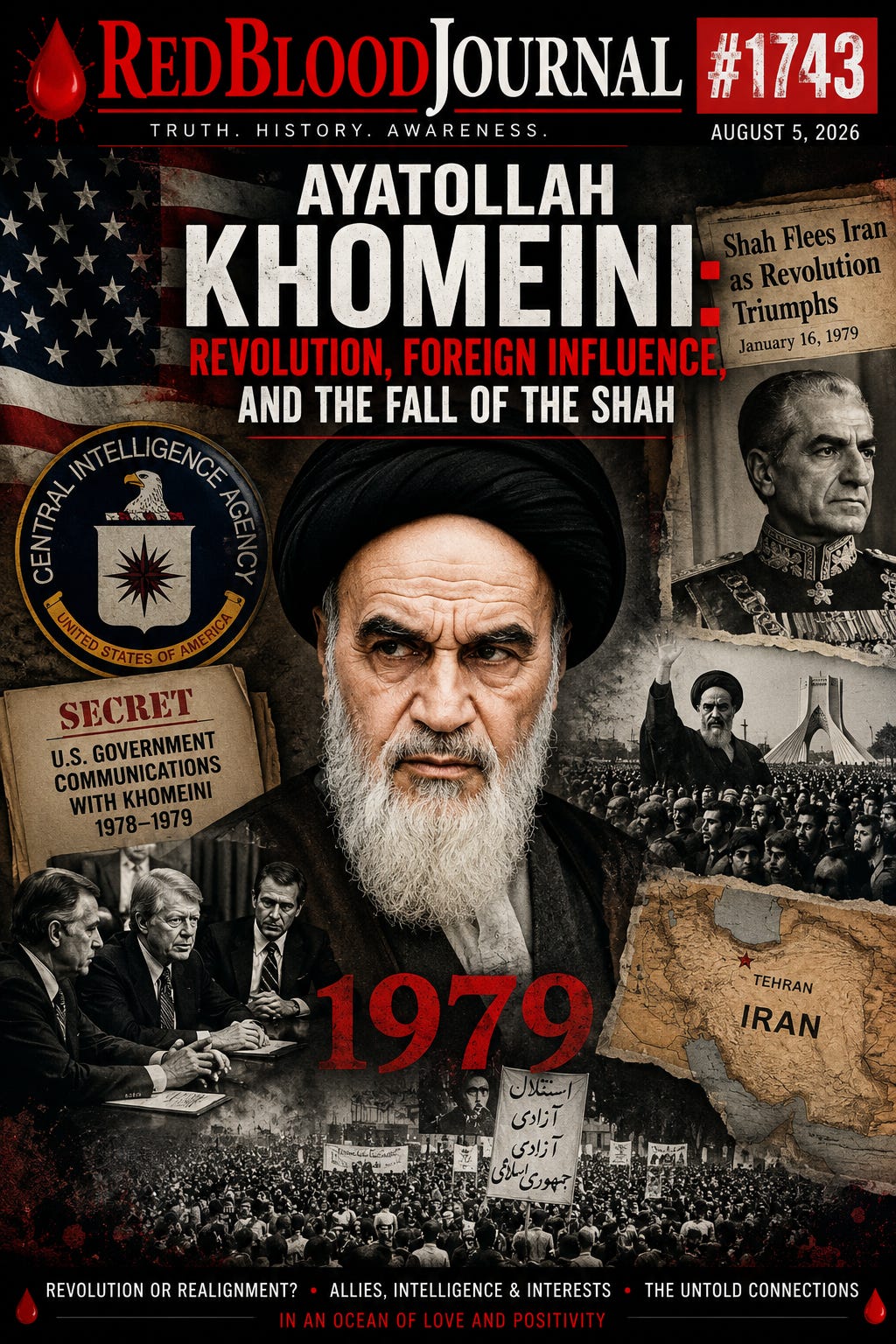
🩸 ☪️ #1743 — Ayatollah Khomeini: Revolution, Foreign Influence, and the Fall of the Shah
The Man Who Changed Iran Forever
August 5, 2026
🩸 RedBloodJournal.com 🩸
Introduction: Who Was Ruhollah Khomeini?
Few individuals have reshaped the modern Middle East as profoundly as Ayatollah Ruhollah Khomeini.
Born in 1902 in central Iran, Khomeini rose through the ranks of the Shiite clergy to become one of the country’s most influential religious scholars. During the 1960s, he became an outspoken critic of Shah Mohammad Reza Pahlavi, accusing the Shah of authoritarian rule, corruption, rapid Westernization, and growing dependence on the United States.
His opposition led to imprisonment and eventual exile. Over the next fourteen years, Khomeini lived first in Iraq and later in France, where modern communication allowed his speeches and sermons to reach millions of Iranians despite the distance.
When the Shah left Iran in January 1979, Khomeini returned from exile on February 1 to an enormous public استقبال (welcome), and within weeks the centuries-old monarchy collapsed. By the end of the year, Iran had become the world’s first modern Islamic Republic governed under the doctrine of Velayat-e Faqih (Guardianship of the Islamic Jurist), with Khomeini serving as its Supreme Leader.
Nearly half a century later, the events surrounding the 1979 revolution remain one of the most debated geopolitical transformations of the twentieth century.
Was the Revolution Entirely an Internal Movement?
The traditional narrative portrays the Iranian Revolution as a popular uprising driven entirely by domestic dissatisfaction.
The historical record supports many internal causes:
Political repression by SAVAK.
Economic inequality despite oil wealth.
Inflation and unemployment.
Rapid modernization that alienated religious and traditional communities.
Perceived erosion of Iranian cultural identity.
These factors unquestionably contributed to the Shah’s downfall.
Yet historians continue to debate another question:
Did foreign governments influence the outcome—not by creating the revolution, but by shaping how it unfolded?
America’s Long Shadow in Iran
Understanding 1979 requires looking back to 1953.
That year, Britain’s MI6 and the CIA participated in Operation Ajax, which helped overthrow Prime Minister Mohammad Mossadegh after he nationalized Iran’s oil industry.
The Shah was restored to power and became one of America’s closest allies in the Middle East.
For the next twenty-five years:
Iran purchased billions of dollars of American weapons.
U.S. intelligence cooperated closely with Iranian security services.
Iran served as a strategic barrier against Soviet influence.
Ironically, the same alliance that strengthened the Shah also tied his government closely to American policy, making anti-American sentiment part of the revolutionary movement.
Khomeini’s Time in France
One of the most discussed chapters involves Khomeini’s final months before returning to Iran.
After leaving Iraq in 1978, Khomeini settled in Neauphle-le-Château, France.
Rather than silencing him, France became an ideal platform.
International journalists had unrestricted access.
Television crews broadcast his interviews worldwide.
Cassette recordings of his speeches were copied and smuggled into Iran in enormous numbers.
His message spread faster than it likely could have from Iraq.
Whether intentional or simply a consequence of France’s democratic freedoms remains debated.
Secret Communications with Washington
Declassified U.S. government documents confirm that representatives connected with Khomeini exchanged messages with officials in the Carter administration during the final months of the Shah’s rule.
These communications reportedly focused on:
preventing widespread bloodshed,
discouraging an Iranian military coup,
reassuring Washington that Americans would not necessarily be targeted,
discussing the political transition after the Shah.
These contacts are historical fact.
What they mean is where interpretations differ.
One interpretation argues they were routine diplomatic back-channel communications during a rapidly evolving crisis.
Another argues they demonstrate that Washington had concluded the Shah could not survive and began preparing for a post-Shah Iran.
Neither interpretation, however, is equivalent to evidence that Khomeini was a CIA operative or under CIA control.
Did the United States Prefer an Islamic Government?
This question continues to divide historians.
Several possibilities are frequently discussed.
Theory One: No Preference
Washington attempted to save the Shah until the very end.
When that became impossible, officials simply tried to minimize chaos.
Theory Two: The Lesser Evil
Some analysts suggest American policymakers viewed Khomeini as preferable to a possible communist takeover supported by the Soviet Union.
During the Cold War, containing Soviet influence was often Washington’s highest strategic priority.
Theory Three: A Miscalculation
Another interpretation suggests U.S. officials believed Iran’s religious leadership would eventually moderate once in power.
If true, the hostage crisis beginning later in 1979 demonstrated how inaccurate that assumption proved to be.
Was Khomeini Connected to the CIA?
This question often appears in public discussions.
The evidence currently available supports several conclusions.
Supported by historical documentation:
secret communications occurred before the revolution,
U.S. officials monitored Khomeini extensively,
intelligence agencies analyzed his movement,
diplomatic contacts existed.
Not supported by publicly available declassified evidence:
that Khomeini worked as a CIA agent,
that he was recruited by the CIA,
that the CIA controlled his decisions after taking power.
Those stronger claims remain unproven by the documentary record available today.
The Revolution’s Lasting Consequences
Regardless of foreign involvement during the transition, the outcome transformed global politics.
Iran shifted from one of America’s closest regional allies to one of its most determined adversaries.
The U.S. Embassy hostage crisis lasted 444 days.
Regional alliances changed.
Middle Eastern geopolitics entered a new era whose effects continue today.
Ironically, any expectation that Iran would remain cooperative with Washington disappeared almost immediately after the revolution.
The Red Blood Perspective
Critical thinking often begins by recognizing that major historical events rarely have a single cause.
The Iranian Revolution emerged from genuine domestic grievances, yet it also unfolded within the broader context of Cold War competition, international diplomacy, and foreign intelligence activity.
Documented contacts between Khomeini’s representatives and American officials are part of the historical record. At the same time, the available evidence does not establish that Khomeini himself was a CIA asset or that the revolution was directed by U.S. intelligence. Between those two positions lies a wide field of historical inquiry that continues to be studied and debated.
Understanding history requires distinguishing documented facts, reasonable interpretations, and unsupported conclusions.
Ocean of Love and Positivity
History invites curiosity rather than certainty. Every generation uncovers new archives, new testimonies, and new perspectives that refine our understanding of the past. The pursuit of truth is strengthened when questions remain open to evidence instead of becoming fixed beliefs.
May the study of history encourage wisdom, humility, and a commitment to seeking understanding beyond slogans or assumptions.
In an Ocean of Love and Positivity.
🩸🌊✨ Fantastic!
🇮🇷
🇮🇷 Khomeini and the Geopolitics of the Iranian Revolution
Aug 5, 2026
This text examines the life of Ayatollah Khomeini and his role in the 1979 Iranian Revolution, which replaced the monarchy with an Islamic Republic. While the movement was largely fueled by domestic grievances and opposition to the Shah’s Westernization, the source explores the complex geopolitical factors and foreign influences involved. It highlights declassified evidence of secret communications between Khomeini’s circle and the United States government during the transition of power. These records spark ongoing debate regarding whether Washington viewed a religious government as a strategic alternative to Soviet communism. Ultimately, the author distinguishes between documented diplomatic contacts and unproven theories of intelligence control, emphasizing the revolution’s lasting impact on global politics.


