


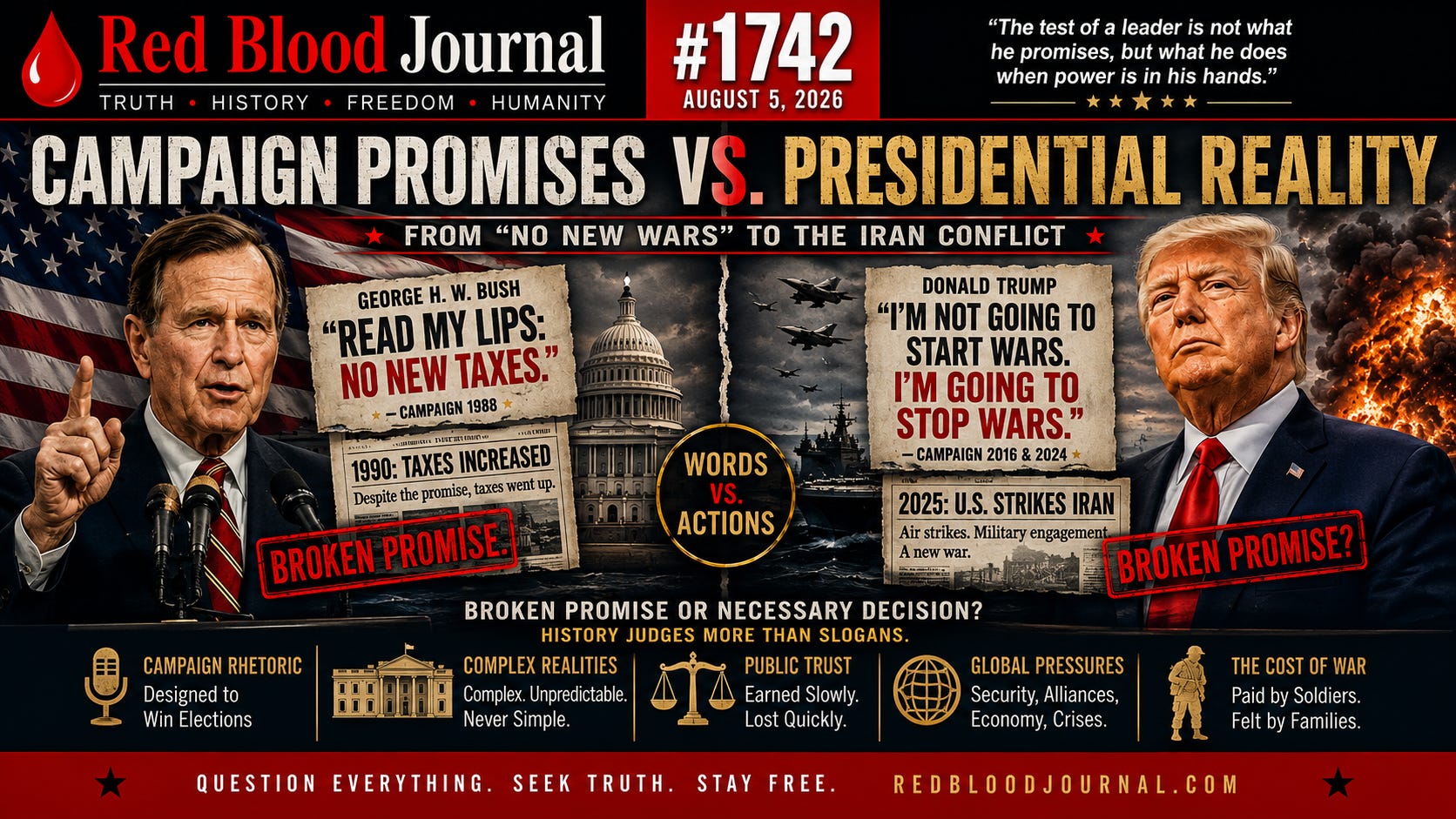
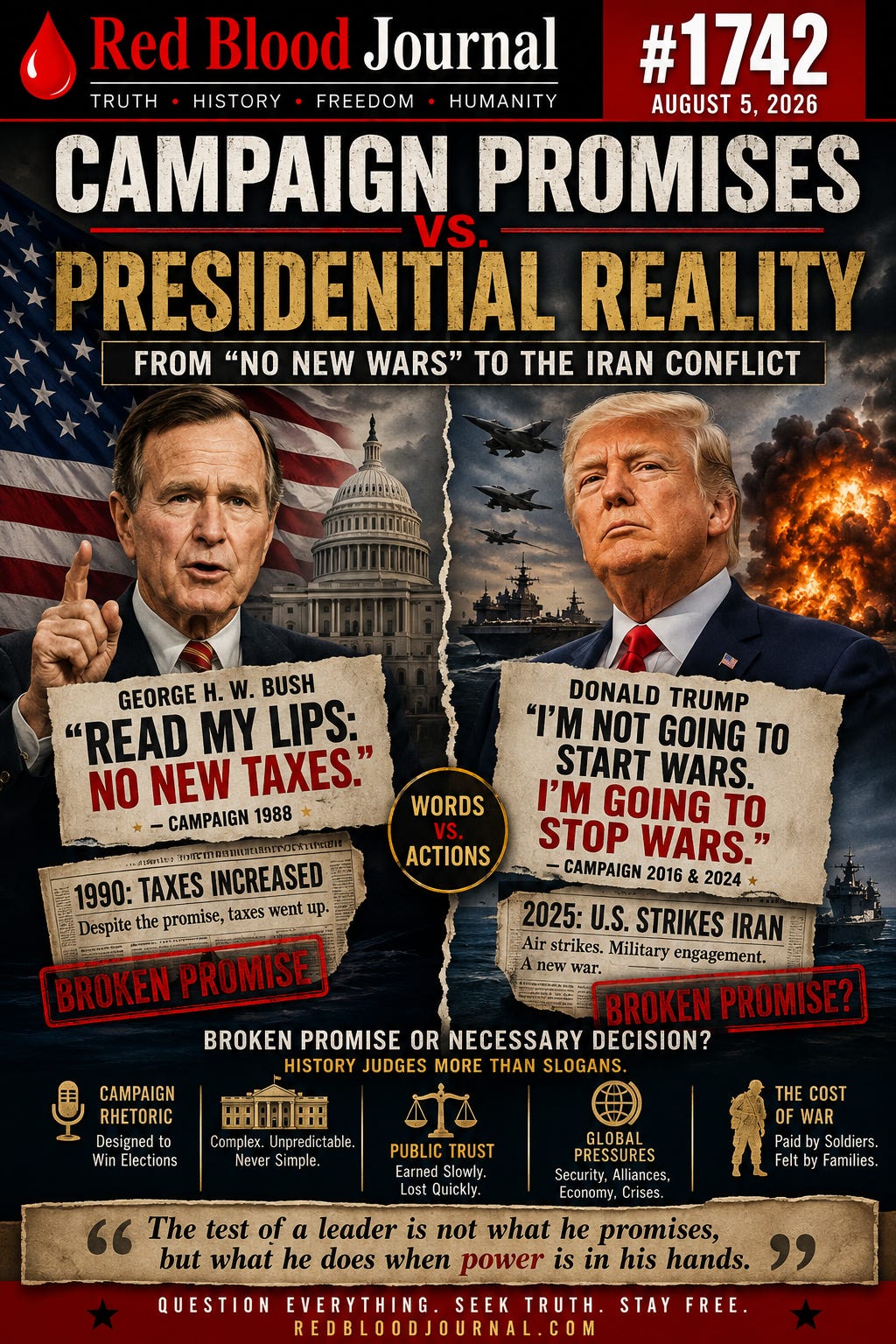
🩸 ⚖️ #1742 — Campaign Promises vs. Presidential Reality
From “No New Wars” to the Iran Conflict
August 5, 2026
🩸 RedBloodJournal.com 🩸
History often remembers presidents by a single sentence.
George H. W. Bush had:
“Read my lips: No new taxes.”
Donald Trump may ultimately be remembered by another:
“I’m not going to start wars. I’m going to stop wars.”
Both statements became defining campaign promises.
Both helped shape public expectations.
Both would later face the test of governing.
Whether history ultimately judges them equally remains an open question, but the comparison raises an important discussion about campaign promises and presidential reality.
The Bush Promise
During the 1988 presidential campaign, George H. W. Bush made one of the most famous political pledges in modern American history.
“Read my lips: No new taxes.”
The statement became the centerpiece of his economic campaign.
Two years later, facing growing budget deficits and pressure from Congress, Bush signed legislation that increased taxes.
Many political historians argue that this single decision permanently damaged his credibility with many conservative voters.
The promise became larger than the policy itself.
It became a symbol of broken trust.
Trump’s Promise
Donald Trump built much of his political identity around a different issue.
War.
Throughout multiple campaigns, Trump repeatedly criticized America’s involvement in Iraq, Afghanistan, Libya, Syria, and other prolonged military interventions.
He argued that previous presidents had wasted trillions of dollars while sacrificing American lives in conflicts that failed to deliver lasting stability.
His message was straightforward.
America should stop entering endless wars.
Following the 2024 election, Trump declared:
“I’m not going to start wars. I’m going to stop wars.”
During his inauguration, he further stated that his success would be measured by:
“The wars we end—and perhaps most importantly, the wars we never get into.”
Those words reinforced one of the central themes of his political movement.
The Test of Reality
Presidents do not govern under campaign conditions.
They govern under evolving intelligence, international crises, military assessments, economic pressures, and unexpected events.
Supporters argue that circumstances change.
Critics argue that principles should not.
The challenge facing every president is deciding whether changing circumstances justify changing promises.
The Iran Conflict
During Trump’s second term, tensions with Iran escalated dramatically.
Economic sanctions expanded.
Military deployments increased.
Air strikes followed.
American forces entered direct combat operations.
Supporters argued that the administration was preventing a greater conflict and protecting American interests.
Critics argued that the United States had entered exactly the type of new Middle Eastern war Trump promised to avoid.
The disagreement is not merely about military strategy.
It concerns political consistency.
A Historical Comparison
George H. W. Bush promised:
No new taxes.
Taxes increased.
Donald Trump promised:
No new wars.
The United States became engaged in a new military conflict with Iran.
The comparison does not suggest identical circumstances.
Taxes and war involve profoundly different moral, economic, and strategic questions.
However, both cases illustrate a similar historical pattern.
Campaign promises often encounter realities that candidates never fully control.
Broken Promise or Necessary Decision?
An important distinction exists between a broken promise and a deliberate lie.
A broken promise can be observed.
A deliberate lie requires evidence that the speaker knowingly intended to do the opposite when the promise was made.
History frequently struggles to answer that second question.
Only the individual making the promise knows their true intentions at the time.
For that reason, responsible historical analysis should distinguish between political disappointment and provable deception.
The Weight of Public Trust
Democratic systems function largely on trust.
Citizens vote based upon expectations.
When major campaign promises change after taking office, public confidence can weaken regardless of whether the decision was justified.
That phenomenon extends far beyond any single president.
It applies equally to leaders of every political party.
History repeatedly shows that trust is one of the most difficult assets for governments to rebuild once lost.
The Larger Lesson
Campaign slogans are designed for elections.
Presidential decisions are made under entirely different conditions.
Every administration eventually discovers that governing is far more complex than campaigning.
The question citizens should continue asking is not whether leaders ever change course.
The question is whether those changes are explained honestly, transparently, and consistently.
History tends to judge leaders not only by the outcomes of their decisions, but also by whether they remained faithful to the principles they presented to the public.
The Red Blood Perspective
Critical thinking requires evaluating leaders by measurable actions rather than campaign slogans alone.
Supporters naturally emphasize changing circumstances.
Critics naturally emphasize broken promises.
Both perspectives deserve examination.
The healthiest democracy encourages citizens to compare words with actions, promises with outcomes, and rhetoric with historical evidence before reaching conclusions.
Ocean of Love and Positivity
Every generation inherits both inspiring promises and difficult realities.
The search for truth should never become an excuse for division.
Instead, it should encourage greater wisdom, accountability, and understanding.
Nations become stronger when citizens ask thoughtful questions, remain open to evidence, and recognize that no political figure is beyond examination.
Truth grows strongest where curiosity remains alive.
In an Ocean of Love and Positivity.
🩸🌊✨ Fantastic!
⚖️
⚖️ The Paradox of the Presidential Promise
Aug 5, 2026
The provided text explores the disconnect between campaign slogans and presidential actions by comparing the administrations of George H. W. Bush and Donald Trump. Just as Bush’s famous pledge of “no new taxes” was eventually broken due to economic pressures, the source argues that Trump’s promise to avoid foreign conflicts was tested by military escalation with Iran. This comparison highlights a recurring historical pattern where the complexities of governing force leaders to deviate from their original platforms. The author distinguishes between deliberate deception and necessary policy shifts, noting that such changes often result in a significant loss of public trust. Ultimately, the article encourages citizens to look beyond political rhetoric and evaluate leaders based on the transparency and consistency of their decision-making. These examples serve as a broader lesson on the inherent difficulty of maintaining ideological purity when faced with unpredictable global realities.


