


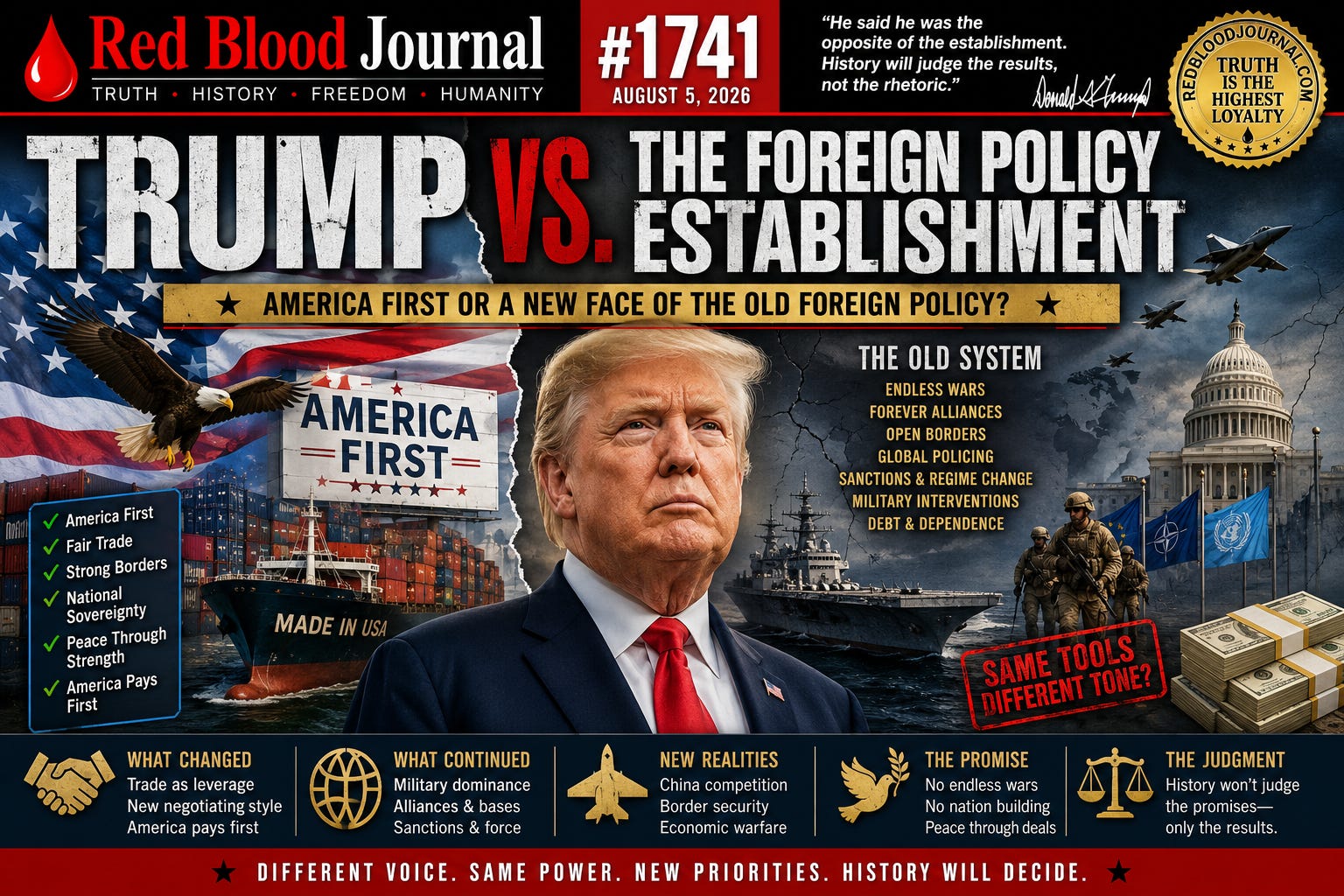
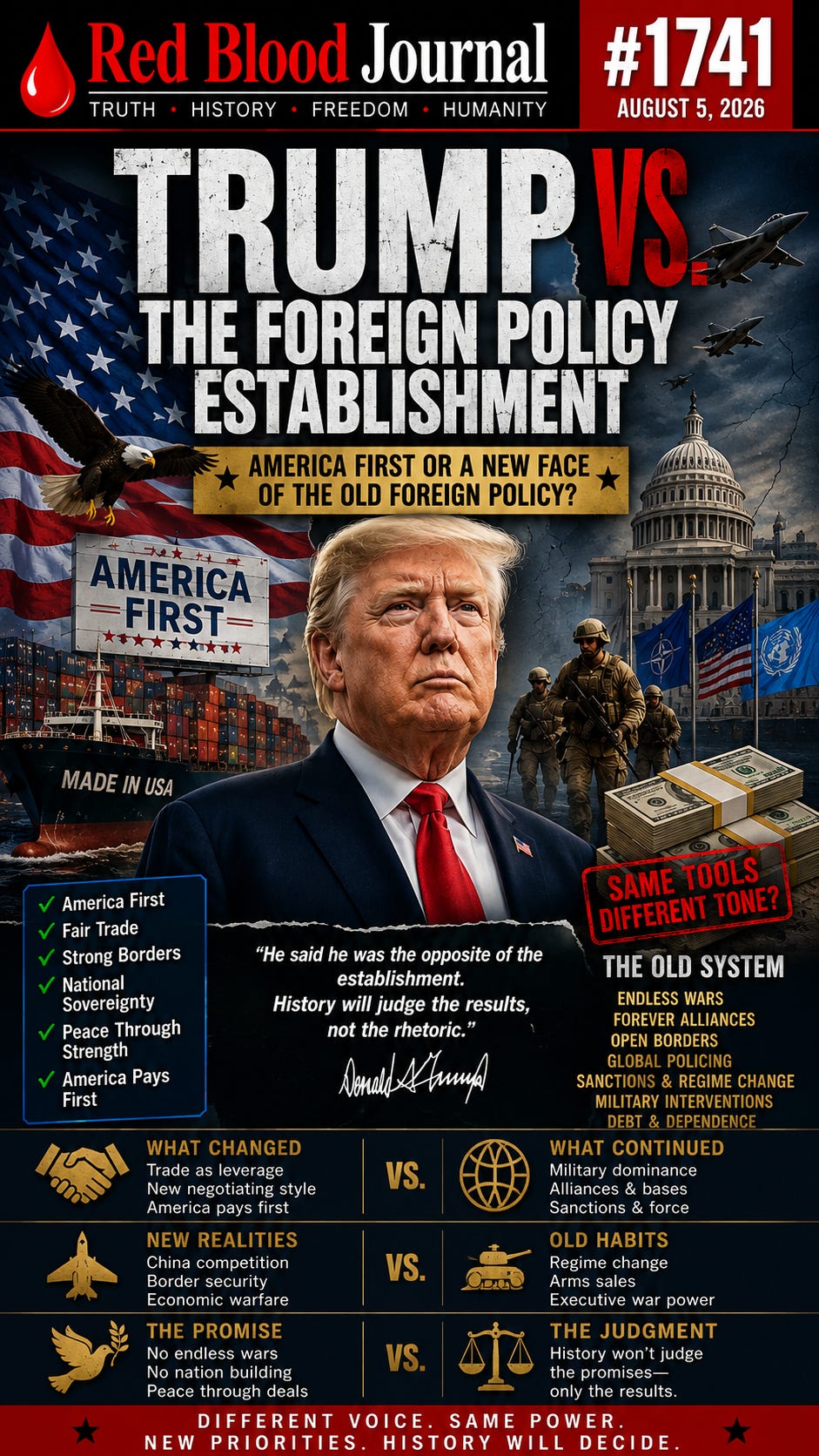
🩸 🇺🇸 #1741 — Trump vs. the Foreign Policy Establishment
America First or a New Face of the Old Foreign Policy?
August 5, 2026
🩸 RedBloodJournal.com 🩸
Donald Trump has repeatedly described himself as the opposite of the traditional American foreign-policy establishment. Throughout his political career, he has argued that previous presidents wasted American lives and wealth on endless wars, unfair alliances, and international agreements that benefited everyone except the American people.
The question is whether history will ultimately support that claim.
A close examination of both his first and second terms reveals a more complicated picture.
Trump unquestionably changed the language, priorities, and negotiating style of American foreign policy. Yet many of the strategic objectives and instruments of American power remained remarkably familiar.
The result is a presidency that is simultaneously one of the greatest departures from modern foreign policy—and, in several critical areas, one of its continuations.
The Traditional American Foreign Policy Model
For nearly eight decades following World War II, Republican and Democratic administrations generally shared several core assumptions.
America would maintain military superiority.
America would lead alliances.
America would protect global trade routes.
America would contain rival powers before they became dominant.
America would support strategic allies through military aid and arms sales.
America would use sanctions, intelligence operations, and military force when necessary to defend perceived national interests.
Although presidents often disagreed over tactics, the overall structure changed surprisingly little.
Trump entered office promising to challenge that entire system.
Trump’s First Term (2017–2021)
Where Trump Broke with Tradition
Trump immediately rejected several pillars of the post-Cold War consensus.
He withdrew from the Trans-Pacific Partnership.
He questioned NATO burden-sharing more aggressively than any previous president.
He challenged international trade agreements.
He withdrew from the Iran nuclear agreement.
He withdrew from the Paris Climate Accord.
He negotiated directly with North Korean leader Kim Jong Un.
He openly criticized nation-building and democracy promotion.
Rather than presenting America as the world’s permanent guardian, Trump promoted a far more transactional philosophy.
His message was simple.
Every relationship should benefit the United States first.
If allies wanted American protection, they should contribute more financially.
Trade deficits were treated not as inevitable consequences of globalization but as evidence that America had negotiated poorly.
For many supporters, this represented the first serious challenge to decades of bipartisan foreign-policy thinking.
Where Trump Continued the Old System
Despite the dramatic rhetoric, much of the underlying structure remained intact.
The United States maintained its worldwide military presence.
NATO survived.
American bases remained across Europe, Asia, and the Middle East.
Arms sales continued.
Sanctions expanded.
American naval dominance continued protecting global shipping lanes.
Most importantly, Trump demonstrated that he was willing to use military force.
Missile strikes were launched against Syria.
General Qassem Soleimani was killed in Iraq.
Counterterrorism operations continued.
Although Trump criticized endless wars, he did not dismantle America’s global military architecture.
He managed it differently.
He did not eliminate it.
Trump’s Second Term (2025–Present)
The second term has made the contrast even clearer.
Trump has continued demanding that allies carry a larger financial burden.
Economic leverage has become one of his primary diplomatic tools.
Tariffs have become foreign-policy instruments.
Negotiations are increasingly measured through economics rather than ideology.
Immigration and border security now occupy a far larger place within American national-security planning than under previous administrations.
In many ways, this represents one of the largest shifts in American strategic thinking in decades.
The Return of Traditional Military Power
Yet while diplomacy changed, military strategy revealed far greater continuity.
The renewed confrontation with Iran has followed a familiar historical pattern.
Economic sanctions.
Maximum pressure.
Military deployments.
Air strikes.
Protection of strategic shipping routes.
Support for regional allies.
Congressional debate over presidential war powers.
Whether one supports or opposes these actions is a separate question.
Historically, the pattern closely resembles previous American administrations.
Trump may speak differently.
He may negotiate differently.
But the machinery of American power remains largely the same.
What Actually Changed?
Trump changed the philosophy of management.
He challenged diplomatic etiquette.
He transformed trade into a national-security weapon.
He publicly pressured allies in ways previous presidents rarely attempted.
He emphasized national sovereignty over international institutions.
He questioned whether America should continue paying disproportionate costs for global leadership.
These changes are genuine.
What Did Not Change?
American military superiority remains central.
Strategic alliances remain.
Support for Israel remains.
Containment of China continues.
Military sales remain major diplomatic tools.
Sanctions remain central to foreign policy.
Protection of global energy routes remains an American priority.
The President still exercises enormous military authority without formal declarations of war.
These are not revolutionary departures.
They represent remarkable continuity.
The Great Paradox
Trump may ultimately become remembered as the president who most openly criticized the foreign-policy establishment...
...while simultaneously preserving many of its most important institutions.
He changed the language.
He changed the priorities.
He changed who should pay.
He changed the negotiating style.
But the fundamental instruments of American global power remained.
History may therefore describe Trump’s foreign policy not as a complete revolution...
...but as a nationalist renovation of an existing system.
The Red Blood Perspective
Political campaigns often promise dramatic change.
Governments frequently discover that history, geography, economics, and military realities limit how much any president can truly alter the direction of a superpower.
Critical thinkers should therefore separate political rhetoric from measurable actions.
Neither admiration nor criticism should replace careful observation.
The question is not whether a leader claims to be different.
The question is whether history ultimately records that difference.
Ocean of Love and Positivity
Every generation believes it is witnessing unprecedented change.
Yet history reminds us that patterns often repeat beneath new faces, new slogans, and new technologies.
Understanding those patterns allows societies to become wiser rather than more divided.
Knowledge encourages humility.
Curiosity encourages peace.
The search for truth is not about proving ourselves right.
It is about becoming more capable of understanding the world together.
In an Ocean of Love and Positivity.
🩸🌊✨ Fantastic!
🇺🇸
🇺🇸 The Nationalist Renovation of American Global Power
Aug 4, 2026
This analysis explores the complex relationship between Donald Trump’s “America First” agenda and the established norms of U.S. foreign policy. While the text acknowledges that Trump revolutionized diplomatic rhetoric, trade strategy, and ally expectations, it argues that the fundamental mechanisms of American global power remain largely unchanged. The source highlights a persistent paradox where nationalist reforms coexist with traditional military commitments, such as overseas bases and strategic sanctions. Ultimately, the narrative suggests that while the style and philosophy of management have shifted toward a transactional model, the underlying architecture of the superpower has been preserved rather than dismantled. This overview encourages readers to distinguish between political theater and the enduring realities of international influence.


