


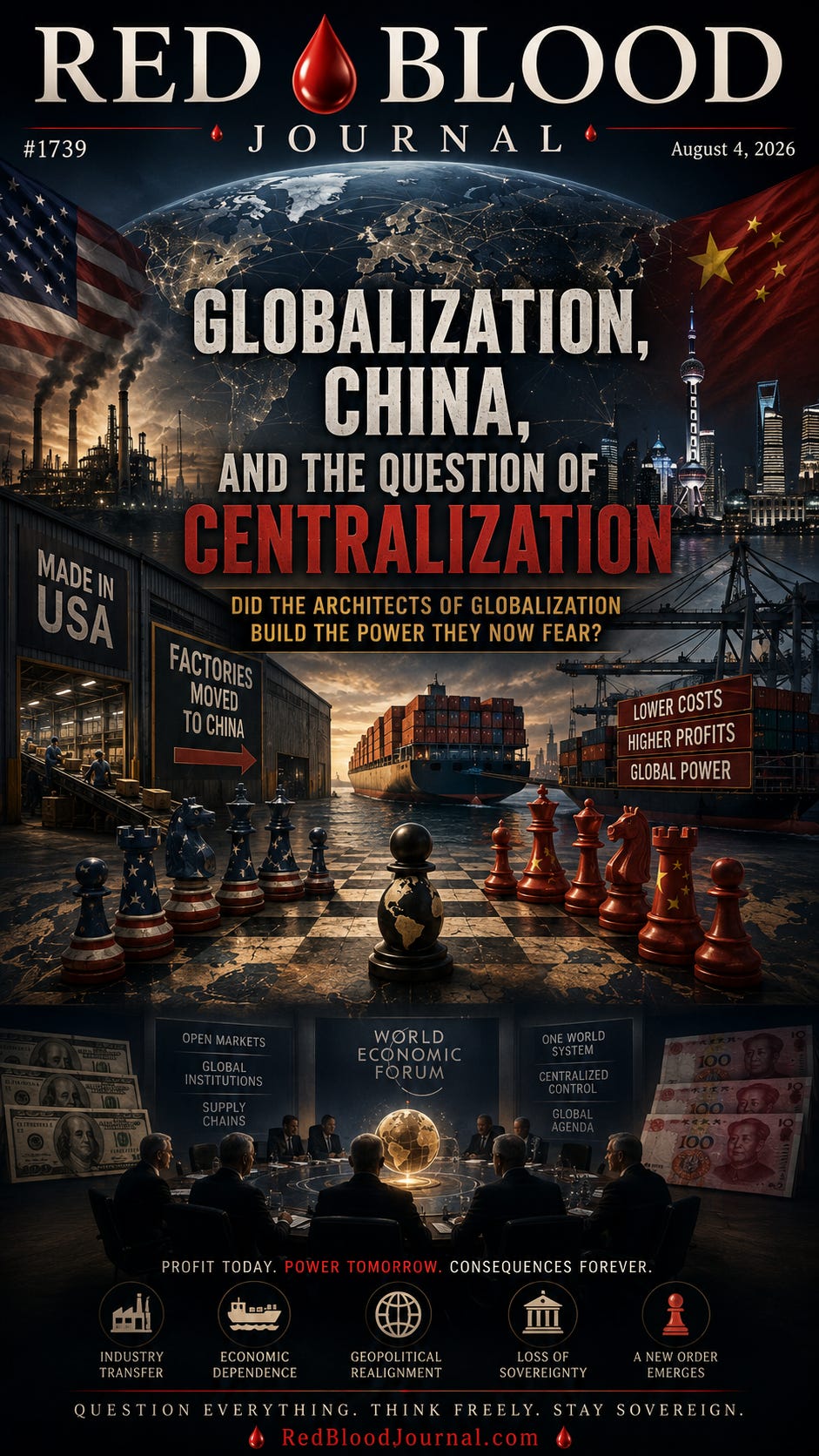
🩸 🌐 #1739 — Globalization, China, and the Question of Centralization
Did the Architects of Globalization Build the Power They Now Fear?
August 4, 2026
🩸 RedBloodJournal.com 🩸
For decades, Americans were told that globalization would create a more prosperous and peaceful world.
Factories could move wherever production was cheapest.
Corporations could build international supply chains.
Consumers would receive lower-priced goods.
Developing countries would become wealthier.
Economic integration, it was argued, would gradually encourage political openness and reduce conflict.
China became the greatest experiment in that theory.
But today, a difficult question remains:
Was China merely the accidental winner of globalization—or was its centralized political and economic system especially useful to those seeking a more centralized world order?
That question deserves investigation without pretending that speculation is proof.
The Movement of American Industry
The relocation of manufacturing to China did not happen overnight.
Western corporations were attracted by:
lower labor costs,
large-scale industrial capacity,
expanding ports and transportation infrastructure,
favorable manufacturing policies,
access to a vast workforce,
and the opportunity to increase corporate profit margins.
The international system encouraged that movement.
China entered the World Trade Organization on December 11, 2001, after years of negotiations and commitments to alter parts of its trade system. Its admission accelerated its integration into global commerce.
The rise of global value chains was not a minor economic adjustment.
The World Bank reports that such production networks powered the surge in international trade after 1990 and eventually accounted for nearly half of global trade. Those networks helped developing countries grow, but they also transferred industrial capacity, technical knowledge, supply-chain influence, and employment from one country to another.
China was not simply selling inexpensive toys and clothing.
It was building the industrial foundation of a future superpower.
Profit Was the Immediate Incentive
The clearest documented explanation for offshoring is not ideology.
It is profit.
Corporations could reduce labor and production costs while continuing to sell products in wealthy Western markets.
Executives benefited.
Shareholders benefited.
Consumers sometimes benefited through lower prices.
China benefited through investment, jobs, infrastructure, exports, industrial expertise, and access to foreign markets.
But many Western manufacturing communities paid a different price.
Factories closed.
Skilled jobs disappeared.
Local tax bases declined.
Entire regions became more dependent on imported products that they had once manufactured themselves.
What appeared profitable on the corporate balance sheet could be strategically damaging to the nation.
The Original Promise
Many Western policymakers believed economic engagement would change China.
The expectation was that trade, investment, and exposure to global markets would gradually encourage:
market liberalization,
greater transparency,
stronger rule of law,
political moderation,
and perhaps eventual democratic reform.
Early official assessments noted significant Chinese economic reforms following WTO accession, but later U.S. trade reports also raised concerns about stalled liberalization, transparency problems, state intervention, and incomplete compliance.
Instead of China becoming fully Westernized, another outcome emerged.
China used access to the global market while retaining a highly centralized political system.
It participated in globalization without surrendering centralized authority.
Why Centralization Matters
China offers international capital several features that decentralized democracies often cannot provide as easily:
long-term national planning,
rapid infrastructure construction,
coordinated industrial policy,
limited resistance from independent labor organizations,
fewer electoral disruptions,
and the ability to direct national resources toward strategic sectors.
From the perspective of a multinational corporation, such a system may appear efficient.
A single government can approve industrial zones, ports, rail systems, energy projects, and manufacturing expansion without years of public debate.
But efficiency is not the same as freedom.
Centralized systems can move quickly partly because ordinary citizens possess fewer opportunities to stop, question, or reverse government decisions.
This leads to the deeper concern behind the globalization hypothesis.
Perhaps certain political and corporate elites did not consciously seek Chinese domination.
But they may have preferred systems capable of implementing large economic programs with less public resistance.
Was China Chosen Because It Was Centralized?
There is no publicly proven document establishing that one unified group deliberately selected China to become the dominant global power.
That claim would require evidence beyond patterns and outcomes.
However, several facts remain open to examination:
Western capital helped build China’s industrial base.
Western consumers financed its export economy.
Western policymakers supported its integration into global institutions.
Western corporations transferred production capacity and technical expertise.
Chinese leaders preserved centralized political control while gaining the benefits of international commerce.
The result was a remarkable imbalance.
The democratic West exported factories.
The centralized Chinese state accumulated them.
Globalism and Centralized Governance
The word globalism is often used too broadly.
Some use it to describe ordinary international trade.
Others use it to describe the belief that national sovereignty should gradually give way to international institutions, shared rules, transnational corporations, and coordinated global governance.
Those are not identical ideas.
Trade between nations does not automatically require centralized global authority.
But highly interconnected supply chains create pressure for:
standardized regulations,
coordinated monetary policies,
international enforcement systems,
cross-border digital identification,
common financial rules,
and supranational decision-making.
The more dependent nations become on a single integrated system, the more difficult it becomes for any individual country to operate independently.
Centralization can therefore arise without a secret meeting or a single master plan.
It can emerge gradually from institutions, incentives, corporate decisions, treaties, emergencies, and increasing economic dependence.
Where Iran Fits
Iran presents a different situation from China.
The Islamic Republic has spent decades under sanctions, diplomatic isolation, and confrontation with the United States.
There is no clear public evidence proving that Western policymakers preferred the Islamic Republic because of its centralized form of government.
Yet the outcome must still be examined.
Sanctions and isolation helped push Iran toward:
China,
Russia,
BRICS,
the Shanghai Cooperation Organisation,
and alternative financial and trade networks.
This may not have been the intended outcome.
But policies should be judged by their consequences, not merely their declared intentions.
If Western policy was intended to isolate and weaken Iran, but instead contributed to a stronger China–Russia–Iran alignment, then the policy may have helped build the very geopolitical bloc it claimed to oppose.
Centralization Does Not Mean Friendship
Iran, China, and Russia are not identical.
They possess different histories, religions, economic interests, and national ambitions.
Their cooperation does not necessarily mean they share one political vision.
Nor does participation in global institutions mean that Western elites and Eastern governments secretly belong to one unified structure.
Power centers can cooperate in one area while competing fiercely in another.
Corporations can profit from China while Western governments regard China as a strategic threat.
Financial institutions can favor global integration without favoring Chinese military power.
Contradiction is common in history.
Sometimes short-term profit builds a long-term rival.
The Possibility of an Unplanned Agenda
The most plausible explanation may not be a perfectly coordinated conspiracy.
It may be something more ordinary—and perhaps more troubling.
Corporate leaders pursued profit.
Politicians pursued economic growth.
Consumers pursued lower prices.
International institutions pursued deeper integration.
Chinese leaders pursued national power.
Each group followed its own interests.
Together, those separate decisions produced a historic transfer of industrial power.
No single architect may have designed the complete building.
Yet the building still stands.
The Question America Must Ask
The question is no longer whether inexpensive imported goods benefited consumers.
The larger question is:
What did the United States surrender in exchange?
A nation may save money on manufactured products while losing:
industrial independence,
skilled employment,
domestic supply chains,
strategic technology,
national resilience,
and control over essential goods.
A lower price at the store can conceal a much larger national cost.
The disappearance of factories is not merely an economic event.
It is a transfer of power.
The Question Iran Must Ask
Iran must also decide whether moving closer to China and Russia produces genuine sovereignty or merely exchanges one form of dependence for another.
A country that rejects Western domination but becomes economically dependent on Eastern powers has not necessarily achieved independence.
Iran’s best future may not be permanent submission to either camp.
Its strongest position may be as a sovereign bridge:
trading with East and West,
protecting its national resources,
diversifying its partnerships,
rebuilding its domestic productive capacity,
and refusing to become a battlefield or instrument of foreign powers.
🩸 The Red Blood Perspective
Globalization was presented as an economic arrangement.
But factories are power.
Ports are power.
Technology is power.
Supply chains are power.
The nation that manufactures the world’s necessities gains influence over every country that depends upon them.
Whether China’s rise was deliberately designed, carelessly enabled, or simply pursued for immediate profit, the result is undeniable:
The West helped construct the industrial strength of its greatest strategic competitor.
The most important lesson is not that every event was controlled by one hidden hand.
It is that concentrated wealth, short-term profit, and centralized decision-making can produce the same outcome even without a single visible commander.
When ordinary citizens lose influence over economic policy, decisions affecting generations can be made inside boardrooms, ministries, financial institutions, and trade negotiations far removed from public accountability.
🌊 Ocean of Love and Positivity
Trade can connect humanity without erasing nations.
Cooperation can bring prosperity without demanding submission.
Economic growth can serve people instead of reducing them to labor costs, consumer statistics, or pieces on a geopolitical board.
A healthier world does not require one centralized authority controlling every nation.
It requires sovereign peoples cooperating freely, protecting their communities, respecting one another, and ensuring that prosperity is shared rather than concentrated.
The future does not have to belong to global corporations, centralized governments, or competing empires.
It can belong to informed people who understand that freedom, production, dignity, and national independence must grow together.
In an Ocean of Love and Positivity.
🩸🌊✨ Fantastic!
🌐
🌐 Globalization and the Strategic Architecture of Centralized Power
Aug 4, 2026
The provided text examines the geopolitical consequences of globalization, specifically focusing on how Western pursuit of profit and industrial integration fueled the rise of China as a centralized superpower. It explores the tension between the original promise of economic liberalization and the reality of deindustrialization in the West, which traded national self-sufficiency for cheaper goods. The source suggests that while this shift may not have been a singular conspiracy, the alignment of corporate and political interests prioritized short-term gains over strategic independence. Ultimately, the article advocates for a return to national sovereignty and domestic production to counter the risks of global economic dependence. It concludes that true prosperity requires a balance between international trade and the preservation of community dignity without surrendering to centralized authority.


