


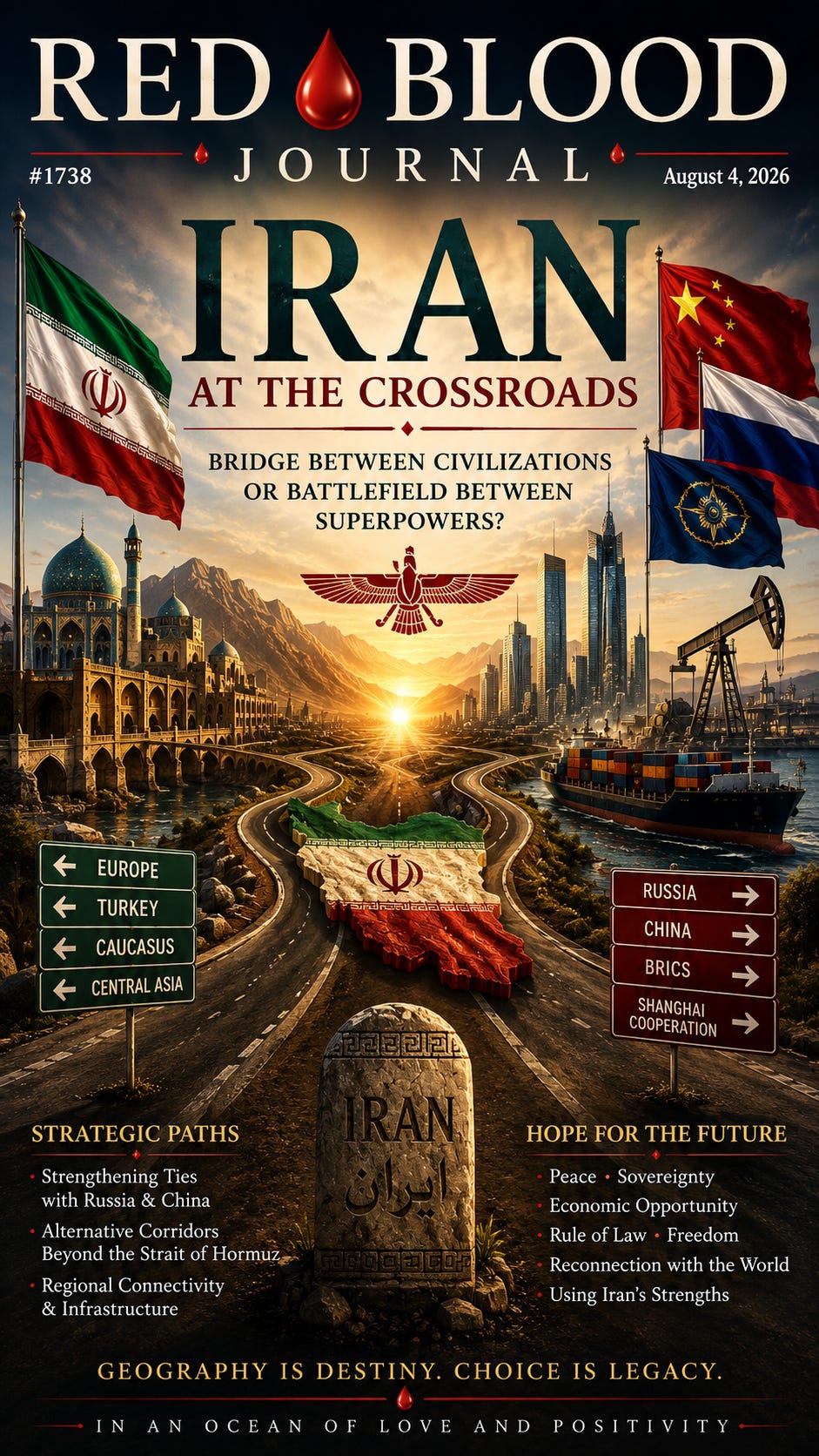
🩸 #1738 — Iran at the Crossroads
Bridge Between Civilizations or Battlefield Between Superpowers?
August 4, 2026
🩸 RedBloodJournal.com 🩸
Throughout history, Iran has occupied one of the world’s most strategic geographic positions.
It connects Central Asia, the Caucasus, the Persian Gulf, South Asia, the Middle East, and historically the Silk Road.
Today, another historic question appears to be emerging.
Where does Iran fit in the next global order?
No one can answer that question with certainty.
However, current geopolitical developments suggest several strategic possibilities that deserve careful consideration.
Two Strategies May Be Unfolding Simultaneously
Many geopolitical discussions tend to frame the future as a choice between East and West.
Reality may prove far more complex.
Strategy One
Iran continues strengthening its relationship with Russia and China.
Several developments support this possibility.
Iran has expanded its participation in organizations such as BRICS and the Shanghai Cooperation Organisation.
China has become one of Iran’s largest energy customers while investing in long-term economic cooperation.
Russia and China have frequently coordinated diplomatic positions regarding Iran in international forums.
If sanctions remain in place, Iran has strong incentives to continue expanding its eastern partnerships.
Strategy Two
At the same time, another trend appears across the region.
Countries have renewed discussions about alternative transportation and energy corridors that reduce dependence on the Strait of Hormuz and the Persian Gulf.
Examples include:
Iraq–Syria transport corridors.
Mediterranean energy routes.
Red Sea shipping alternatives.
Pipeline projects bypassing the Strait of Hormuz.
Broader regional infrastructure initiatives connecting Turkey, Jordan, Iraq and the Eastern Mediterranean.
If successful, these projects could reduce the strategic leverage associated with one of the world’s most important maritime chokepoints.
This does not automatically mean such efforts are directed against Iran.
Governments may pursue these projects for several reasons:
increasing energy security,
diversifying trade routes,
reducing vulnerability to regional conflicts,
or limiting dependence on any single corridor.
Different analysts emphasize different motivations.
Where Tom Barrack Fits
Recent public remarks by U.S. envoy Tom Barrack have emphasized regional diplomacy, connectivity and infrastructure rather than traditional regime-change rhetoric.
Some analysts interpret this as support for creating broader economic networks linking:
Turkey
Iraq
Syria
Jordan
the Eastern Mediterranean
If these networks expand, they could reshape regional trade regardless of political changes inside Iran.
Could Both Paths Be Happening?
Yes.
These strategies are not mutually exclusive.
Iran may continue moving economically toward Russia and China.
At the same time, the United States and several regional partners may pursue alternative trade and energy corridors that lessen global dependence on the Persian Gulf.
Each side is pursuing what it considers its own strategic interests.
The Bigger Question
Perhaps the more important question is not:
“Which side will Iran join?”
Instead, it may be:
“How can Iran position itself to benefit regardless of which global power rises?”
History shows that countries positioned between civilizations often become either:
battlefields for competing powers,
or
bridges connecting them.
The choice is rarely determined by geography alone.
It is shaped by long-term political, economic and diplomatic decisions.
What Should the People of Iran Hope For?
Regardless of political preference, many long-term aspirations remain broadly shared.
The people of Iran may reasonably hope for:
Peace rather than another generation of war.
National sovereignty with decisions made by Iranians.
Economic opportunity and productive investment.
Rule of law and accountable institutions.
Freedom to think, create and innovate peacefully.
Modern infrastructure.
Scientific, educational and commercial engagement with the wider world.
The opportunity for talented young people to build their future inside Iran rather than feeling compelled to leave.
What Should They Be Careful Not to Hope For?
History also suggests several risks.
Many countries have discovered that becoming overly dependent on any single great power can reduce strategic flexibility.
Whether aligned primarily with the United States, Russia, China, or another nation, excessive dependence may leave national priorities vulnerable to outside interests.
Likewise, prolonged isolation, corruption, and repeated conflict can consume resources that might otherwise support development and prosperity.
A Different Possibility
Iran’s geography cannot be changed.
It sits between East and West.
Rather than becoming permanently tied to one geopolitical bloc, another long-term possibility would be to serve as a commercial and diplomatic bridge connecting multiple regions.
Historically, crossroads civilizations have often prospered when they maintained diverse economic relationships instead of relying exclusively on one partner.
Whether that path becomes reality will depend on decisions made both inside Iran and throughout the surrounding region.
🩸 The Red Blood Perspective
History reminds us that governments change, alliances shift, and global powers rise and fall.
Geography, however, endures.
Iran’s greatest strategic asset may not be choosing one side over another, but understanding the enduring value of its location, its people, its civilization, and its ability to connect rather than divide.
The ultimate measure of any geopolitical strategy is not which power gains influence, but whether ordinary citizens inherit greater peace, prosperity, and opportunity.
🌊 Ocean of Love and Positivity
Every nation possesses the opportunity to transform its geography into a bridge rather than a battlefield.
When trade replaces conflict, when knowledge replaces fear, and when cooperation replaces permanent confrontation, future generations inherit possibilities instead of burdens.
May wisdom guide decisions that allow people—not politics alone—to flourish.
In an Ocean of Love and Positivity.
🩸🌊✨ Fantastic!
🇮🇷
🇮🇷 Persia at the Crossroads: Bridge or Battlefield
Aug 4, 2026
This source analyzes the geopolitical future of Iran, questioning whether the nation will serve as a global bridge or a battlefield for competing superpowers. The text identifies two simultaneous strategies: Iran’s growing economic alignment with Russia and China and the development of regional trade corridors designed to bypass Iranian maritime chokepoints. Rather than viewing these as simple choices between East and West, the author suggests that diverse diplomatic infrastructure and regional connectivity could reshape the Middle East. The narrative emphasizes that national sovereignty and economic prosperity for Iranian citizens depend on avoiding excessive reliance on any single foreign power. Ultimately, the article argues that Iran’s strategic geographic position remains its greatest asset if utilized to foster cooperation rather than conflict. The conclusion advocates for long-term stability through wisdom and the pursuit of peaceful, multi-lateral engagement.


