


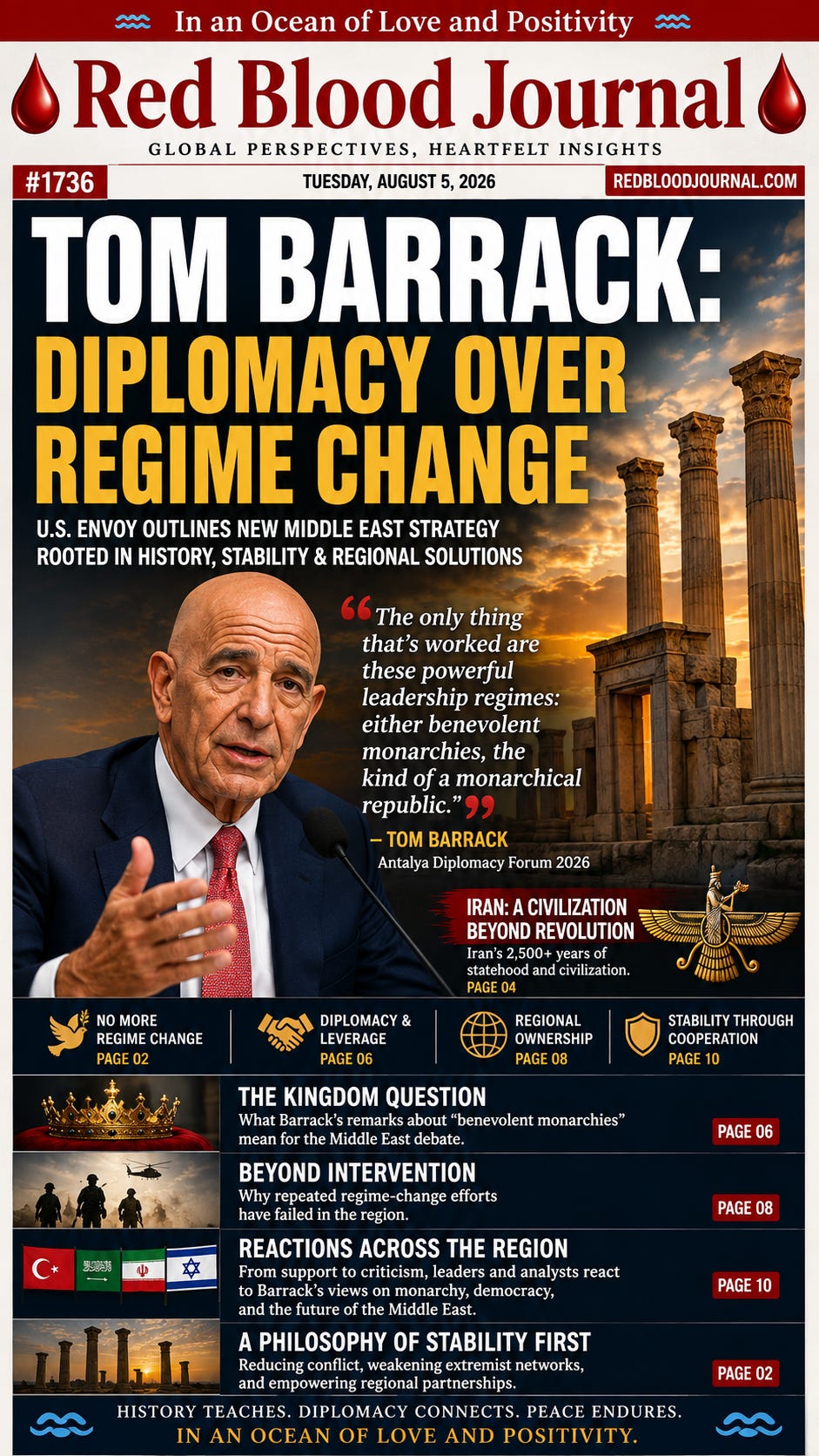
🩸 #1736 — Tom Barrack’s Middle East Doctrine
From Regime Change to Regional Diplomacy
August 4, 2026
🩸 RedBloodJournal.com 🩸
For decades, United States policy in the Middle East has often been associated with sanctions, military interventions, and, in some cases, support for changes in government. Whether those policies achieved their intended objectives remains the subject of ongoing historical and political debate.
In 2026, U.S. Ambassador and Special Presidential Envoy Tom Barrack presented a noticeably different public message.
Rather than emphasizing the replacement of governments, Barrack has repeatedly spoken about diplomacy, regional cooperation, and encouraging Middle Eastern nations to develop their own political and security arrangements.
His comments suggest a strategic shift from attempting to reshape governments directly toward reshaping the regional environment through diplomacy.
Barrack has argued that repeated attempts to impose political change from outside have often produced instability rather than lasting peace. Instead, he has emphasized dialogue among neighboring countries, economic cooperation, and long-term regional security.
This philosophy is particularly significant because Barrack’s diplomatic responsibilities include Turkey, Syria, Iraq, and broader regional affairs—areas where Iranian influence has been a major strategic consideration for many years.
Instead of approaching Iran solely as an isolated challenge, Barrack’s public statements indicate a broader effort to reduce tensions by encouraging stability across the surrounding region.
His approach does not necessarily eliminate disagreements with Tehran.
Rather, it suggests that changing the strategic environment may prove more effective than relying exclusively on confrontation.
This represents a notable contrast with earlier eras in which military pressure and regime change were often discussed as primary policy tools.
Whether this diplomatic approach ultimately succeeds remains uncertain.
Supporters argue that regional stability is more likely when neighboring countries assume greater responsibility for their own security and political future.
Critics contend that diplomacy without sufficient leverage may fail to alter the behavior of governments or armed groups with entrenched interests.
History will ultimately judge which approach proves more effective.
For now, Barrack’s statements illustrate an evolving conversation about how the United States engages one of the world’s most strategically important regions.
🩸 The Red Blood Perspective
Foreign policy is often remembered not for its intentions but for its consequences.
Every generation inherits the results of decisions made by those before it.
Whether peace is pursued through military power, diplomacy, economic partnerships, or a combination of all three, history eventually measures success by one question:
Did ordinary people experience greater security, stability, and opportunity?
🌊 Ocean of Love and Positivity
Diplomacy begins with listening before speaking.
History shows that lasting peace rarely emerges from force alone. It grows when people and nations find ways to communicate, understand one another, and pursue solutions that reduce suffering rather than prolong it.
Every conversation that replaces conflict with dialogue becomes another opportunity to build a more peaceful future.
In an Ocean of Love and Positivity.
🩸🌊✨ Fantastic!
🕊️
🕊️ The Barrack Doctrine:
A Strategic Shift in Middle East Diplomacy
Aug 4, 2026
This text details a significant pivot in American foreign policy directed by Ambassador Tom Barrack in 2026. Rather than continuing a legacy of military intervention and forced regime change, this new doctrine prioritizes regional diplomacy and economic collaboration. Barrack suggests that long-term stability in the Middle East is best achieved when neighboring nations, including those in conflict zones like Syria and Iraq, manage their own security arrangements. While this strategy aims to reduce regional tensions and move away from direct confrontation with Iran, its ultimate success remains a subject of intense debate. The source emphasizes that genuine peace is fostered through dialogue and understanding rather than the application of external force. This evolution in strategy reflects a broader attempt to provide security and opportunity for the people living within the region.


