


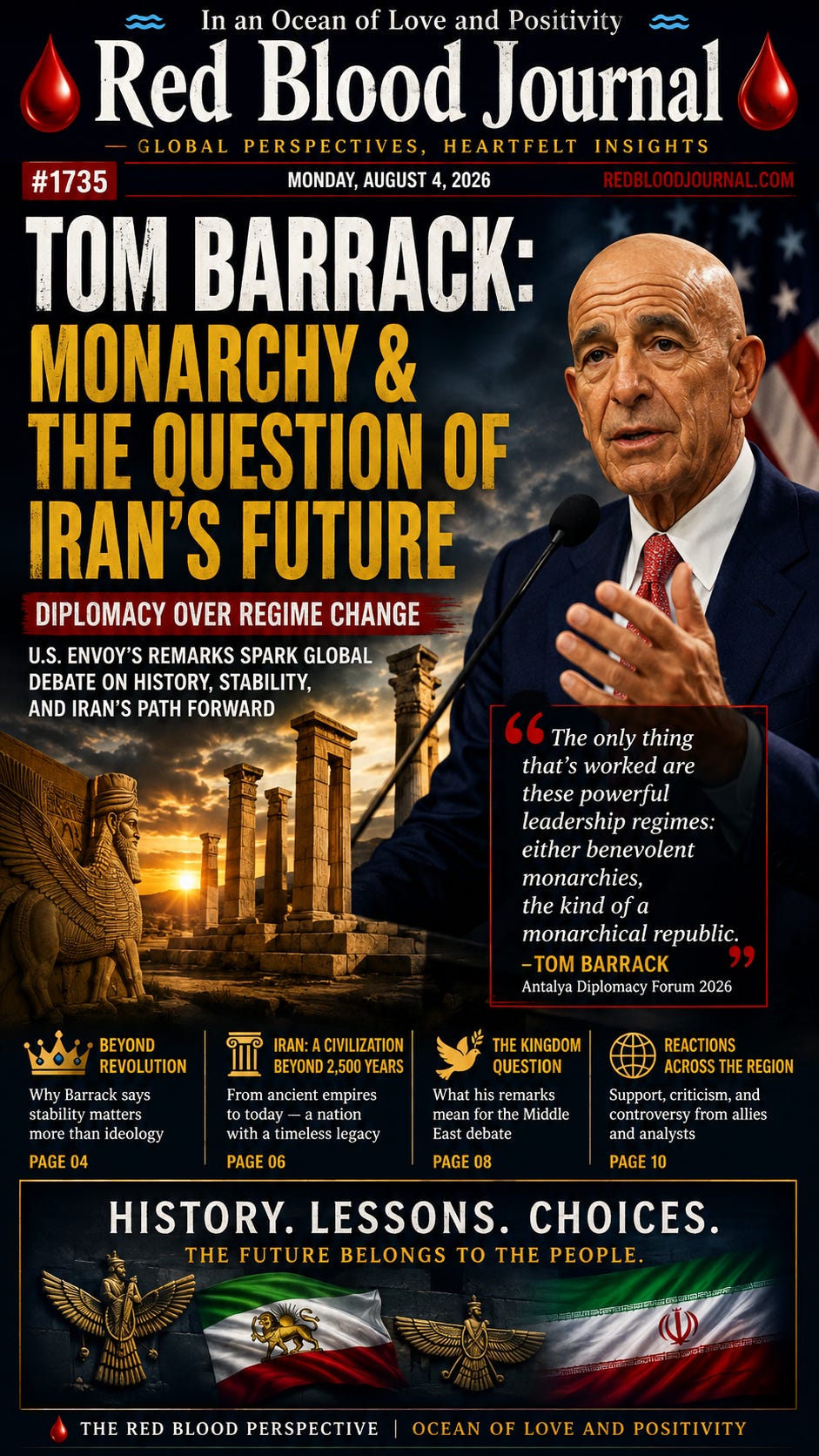
#1735 — Tom Barrack, Monarchy, and the Question of Iran’s Future
August 4, 2026
🩸 RedBloodJournal.com 🩸
During the 2026 Antalya Diplomacy Forum, U.S. Ambassador and Special Presidential Envoy Tom Barrack made remarks that quickly attracted international attention.
He stated:
“The only thing that’s worked are these powerful leadership regimes: either benevolent monarchies, the kind of a monarchical republic.”
He contrasted those systems with many of the democratic experiments that followed the Arab Spring, arguing that numerous attempts to reshape governments through outside pressure had failed.
Although Barrack did not specifically call for restoring Iran’s monarchy, his comments immediately sparked discussion because Iran spent over 2,500 years under various monarchies before the 1979 Islamic Revolution abolished the institution.
This raises an important geopolitical question.
Was Barrack merely describing what he believes has historically produced stability in the Middle East?
Or was he signaling a broader strategic philosophy for the region?
His recent public statements suggest several consistent themes:
He has argued that repeated foreign-led regime-change efforts have generally failed.
He has emphasized diplomacy and regional political settlements over imposing new governments from abroad.
He has acknowledged Iran as one of the world’s oldest civilizations whose history extends far beyond the current Islamic Republic.
For observers of Iran, those remarks naturally lead to comparisons with Persian history.
For centuries, Iran existed under successive dynasties—from the Medes and Achaemenids through the Safavids, Qajars, and finally the Pahlavis. Since 1979, the country has been governed as an Islamic Republic. Whether monarchy, republic, or another model best serves Iran remains a political question on which Iranians themselves hold diverse views.
Barrack’s comments also drew criticism.
Opposition figures in Turkey argued that praising “benevolent monarchies” undermined democratic principles and objected strongly to his remarks, illustrating how controversial this philosophy is even among U.S. partners.
The discussion extends beyond Iran.
It touches a larger historical debate:
Should political systems be judged primarily by whether they produce stability?
Or should they be judged by democratic participation, civil liberties, accountability, and the peaceful transfer of power?
Different societies—and different historians—answer that question differently.
🩸 The Red Blood Perspective
History repeatedly shows that governments come and go, while civilizations often endure.
Empires rise.
Kingdoms fall.
Republics emerge.
Revolutions replace them.
The deeper question is not simply which label a government carries, but whether it delivers security, justice, opportunity, and accountability for its people. Political systems should ultimately be judged by their results as experienced by citizens, not by their titles alone.
🌊 Ocean of Love and Positivity
Every civilization carries lessons from its past.
Studying history with curiosity rather than hostility allows people to better understand the present without becoming prisoners of ideology. Wisdom grows when history is explored openly, evidence is examined carefully, and the future remains open to peaceful choices made by the people themselves.
In an Ocean of Love and Positivity.
🩸🌊✨ Fantastic!
👑
👑 The Barrack Doctrine:
Monarchy, Stability, and the Iranian Question
Aug 4, 2026
The provided text examines a controversial foreign policy debate sparked by U.S. Ambassador Tom Barrack during a 2026 diplomatic forum. Barrack suggested that benevolent monarchies or monarchical republics often provide more regional stability than foreign-led democratic experiments, which he argues frequently fail. These remarks have reignited discussions regarding Iran’s political future, contrasting its long imperial history with the current Islamic Republic. While some view his stance as a pragmatic pursuit of security and regional settlement, critics argue that such a philosophy undermines democratic principles and human rights. Ultimately, the source posits that the success of a government should be measured by its accountability and justice rather than its specific title. This discourse highlights the ongoing tension between prioritizing historical continuity and promoting modern civil liberties in the Middle East.


