


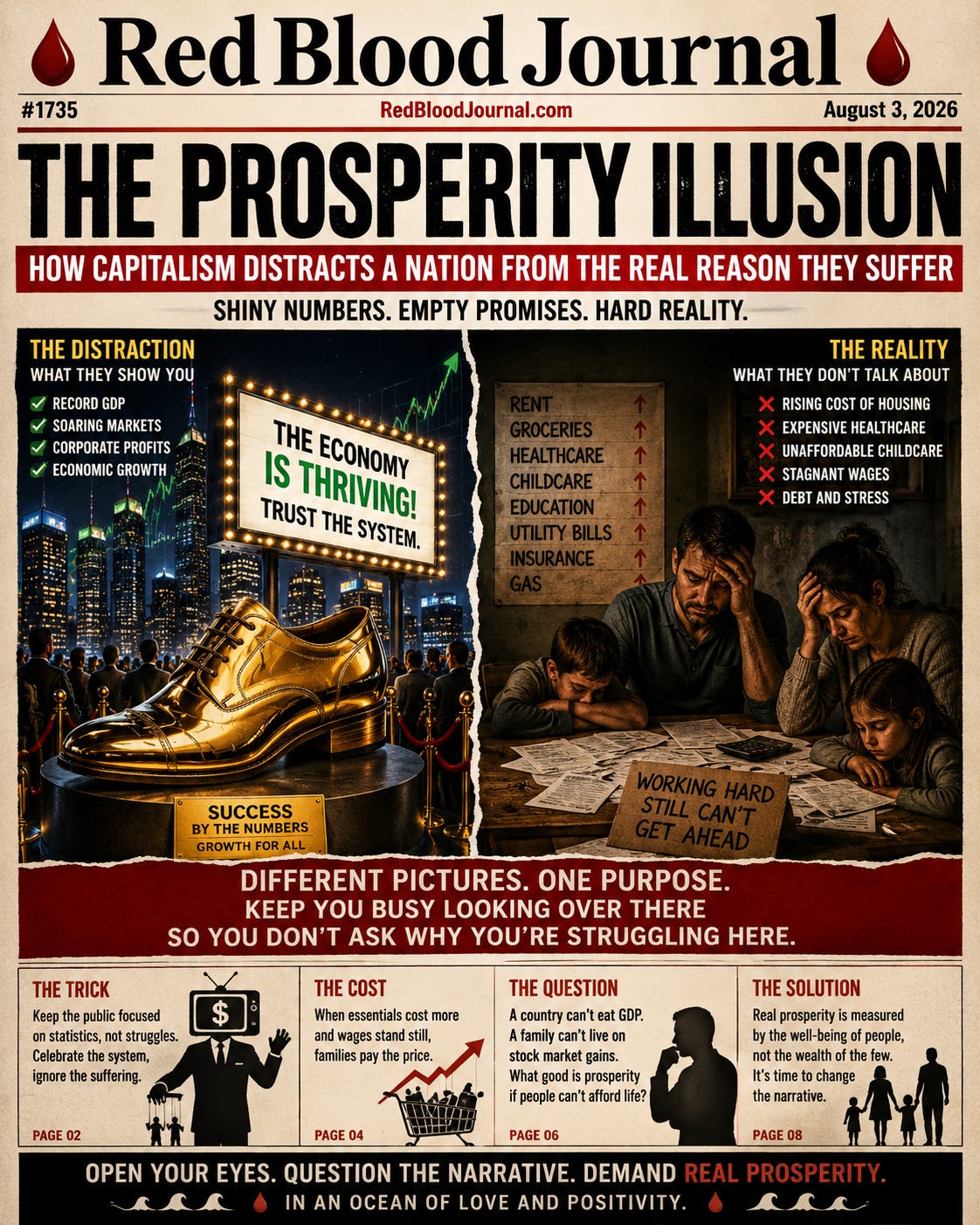
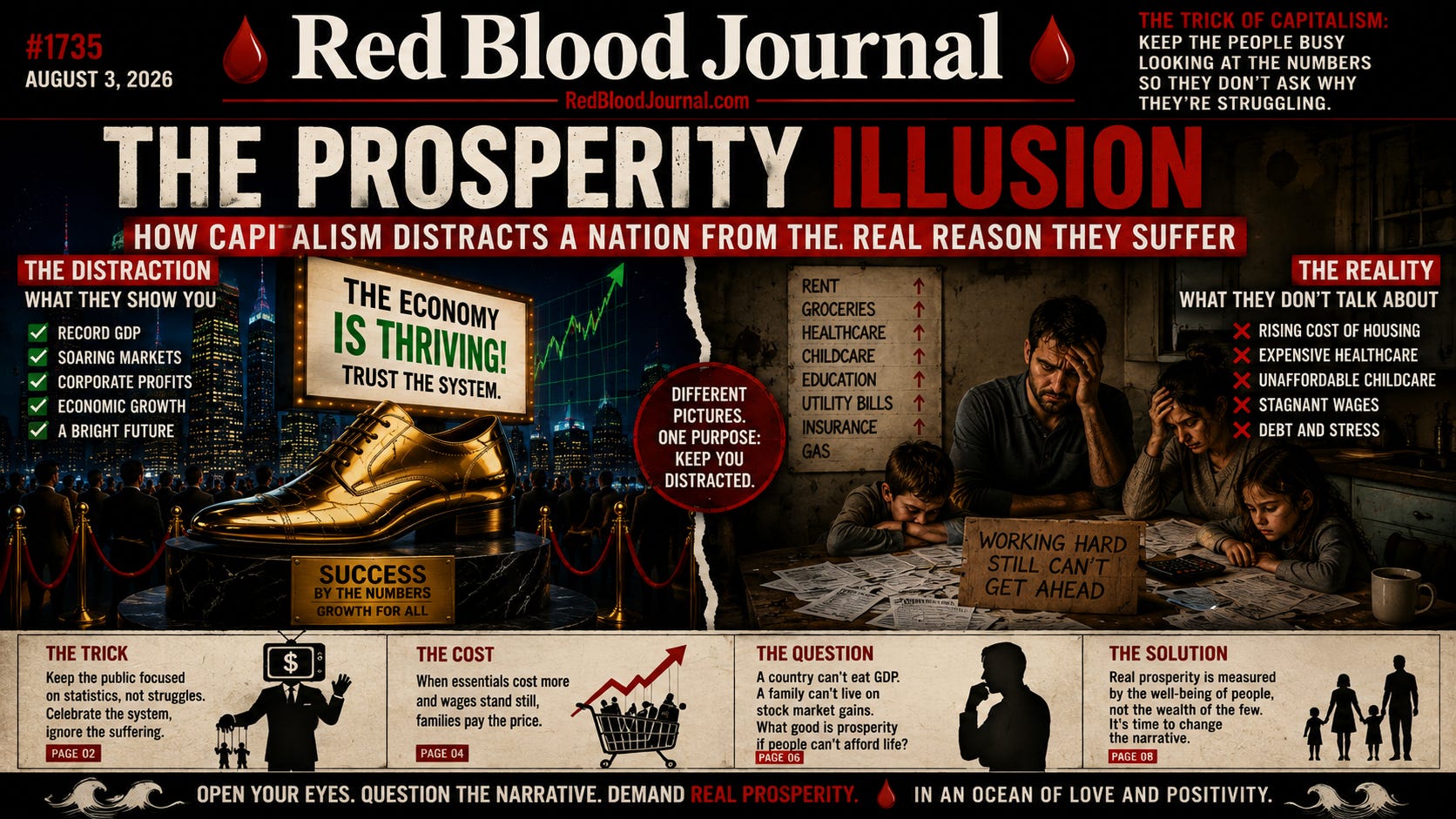
#1735 — The Prosperity Illusion
When Economic Success and Family Reality Diverge
August 3, 2026
🩸 RedBloodJournal.com 🩸
Every economic system develops ways of measuring success.
In capitalist economies, some of the most frequently cited indicators include Gross Domestic Product (GDP), stock market indexes, corporate earnings, and overall economic growth.
These measures provide valuable information about the size and activity of an economy.
But they also raise an important question.
Do they describe the daily experience of the average family?
Imagine a household struggling to pay rent.
Unable to save for a home.
Concerned about healthcare costs.
Watching childcare, insurance, and groceries consume a growing share of the family budget.
Now imagine being told that the economy has never been stronger because GDP has reached another record.
For that family, the announcement may feel disconnected from reality.
GDP cannot pay the rent.
A rising stock market cannot replace affordable healthcare.
Record corporate profits do not automatically lower the price of a first home.
From this perspective, some critics argue that public attention is often directed toward broad national statistics while the affordability of everyday life receives less emphasis.
Whether this reflects political messaging, media priorities, or the natural focus of economic reporting is open to debate.
Regardless of the reason, the result can be similar.
The conversation centers on how large the economy has become instead of how affordable life has become.
The distinction matters.
Economic growth and family affordability are related, but they are not identical.
A nation can produce more wealth while many households still struggle with housing, education, healthcare, or childcare.
Both realities can exist at the same time.
Perhaps prosperity should be judged not only by how much an economy produces, but also by questions every family understands.
Can a full-time worker afford a home?
Can parents raise children without constant financial anxiety?
Can ordinary families save for the future?
Can the next generation expect greater opportunity than the previous one?
Those questions measure lived experience.
They do not reject GDP or other economic statistics.
They simply ask whether those statistics tell the whole story.
The Red Blood Perspective
Every society chooses the measurements it celebrates.
When the public conversation focuses primarily on national economic indicators, there is a risk that the financial pressures experienced by many households receive less attention than they deserve.
The challenge is not to reject economic growth, but to ask whether growth is translating into broader improvements in family affordability and economic opportunity.
Ocean of Love and Positivity
Healthy societies benefit from asking difficult questions with honesty and evidence.
Economic progress is most meaningful when it is reflected not only in charts and headlines, but also in the daily lives of ordinary families.
A nation grows strongest when prosperity can be experienced around the dinner table as clearly as it can be measured in economic reports.
In an Ocean of Love and Positivity.
🩸🌊✨ Fantastic!
📉
📉 The Prosperity Illusion:
Measuring Economic Reality versus Family Life
Aug 3, 2026
The provided text examines the disconnect between national economic indicators and the financial reality of typical households. While metrics like GDP and stock market growth often signal a thriving nation, they frequently fail to reflect the rising costs of essential needs like housing, healthcare, and childcare. The author argues that true prosperity should be measured by the affordability of daily life and the ability of families to save for the future. By shifting focus away from broad statistics, the source advocates for a more human-centered evaluation of economic success. Ultimately, it suggests that a society is only as strong as the financial security experienced by its citizens at the dinner table.


