


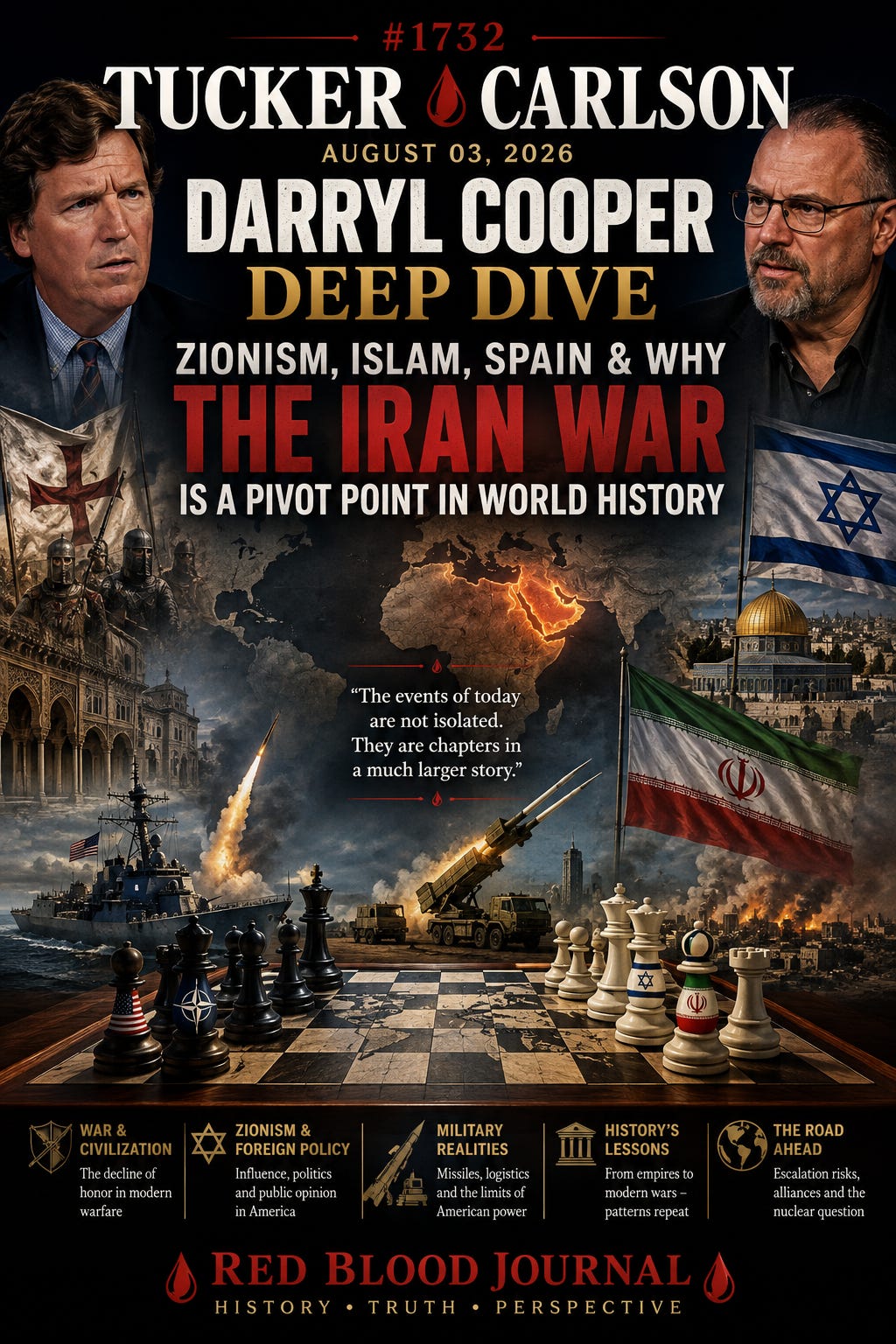
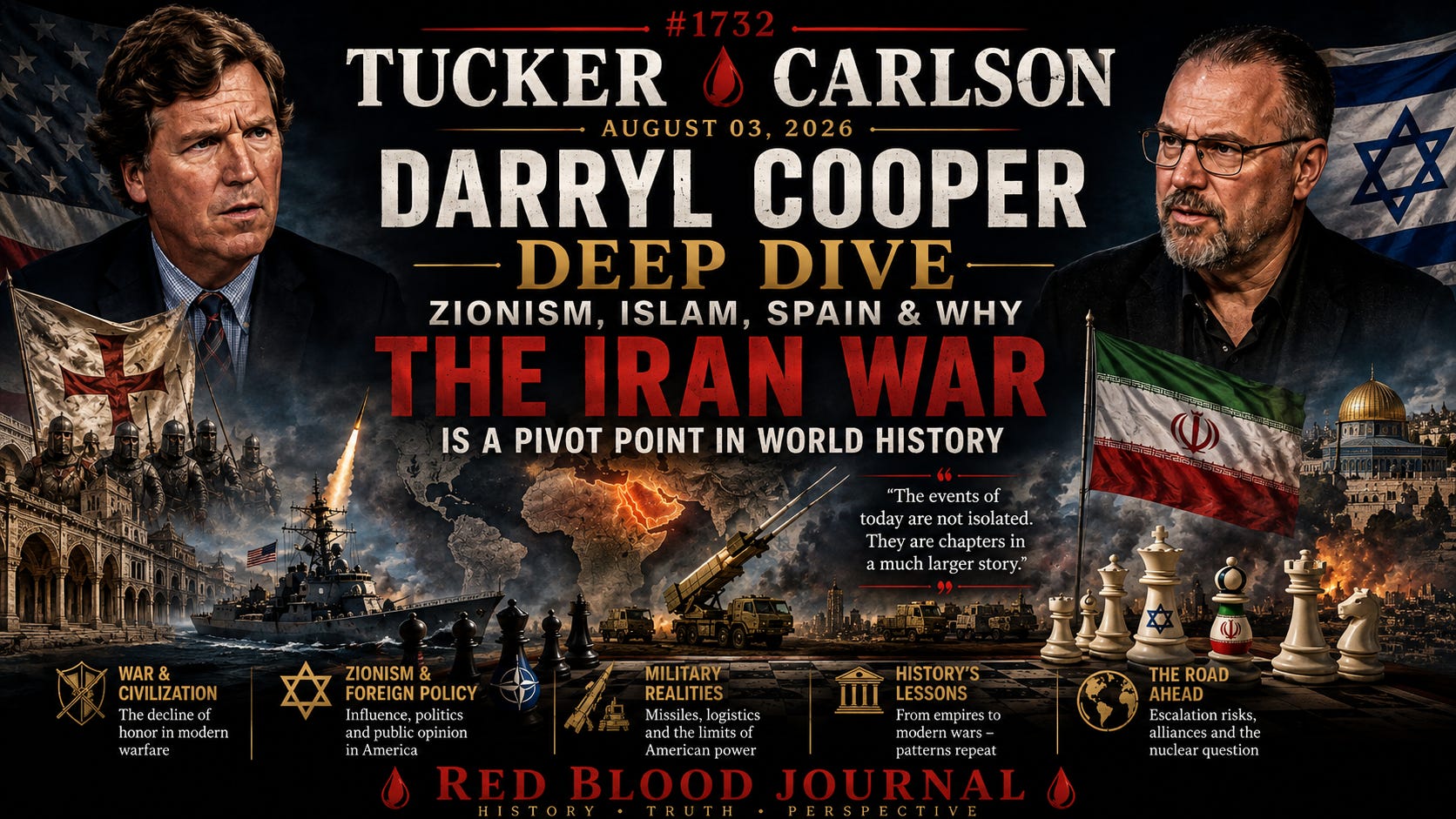
🩸 #1732 — A Summary and Overview of Tucker Carlson’s August 3, 2026 Interview
Darryl Cooper Deep Dive: Zionism, Islam, Spain & Why the Iran War Is a Pivot Point in World History
August 4, 2026
🩸 RedBloodJournal.com 🩸
The August 3, 2026 conversation between Tucker Carlson and Darryl Cooper is a wide-ranging discussion that blends history, geopolitics, military strategy, ethics, and philosophy into one overarching question:
Has Western civilization reached a turning point in the way it understands war, morality, and itself?
Rather than focusing only on the current conflict involving Iran, the discussion repeatedly returns to history, arguing that today’s events should be viewed as part of a much longer historical trajectory stretching from medieval Europe through the World Wars to the modern Middle East.
The Iran War as a Historical Pivot
One of the central themes is that the conflict with Iran should not be viewed as simply another regional war.
Instead, it is presented as a potential turning point that may reshape global alliances, military strategy, and perceptions of American power for decades.
According to the discussion, future historians may look back on this conflict as the moment when the post-Cold War international order began fundamentally changing.
War and Civilization
A recurring topic is the evolution of warfare.
The conversation argues that over centuries, European civilization gradually developed rules intended to limit the brutality of war.
Among those principles discussed are:
Respect for enemy soldiers
Protection of civilians
Honor during combat
Rules governing prisoners of war
Distinguishing military targets from civilian populations
The discussion suggests these principles became part of Western identity and helped define what separated civilization from barbarism.
Has the West Changed?
A major argument throughout the interview is that these traditional standards are now under increasing pressure.
The discussion examines:
Modern military conduct
Political decision-making
Public acceptance of civilian casualties
Long-running wars and their psychological effects
Whether prolonged conflict changes the moral expectations of society
Several examples—including Iraq, Afghanistan, Gaza, and Iran—are referenced as part of this broader discussion.
Zionism and American Foreign Policy
The interview devotes considerable attention to the relationship between American policy and Israel.
Topics include:
U.S. support for Israel
Public opinion
Lobbying and political influence
The Gaza conflict
The broader role of Zionism in shaping foreign policy
These sections are presented as one interpretation of current geopolitical events rather than an established historical consensus.
Lessons from History
The discussion repeatedly draws comparisons with:
World War I
World War II
Pearl Harbor
The collapse of European empires
The Balkan conflicts
Iraq
Afghanistan
The purpose is to argue that history follows recognizable patterns and that understanding those patterns may help explain present events.
Military Logistics
A significant portion of the interview shifts from philosophy to military capability.
Subjects include:
Missile defense systems
Ballistic missile interception
Naval logistics
Tomahawk missiles
U.S. stockpiles
Defense manufacturing
Industrial capacity
Diego Garcia
Sustainment of long-distance warfare
The discussion argues that industrial production and logistics may ultimately determine the duration and outcome of modern conflicts as much as battlefield tactics.
The Future
The interview concludes by examining several possible future scenarios.
Among the questions raised are:
Can the conflict remain limited?
Will regional escalation continue?
Are military stockpiles sustainable?
How might other powers respond?
Could nuclear weapons eventually be introduced into the conflict?
Rather than offering definitive predictions, the discussion frames these as strategic possibilities that policymakers may eventually face.
The Overall Theme
Although the interview discusses Iran, Israel, Gaza, missile defense, Zionism, and military logistics, the broader message is less about any single event and more about the direction of civilization itself.
The central question becomes whether modern societies can preserve principles such as restraint, honor, and respect for human life while navigating increasingly complex geopolitical conflicts.
Whether readers agree or disagree with the arguments presented, the conversation encourages examining contemporary events through a broader historical lens and considering how present decisions may shape future generations.
🩸 The Red Blood Perspective
Every generation believes it is living through extraordinary times. History often reveals that what appeared to be isolated events were instead connected chapters of a much larger story. Whether discussing Iran, Israel, military strategy, or the evolution of warfare, the enduring value lies in asking difficult questions, comparing multiple perspectives, and recognizing that history is rarely understood fully while it is unfolding. Critical thinking grows stronger when evidence, historical context, and differing viewpoints are considered together rather than in isolation.
🌊 Ocean of Love and Positivity
History can remind humanity of both its greatest failures and its greatest achievements. The same civilizations that developed increasingly destructive weapons also developed ideas of honor, restraint, law, and compassion. The hope for the future is that knowledge of the past encourages wiser choices, greater understanding between nations, and a continued commitment to preserving human dignity even during conflict. Progress is measured not only by technological advancement but also by the values societies choose to protect.
In an Ocean of Love and Positivity.
🩸🌊✨ Fantastic!
🌍
🌍 The Iran War: A Pivot Point in Western History
Aug 3, 2026
This summary outlines a comprehensive dialogue between Tucker Carlson and Darryl Cooper regarding the profound geopolitical implications of the Iran War. The source suggests that current Middle Eastern conflicts represent a pivotal historical shift that could fundamentally alter the global order and American influence. A central theme of the discussion is the erosion of Western military ethics, questioning whether modern society has abandoned traditional standards of honor and civilian protection. Beyond philosophy, the text examines military logistics and industrial capacity, arguing that manufacturing power is now as critical as battlefield strategy. Ultimately, the authors present these events as a test of civilization, challenging whether nations can maintain moral restraint amidst escalating global instability.


