


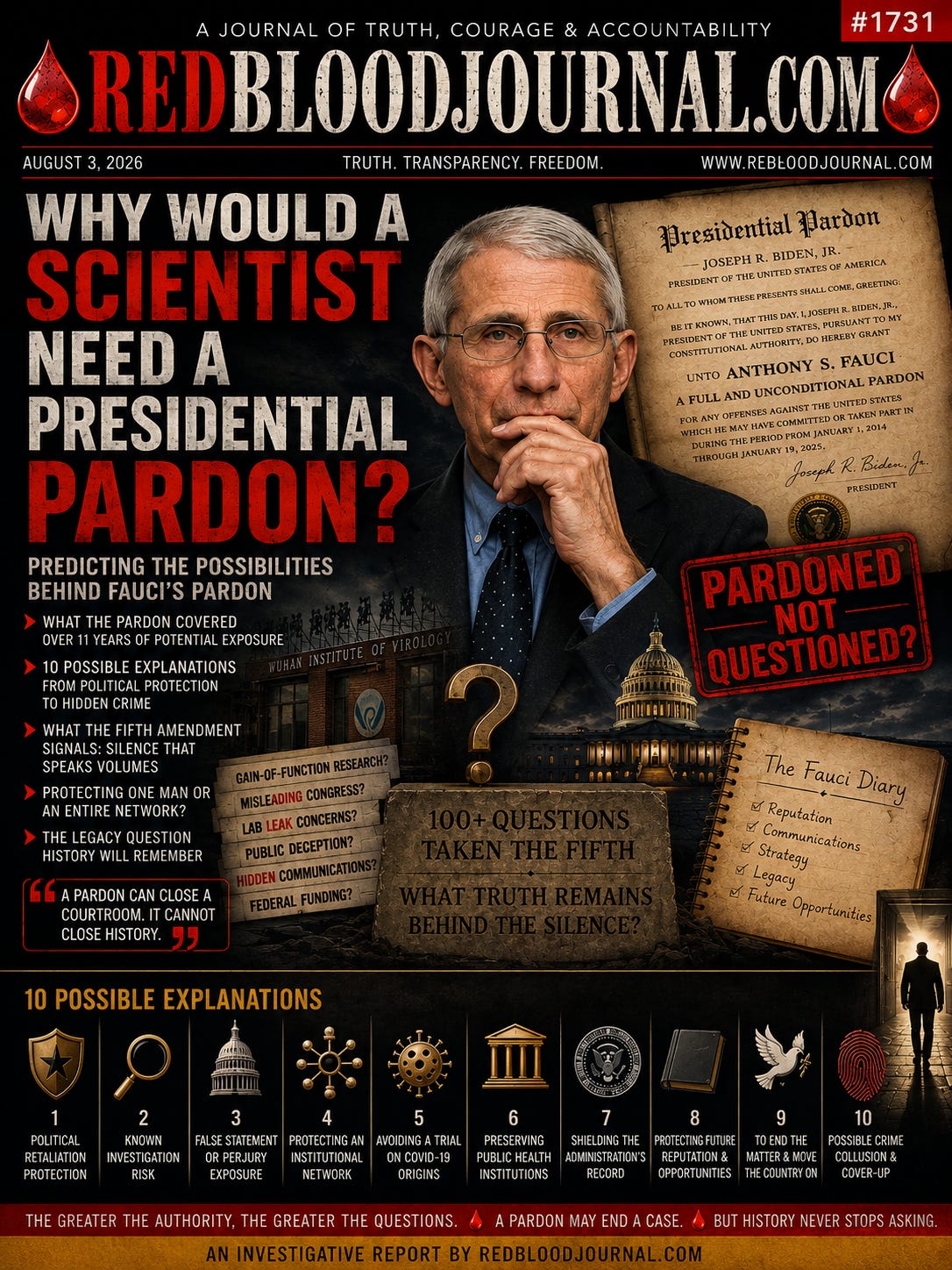
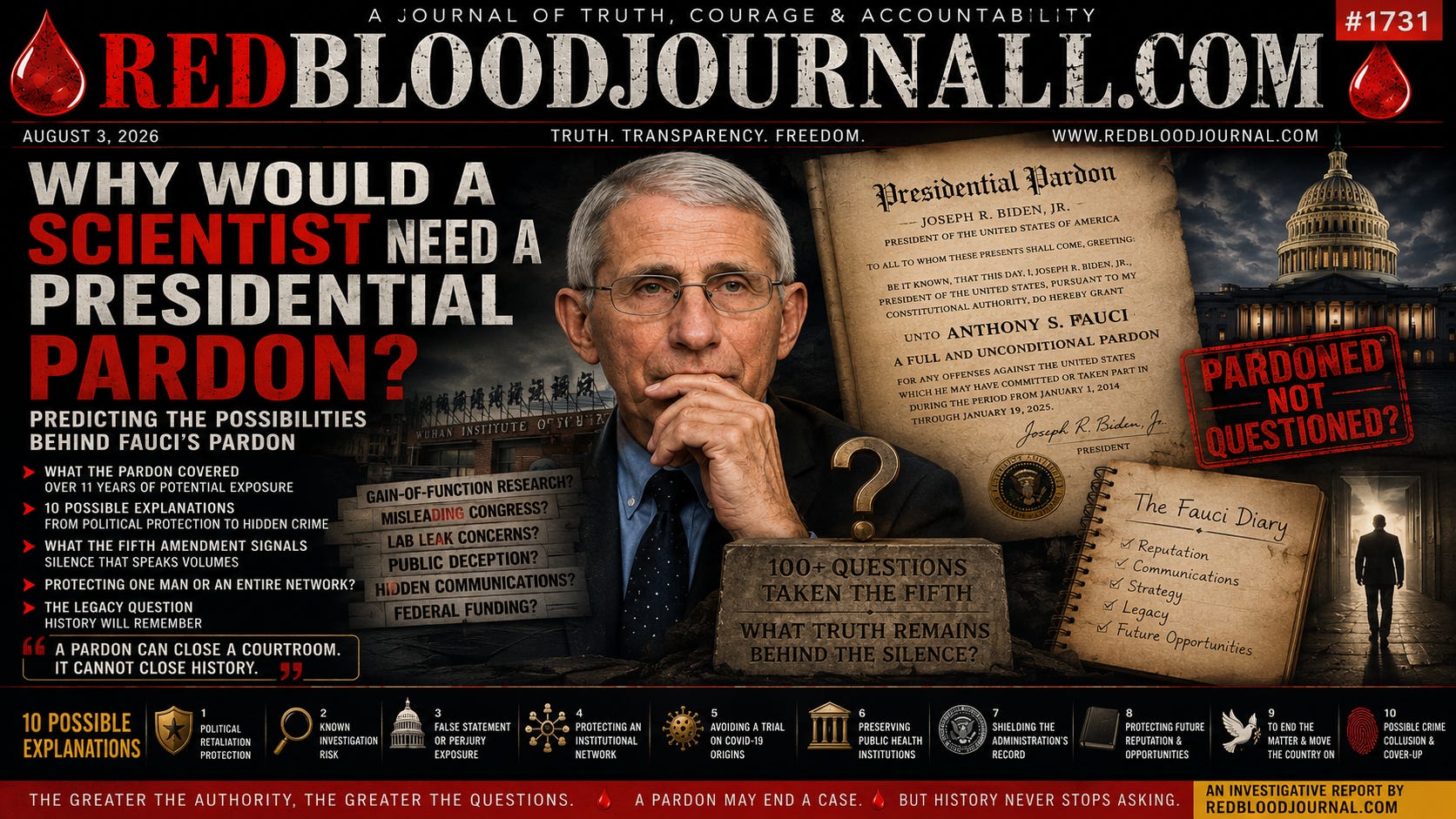
#1731 — Why Would a Scientist Need a Presidential Pardon?
The Fauci Pardon, the Questions It Created, and Every Plausible Explanation
August 3, 2026
🩸 RedBloodJournal.com 🩸
A presidential pardon is usually associated in the public mind with someone who has been convicted, charged, or openly accused of committing a crime.
Dr. Anthony Fauci had not been convicted of a federal offense when President Joe Biden granted him a sweeping preemptive pardon on January 20, 2025.
The pardon was described as full and unconditional, covering any federal offenses Fauci may have committed or participated in from January 1, 2014, through January 19, 2025. Biden said the action was intended to protect public servants from politically motivated prosecution and emphasized that the pardon should not be interpreted as an acknowledgment of wrongdoing.
Legally, a president may issue a pardon before charges are filed.
Politically and psychologically, however, a pardon this broad creates an unavoidable question:
Why would a scientist need protection from prosecution covering more than eleven years if there was nothing criminal to prosecute?
The pardon does not answer that question.
It intensifies it.
What the Pardon Actually Covered
The official warrant did not identify one specific accusation, investigation, transaction, statement, or incident.
Instead, it covered any federal offense Fauci may have committed or taken part in during the stated period.
That period included:
NIH-funded research decisions.
The relationship between NIAID and EcoHealth Alliance.
Coronavirus research connected to the Wuhan Institute of Virology.
Fauci’s congressional testimony.
The COVID-19 response.
Vaccine development and public-health policy.
Federal communications and recordkeeping.
Statements concerning gain-of-function research.
Interactions with scientists studying the origin of SARS-CoV-2.
The pardon does not prove wrongdoing in any of these areas.
But its breadth means it was not limited to protecting Fauci from one narrow allegation.
Possibility One: Protection From Political Retaliation
This was Biden’s public explanation.
Donald Trump and several Republican officials had spoken openly about investigating or prosecuting Fauci. Biden may have concluded that even an innocent person could face enormous expense, reputational damage, and personal strain from politically motivated investigations.
Under this interpretation, the pardon was not designed to conceal a crime.
It was designed to prevent the criminal-justice system from being used as a weapon against a former public servant.
This explanation is plausible, particularly because Biden granted similar protection to other figures whom he believed might become targets of the incoming administration.
The unanswered question is whether such protection should have been granted before any charges, evidence, or formal prosecution existed.
Possibility Two: Biden Knew an Investigation Was Coming
A second possibility is that Biden or his advisers anticipated that the incoming administration would examine Fauci’s testimony, research funding decisions, emails, diary entries, and interactions with scientists.
Under this interpretation, the pardon was defensive rather than confessional.
It may have reflected concern that investigators would attempt to build a federal case from:
allegedly misleading congressional testimony,
false statements,
grant oversight,
destruction or concealment of records,
conspiracy theories converted into legal allegations,
or disputes over the meaning of “gain-of-function.”
This would not necessarily mean Biden believed Fauci was guilty.
It could mean he believed the legal exposure was real enough to require protection.
Possibility Three: Protection Against False-Statement or Perjury Allegations
Congressional testimony carries legal risk.
A witness can face investigation not only for the underlying conduct being examined, but also for allegedly false, misleading, incomplete, or inconsistent statements.
Fauci had repeatedly clashed with Senator Rand Paul over whether NIH had funded gain-of-function research connected to Wuhan. Fauci denied misleading Congress, while Paul continued to argue that his testimony was false.
A broad pardon may therefore have been intended to block prosecution based on past testimony.
However, the pardon does not protect Fauci from offenses committed after January 19, 2025. That distinction became important when he invoked the Fifth Amendment during his July 2026 Senate appearance, because any new false statement, perjury, obstruction, or contempt allegation would fall outside the pardon’s time period.
Possibility Four: Protecting an Entire Institutional Network Through One Person
Fauci was not an isolated scientist working alone in a laboratory.
He served at the center of an institutional network involving:
NIH.
NIAID.
HHS.
CDC.
The White House.
Intelligence agencies.
Universities.
International scientific organizations.
Pharmaceutical companies.
Research foundations.
Foreign laboratories.
If Fauci had been prosecuted, discovery and testimony might have exposed communications involving many other people and institutions.
Under this hypothesis, the pardon may have served not only to protect Fauci personally, but to prevent a prosecution from becoming a gateway into a much larger examination of government decision-making.
The diary does not prove this interpretation.
But from an investigative viewpoint, protecting one central figure can indirectly shield an entire institutional structure from the consequences of a criminal case.
Possibility Five: Preventing a Public Trial Over the Origins of COVID-19
A criminal proceeding involving Fauci could have produced subpoenas, sworn testimony, document discovery, expert witnesses, and public examination of questions that remain politically explosive.
These could have included:
What Fauci knew about laboratory-origin concerns in January 2020.
Why scientists who initially expressed concern later supported a natural-origin explanation.
What role NIH officials played in discussions surrounding Proximal Origin.
Whether the government accurately described research funded through EcoHealth Alliance.
What communications occurred with intelligence or law-enforcement agencies.
The Fauci diary records that scientists discussed the possibility of laboratory involvement privately during the earliest weeks of the outbreak. It does not establish that Fauci concealed a proven laboratory origin, because the participants did not reach a unanimous conclusion.
Still, a trial would have forced these questions into a forum where witnesses could be compelled, cross-examined, and confronted with documents.
The pardon eliminated the most obvious path toward such a federal prosecution for pre-2025 conduct.
Possibility Six: Protecting Public-Health Institutions
Biden may have believed that prosecuting Fauci would damage more than one person.
It might have weakened confidence in:
NIH.
Vaccination programs.
Public-health agencies.
government scientists,
future emergency responses,
and the willingness of experts to serve in government.
Under this interpretation, Fauci’s pardon may have been intended to protect institutional stability.
The danger in that reasoning is that protecting institutions from scrutiny can also weaken public trust.
An institution does not regain credibility by preventing questions.
It regains credibility by answering them.
Possibility Seven: Preserving Biden’s Own Administration
Fauci served as Biden’s chief medical adviser.
A prosecution of Fauci could have drawn attention to decisions made by Biden administration officials concerning:
vaccine mandates,
booster policy,
public messaging,
censorship allegations,
school guidance,
employer requirements,
and treatment of dissenting medical views.
Protecting Fauci may therefore also have protected the administration’s pandemic record.
Again, this remains an inference.
The pardon itself does not state that Biden acted to protect his own legacy.
Possibility Eight: Protecting Fauci’s Reputation and Future Opportunities
As examined in #1729, reputation can operate as a form of professional currency.
A federal indictment—even one ending in acquittal—could severely damage:
speaking opportunities,
book sales,
documentaries,
university positions,
advisory roles,
awards,
historical legacy,
and future institutional relationships.
A pardon may therefore have preserved not only Fauci’s freedom, but the professional reputation upon which his post-government opportunities depended.
This does not prove that future income motivated the pardon.
It identifies one foreseeable effect of preventing prosecution.
Possibility Nine: The Pardon Was Intended to End the Matter
Biden may have believed the country needed to move on.
Under this interpretation, continued investigations into Fauci would deepen division, consume congressional time, damage scientific institutions, and keep the country trapped in unresolved pandemic arguments.
A preemptive pardon might therefore have been viewed as a final boundary:
No prosecution.
No prolonged criminal proceeding.
No national trial.
But pardons do not necessarily end public suspicion.
Sometimes they preserve it indefinitely by preventing the questions from being tested in court.
Possibility Ten: The Worst-Case Interpretation
The most serious prediction is that the pardon was granted because officials feared that a full criminal investigation might uncover evidence of:
coordinated deception,
false congressional testimony,
suppression of scientific disagreement,
misuse of federal research funds,
obstruction,
concealment of records,
or coordination designed to mislead the public.
There is not enough evidence in the pardon itself or in the diary to declare that such crimes occurred.
A pardon is not proof of guilt.
But a pardon written broadly enough to cover any possible federal offense naturally causes citizens to ask whether decision-makers knew more than they disclosed.
That suspicion becomes stronger when the recipient later refuses to answer questions under oath.
It still remains suspicion—not a verdict.
Why the Fifth Amendment Matters
In July 2026, Fauci invoked the Fifth Amendment repeatedly during Senate questioning.
His attorneys argued that the pardon did not eliminate all possible legal exposure because it did not cover post-pardon conduct, including any potential new allegation of perjury or false statements. Legal experts have likewise noted that a pardon may not remove every legitimate basis for invoking the Fifth Amendment.
Legally, that explanation may be valid.
To the public, however, the combination appears extraordinary:
A scientist receives a sweeping presidential pardon despite never being charged.
Then, when questioned about the protected period, he repeatedly declines to answer.
The legal explanation and the public interpretation are not the same.
Does Accepting a Pardon Prove Guilt?
No.
A pardon does not establish a criminal conviction, and Biden explicitly said his action should not be understood as acknowledgment of wrongdoing. The Justice Department also explains generally that a pardon does not mean a recipient is innocent or erase the underlying historical record.
Historical legal language has sometimes described acceptance of a pardon as carrying an implication of guilt, but modern legal practice is more complicated, especially in the case of broad, preemptive pardons issued before charges.
The responsible conclusion is therefore not that the pardon proves guilt.
The responsible conclusion is that it removed the possibility of federal prosecution for a broad period of conduct before the public had received a complete accounting.
The Investigative Prediction
The most likely explanation may not be one single possibility.
It may be a combination:
Biden feared political retaliation.
Advisers knew Fauci faced genuine investigative exposure.
The administration wanted to protect public-health institutions.
A prosecution could have expanded into a wider investigation.
Fauci’s reputation and historical legacy were at risk.
The pardon was intended to close the legal door before the incoming administration could open it.
None of these possibilities independently proves criminal collusion.
Together, they explain why the pardon continues to generate suspicion.
The Red Blood Perspective
A scientist should not ordinarily need a presidential pardon for practicing science.
But Fauci was not merely a laboratory scientist.
He was a government executive, funding authority, presidential adviser, congressional witness, media figure, policy advocate, and one of the most influential officials of the pandemic era.
The greater the authority, the greater the potential legal and ethical exposure.
Biden’s pardon may have protected Fauci from political revenge.
It may also have protected the public from discovering whether a prosecutable case existed.
Because no federal trial occurred, citizens were denied both possible outcomes:
Fauci was neither convicted nor cleared through the judicial process.
The pardon left him legally protected but historically unresolved.
That may become the most enduring consequence of all.
Ocean of Love and Positivity
Truth does not depend on punishment.
Nor does it depend on defending institutions at every cost.
Truth requires documents, testimony, openness, patience, and the courage to allow questions to be examined without fear.
A pardon can close a courtroom.
It cannot close history.
Future generations will continue examining the record, not to seek revenge, but to understand what happened and prevent secrecy from replacing public trust.
In an Ocean of Love and Positivity.
🩸🌊✨ Fantastic!
⚖️
⚖️ The Fauci Pardon: Ten Explanations for Preemptive Legal Protection
Aug 3, 2026
This text analyzes the controversial preemptive presidential pardon granted to Dr. Anthony Fauci by Joe Biden in January 2025. It explores various motivations for this broad legal protection, ranging from preventing political retaliation to shielding public health institutions from invasive criminal discovery. The source highlights how the pardon covered over a decade of federal activity, including COVID-19 response policies and research funding linked to the Wuhan Institute of Virology. While the pardon serves as a legal barrier against prosecution, the author suggests it leaves significant ethical and historical questions unanswered. Ultimately, the narrative examines the tension between legal immunity and the public’s desire for institutional transparency regarding the pandemic’s origins.


