


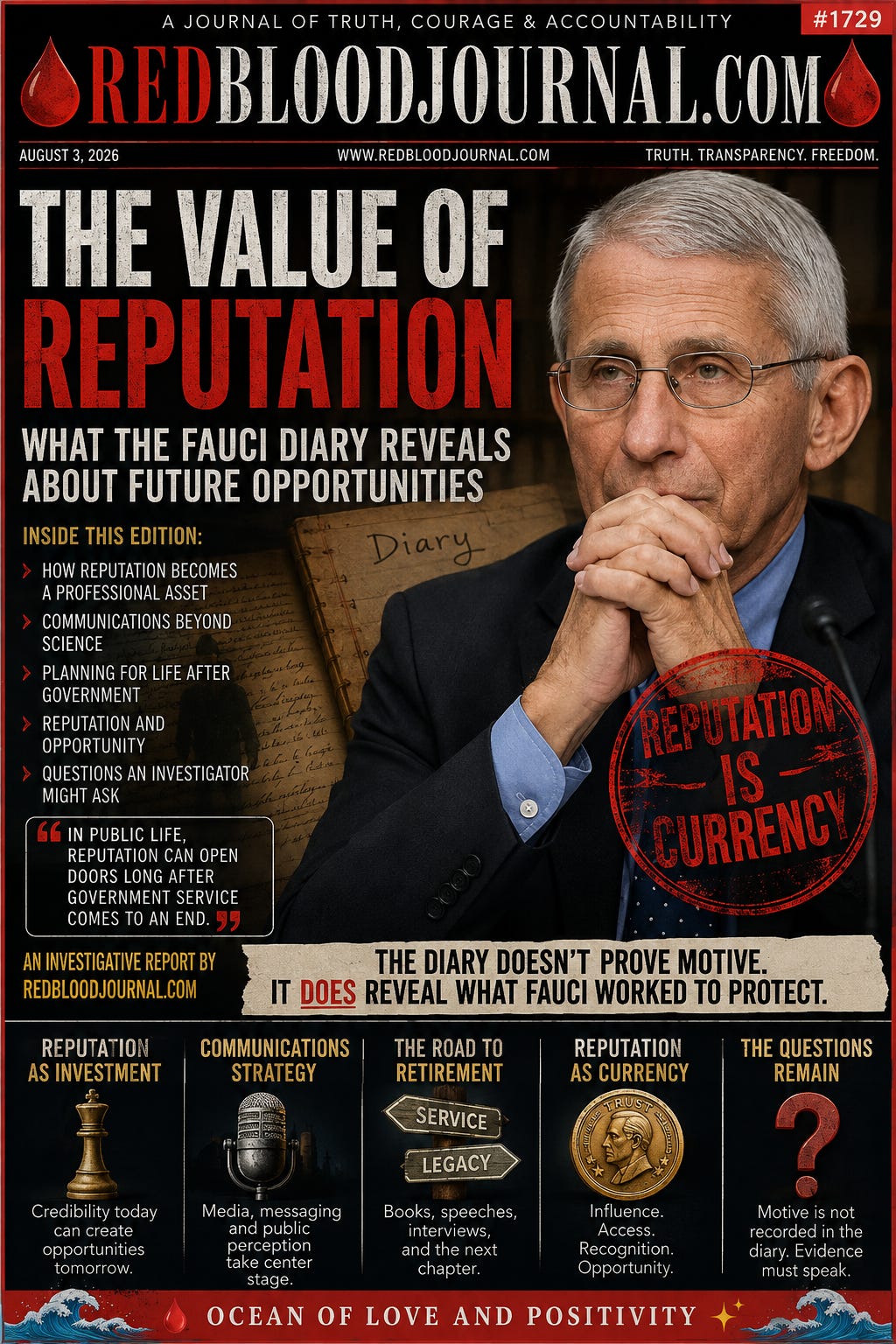
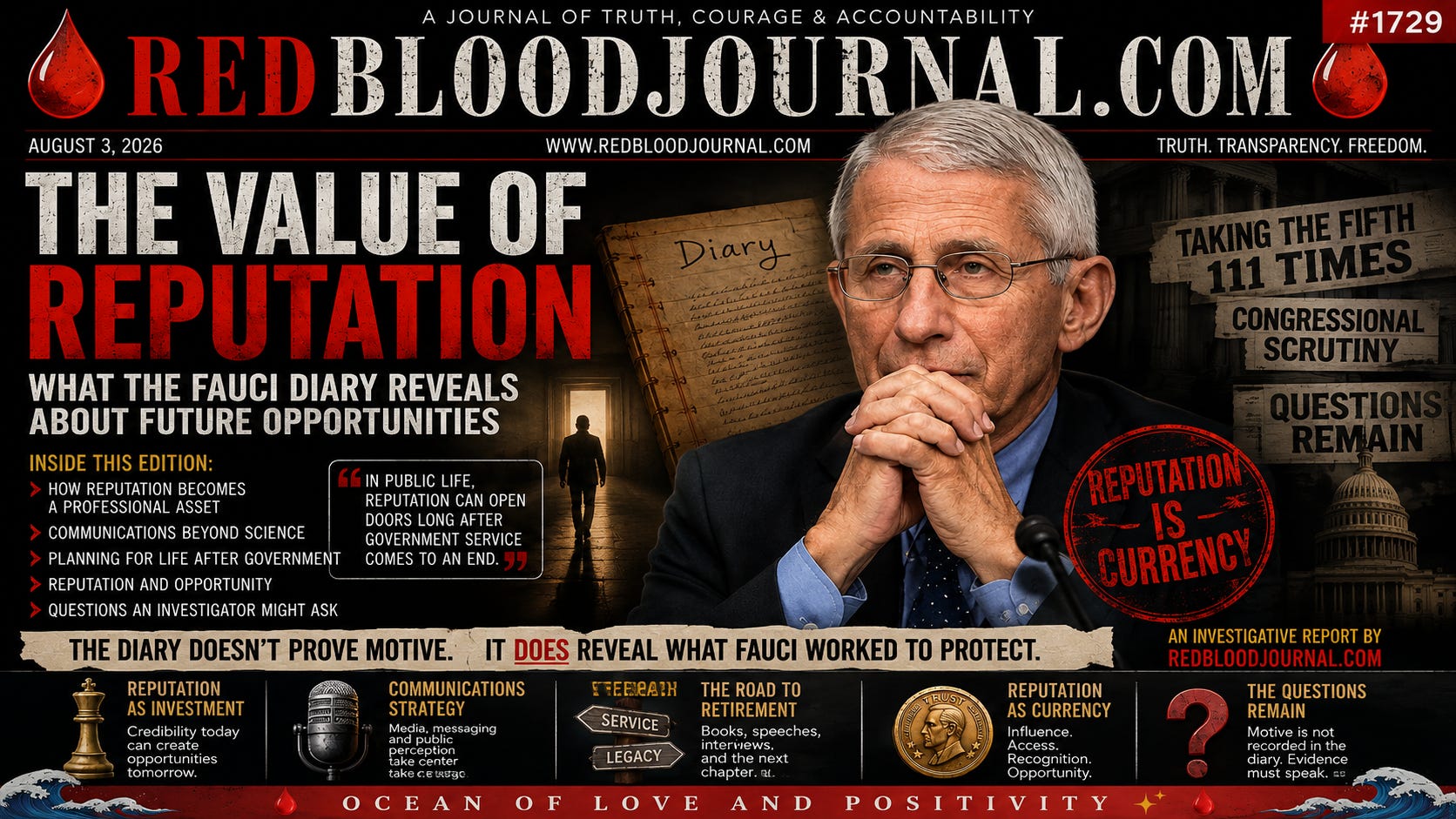
#1729 — The Currency Beyond Money
Why Reputation May Be the Most Valuable Asset in the Fauci Diary
August 3, 2026
🩸 RedBloodJournal.com 🩸
Money is not always transferred through a bank account.
Sometimes it is transferred through reputation.
For investigators examining the Fauci Diary, one question naturally arises.
If the diary does not reveal a direct financial conflict of interest, does it reveal something that may be equally valuable?
The answer may lie in the repeated attention given to protecting professional credibility.
Throughout the diary, Dr. Anthony Fauci records not only scientific meetings and pandemic decisions, but also discussions about criticism, public perception, media appearances, communications strategy, political attacks, interviews, historical preservation, and his professional legacy.
Taken individually, none of these entries establish misconduct.
Viewed collectively, they reveal that reputation occupied a significant place in the later stages of the pandemic.
Reputation Is an Investment
In nearly every profession, reputation has value.
For senior public officials, that value can extend long after government service ends.
A respected reputation may lead to:
Book contracts.
Documentary participation.
Speaking engagements.
University appointments.
Advisory positions.
Foundation leadership.
Corporate consulting.
Historical archive projects.
Awards and public recognition.
None of these opportunities are improper by themselves.
Many public servants legitimately pursue them after retirement.
The question for investigators is different.
Could preserving reputation become an incentive while still serving in office?
The diary raises that question.
It does not answer it.
The Diary’s Repeating Pattern
Across hundreds of pages, recurring subjects include:
responding to criticism,
protecting credibility,
coordinating communications,
preparing media appearances,
defending scientific institutions,
discussing public messaging,
meeting with communications advisers,
expressing concern about political attacks.
These topics appear repeatedly.
Far more often than discussions about personal wealth.
This suggests that, at least from Fauci’s own perspective, reputation was something worth actively protecting.
Communications Become a Strategic Priority
Several diary entries describe meetings focused not on laboratory research or clinical trials, but on communication.
They involve:
responding to criticism,
shaping public messaging,
coordinating interviews,
discussing media strategy,
and maintaining public confidence.
Whether viewed as responsible public communication or reputation management, the diary documents that communications occupied considerable attention.
The Transition Toward Retirement
As the diary approaches its final chapters, another pattern emerges.
Attention gradually shifts toward life after government service.
Entries increasingly mention:
retirement,
oral history interviews,
books,
documentaries,
legal representation,
speaking opportunities,
historical preservation,
legacy.
This transition is natural for someone concluding a long public career.
It also illustrates why reputation can become one of the most valuable professional assets a public official possesses.
Reputation Can Become a Form of Currency
Currency is not limited to dollars.
Influence.
Trust.
Credibility.
Recognition.
Access.
These can all create opportunities.
The diary does not document Fauci making pandemic decisions in exchange for future employment or compensation.
However, it repeatedly documents efforts to preserve and defend the credibility upon which many future opportunities often depend.
That distinction is important.
Protecting one’s reputation is not itself evidence of wrongdoing.
It is also true that reputation can influence future professional opportunities.
Both statements can be true at the same time.
The Investigative Question
Rather than asking:
“Did Fauci receive money?”
The diary encourages a different question:
“Was preserving professional credibility viewed as important because of the responsibilities of public office, because of concern for institutional trust, because of concern for personal legacy, or because of the opportunities that often accompany a respected public reputation?”
The diary records the concern.
It does not establish the motive.
Determining motive would require additional evidence beyond the diary itself.
The Red Blood Perspective
The Fauci Diary reminds us that not every potential conflict of interest begins with a paycheck.
For leaders in science, medicine, government, business, or media, reputation itself can become a valuable asset.
Protecting that asset may be entirely appropriate when the goal is maintaining public trust.
It may also invite legitimate questions when decisions affecting millions of people coincide with efforts to preserve personal credibility and legacy.
The diary documents repeated attention to communications, criticism, and reputation. It does not document that future financial opportunities influenced Fauci’s scientific decisions. That distinction matters. A careful investigation follows the evidence where it leads without assuming motives that the available record does not establish.
Ocean of Love and Positivity
Every generation inherits both achievements and unanswered questions.
The greatest service history can provide is not certainty, but the opportunity to examine evidence with honesty, curiosity, and humility.
Truth grows strongest when reputation never becomes more important than transparency, and when every public servant understands that lasting trust is earned not only through accomplishments, but through openness to scrutiny.
In an Ocean of Love and Positivity.
🩸🌊✨ Fantastic!
📜
📜 The Fauci Diary:
Reputation as the Ultimate Currency
Aug 3, 2026
The provided source explores the concept of professional reputation as a valuable form of currency, specifically through an analysis of Dr. Anthony Fauci’s personal diaries. Rather than focusing on direct financial gain, the text highlights how maintaining credibility and public perception became a primary concern for the official during the pandemic. This strategic focus on communication and legacy is framed as a potential incentive for future opportunities, such as book deals, speaking engagements, and consulting roles. While the diary reveals a consistent effort to defend scientific institutions and personal standing, it does not provide definitive evidence of improper motives. Ultimately, the source argues that protecting one’s image can influence leadership decisions just as much as monetary wealth. Investigators are encouraged to consider whether this emphasis on reputation management impacted public policy or was simply a natural part of transitioning toward retirement.


