


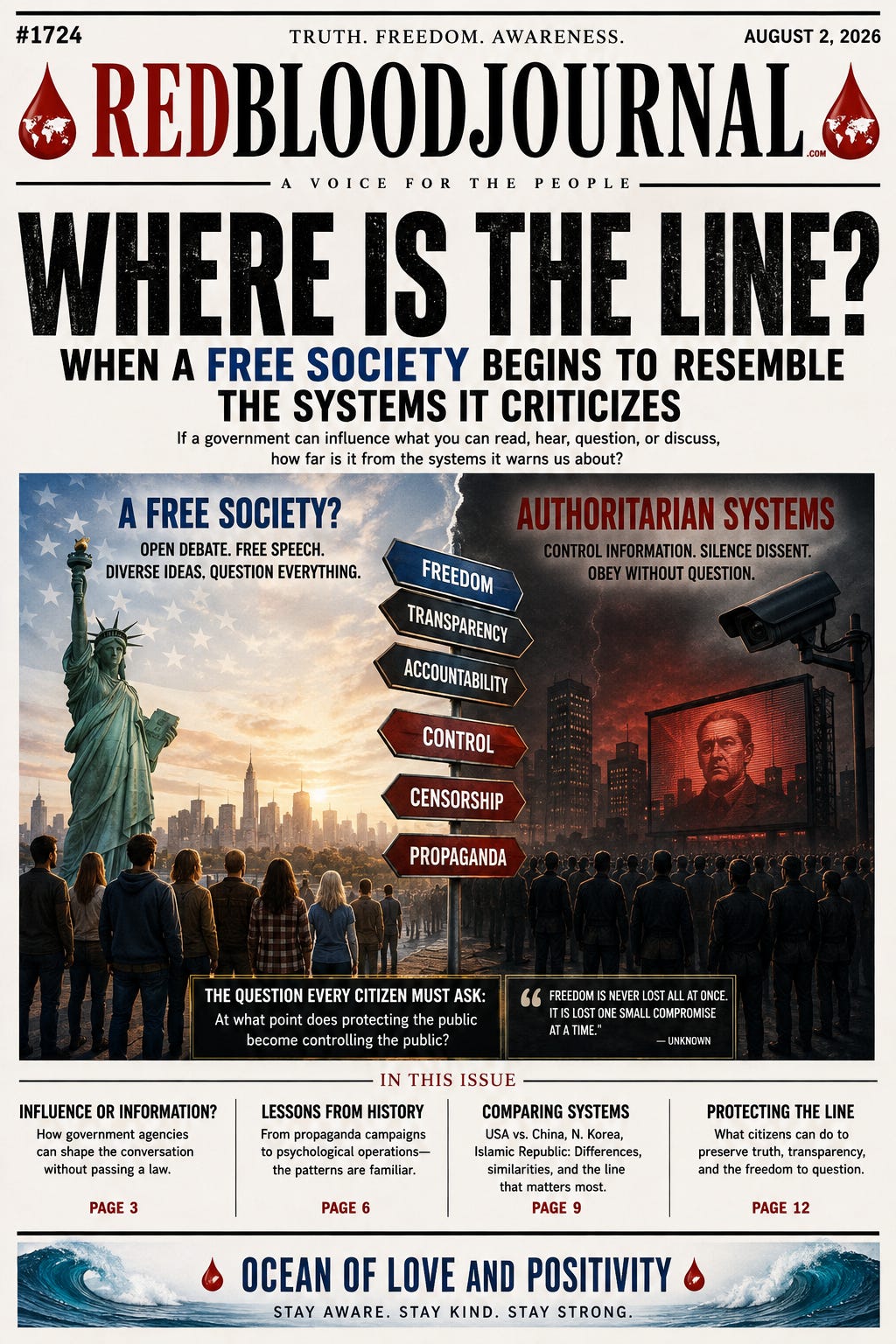
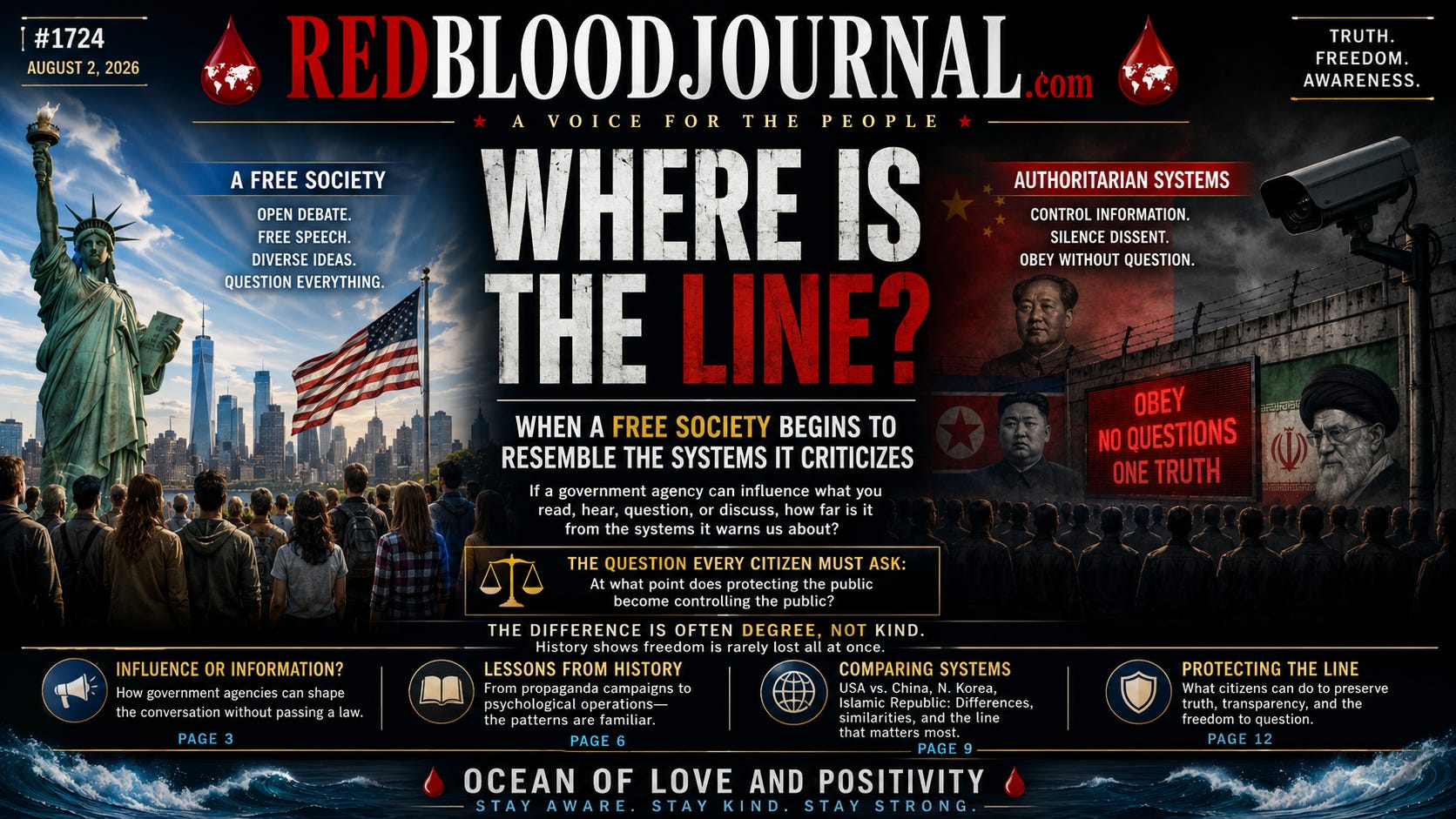
#1724 — Where Is the Line?
When a Free Society Begins to Resemble the Systems It Criticizes
August 2, 2026
🩸 RedBloodJournal.com 🩸
For generations, one of the defining differences between the United States and authoritarian governments has been the promise of freedom.
Freedom of speech.
Freedom of thought.
Freedom of the press.
Freedom to disagree with those in power without fear of government punishment.
These principles have often been presented as the moral distinction separating liberal democracies from governments such as those of China, North Korea, or the Islamic Republic of Iran.
But this raises an important question.
If a government agency in a democratic nation actively influences what citizens can read, hear, discuss, or question online, where is the line?
Every government communicates with its citizens.
Every government attempts to persuade.
Every government explains its policies.
That alone is not unusual.
The concern arises when persuasion evolves into controlling the flow of information or encouraging the suppression of lawful viewpoints.
At that point, many citizens naturally begin asking whether the methods—not necessarily the stated goals—are becoming more similar across different political systems.
Authoritarian governments often justify information control by arguing that it protects national security, social stability, public order, or public health.
Democratic governments have sometimes made similar arguments during periods of war, terrorism, or public emergencies.
The reasoning may differ in context, but the question remains the same.
At what point does protecting society begin limiting the public’s ability to evaluate competing ideas for itself?
This question does not suggest that the United States, China, North Korea, or the Islamic Republic of Iran are equivalent political systems.
They differ significantly in their constitutions, institutions, elections, judicial independence, civil liberties, and the degree of state control over everyday life.
However, comparisons are often made not because the systems are identical, but because they raise similar ethical questions about government influence over information.
The difference is often described as one of degree rather than kind.
In highly authoritarian systems, information control may be centralized, comprehensive, and enforced through criminal penalties.
In democratic systems, the debate has focused more on whether government pressure, coordination, or encouragement directed at private companies can indirectly shape public discourse while preserving the appearance of independent decision-making.
This distinction has become an important subject of public discussion, legal challenges, and congressional oversight.
For many citizens, the issue is no longer simply whether governments communicate.
The issue is whether governments help determine which ideas become widely visible and which become difficult to find.
Once that perception takes hold, trust begins to erode.
If one government says, “You may only hear what we approve,” citizens immediately recognize censorship.
If another government reaches a similar outcome through less direct methods, many people will still ask the same question.
Where is the line?
History teaches that freedom is rarely lost all at once.
It often changes gradually through small decisions, each justified as temporary, necessary, or made for the public good.
Whether those decisions ultimately strengthen or weaken a free society is a question that citizens themselves must continue to examine.
The Red Blood Perspective
The defining characteristic of a free society is not that it never makes mistakes.
It is that citizens remain free to question those mistakes openly.
A government confident in its evidence should not fear scrutiny.
Likewise, citizens should approach all claims—official and unofficial—with intellectual honesty, critical thinking, and a willingness to change their minds when stronger evidence emerges.
Comparing democratic and authoritarian systems does not require concluding they are the same.
It invites examination of where meaningful differences remain, where similarities may appear, and how a society preserves the liberties that distinguish it.
The line between freedom and control is not maintained by slogans.
It is maintained by transparency, accountability, independent institutions, and a public that continues asking difficult questions.
Ocean of Love and Positivity
Perhaps the greatest protection of freedom is not found in governments alone.
It is found within the conscience of ordinary people.
When individuals remain curious rather than obedient, thoughtful rather than reactionary, and committed to seeking evidence rather than merely accepting narratives, society becomes more resilient.
Freedom of thought carries with it the responsibility to think carefully.
A healthy society is not one in which everyone agrees.
It is one in which disagreement can exist without fear, and truth is pursued through open inquiry rather than predetermined conclusions.
In an Ocean of Love and Positivity.
🩸🌊✨ Fantastic!
⚖️
⚖️ Where Is the Line: Freedom versus Information Control
Aug 2, 2026
This article examines the narrowing gap between democratic and authoritarian regimes regarding the manipulation of public discourse. While the United States is traditionally defined by civil liberties, the author argues that government pressure on private platforms to limit certain viewpoints mirrors the tactics of oppressive states. These similarities often arise when leaders use national security or public safety as a justification for shaping information flows and curbing dissent. The text emphasizes that true freedom depends on the public’s ability to scrutinize official narratives and maintain independence from state-led persuasion. Ultimately, the piece warns that erosion of trust occurs when democratic institutions prioritize controlled messaging over the transparency and open inquiry required for a healthy society.


