


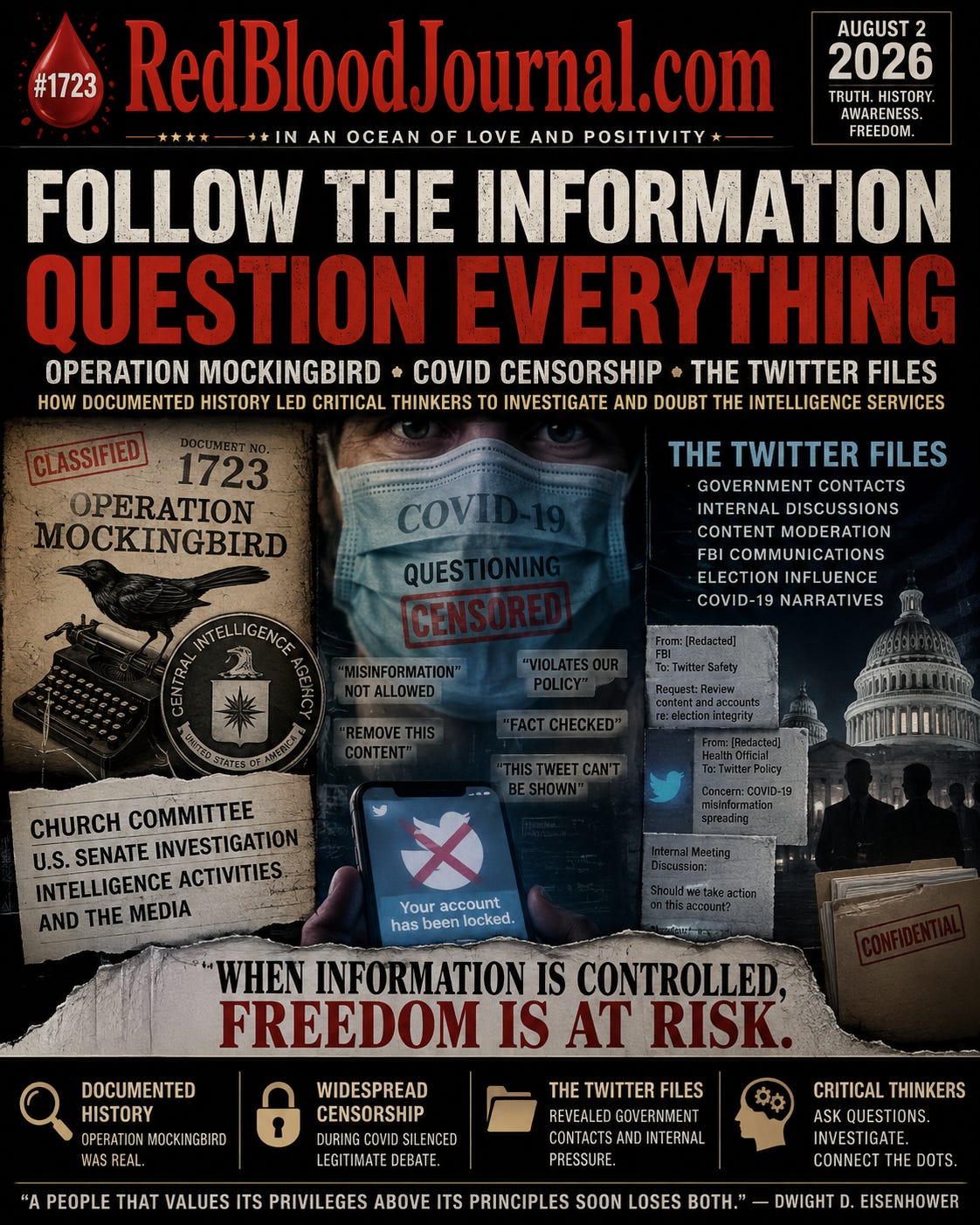
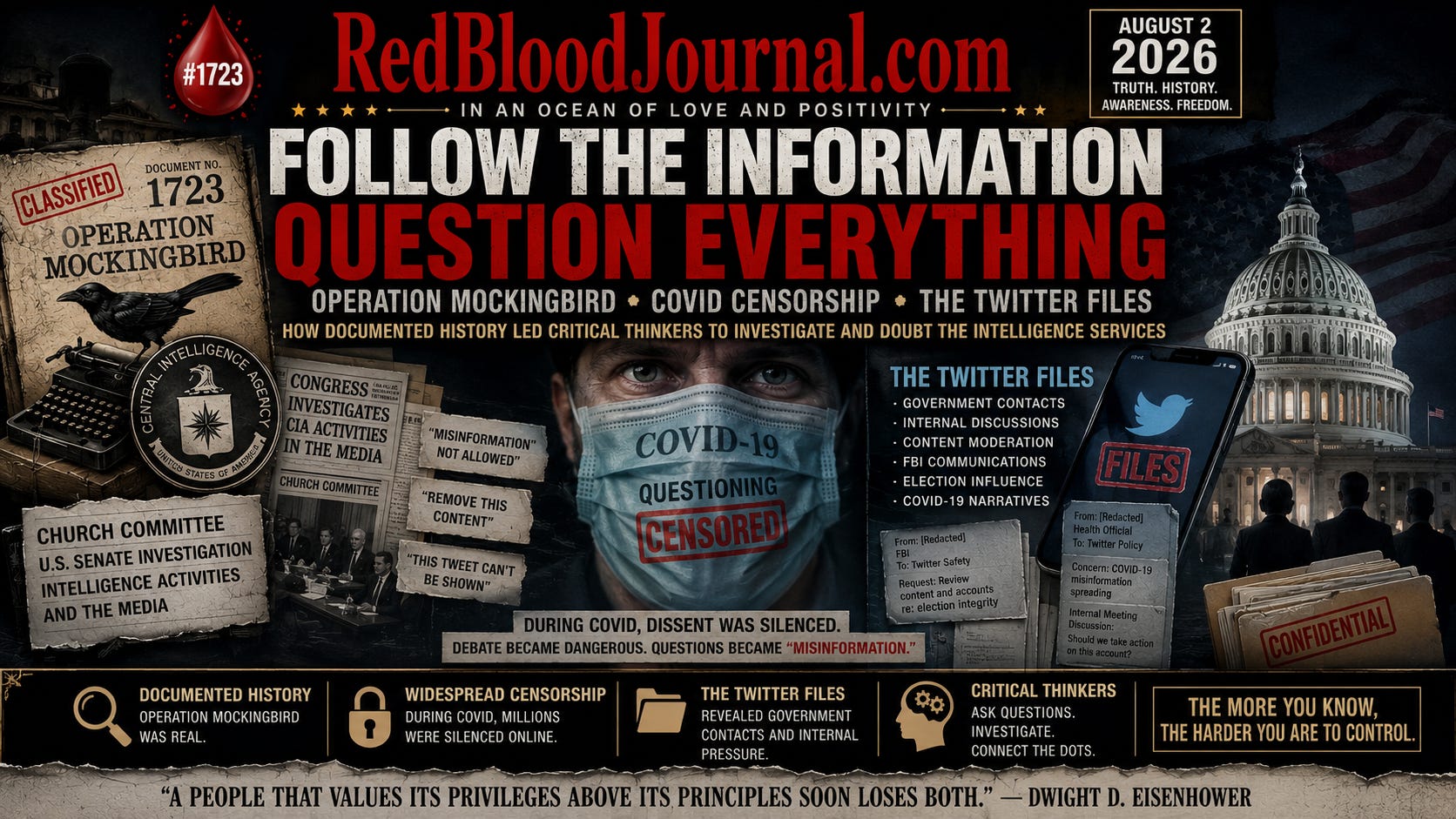
#1723 — Operation Mockingbird, the Media, COVID-19 Censorship, and the Twitter Files
How Documented History Leads Some Citizens to Ask Hard Questions
August 2, 2026
🩸 RedBloodJournal.com 🩸
Throughout modern history, governments have recognized that information can influence public opinion as powerfully as military or economic actions.
Sometimes through official public statements.
Sometimes through public relations campaigns.
Sometimes through intelligence operations.
One of the best-known historical examples is Operation Mockingbird.
Although many claims surrounding the operation have expanded beyond the historical record, it is well documented that during the Cold War the CIA maintained relationships with certain journalists and media organizations as part of broader efforts to influence information during the ideological struggle with the Soviet Union. Congressional investigations, including the Church Committee in the 1970s, later examined aspects of those relationships.
For many people, this history represents more than an isolated event.
It establishes that governments have, at times, attempted to shape public narratives.
That historical reality becomes part of the context through which later events are viewed.
COVID-19 and the Question of Censorship
The COVID-19 pandemic became another turning point for many citizens.
During the pandemic, major social media platforms removed content, suspended accounts, labeled posts, and limited the distribution of information that they believed violated their COVID-19 policies.
Government officials also communicated with technology companies regarding misinformation and public health concerns.
Many physicians, scientists, and commentators argued that some legitimate scientific debate was restricted.
Others maintained that strong moderation policies were necessary to reduce the spread of false medical claims during a global public health emergency.
As years passed, some scientific questions that had once been considered beyond acceptable discussion—such as debates over the virus’s origins, the effectiveness of certain public health measures, and aspects of vaccine policy—received broader public discussion and additional scientific investigation.
For many observers, this experience raised an important question.
If scientific understanding evolves, how should societies balance limiting harmful misinformation with protecting open scientific debate?
The Twitter Files
The release of the Twitter Files after Elon Musk acquired Twitter added another layer to that discussion.
The published internal communications revealed interactions between Twitter employees and various government agencies, including the FBI, as well as communications involving public officials and political campaigns regarding content moderation.
The files documented discussions about COVID-19 content, election-related posts, account moderation, and requests to review particular content.
People interpreted these documents differently.
Some concluded they demonstrated excessive government influence over online speech.
Others viewed the communications as expected cooperation between government agencies and a private company addressing cybersecurity, elections, and public health concerns.
The documents themselves became part of the public record for independent examination.
Why Some Critical Thinkers Began Asking New Questions
For some citizens, the combination of documented historical intelligence activities, widespread COVID-era content moderation, and the publication of the Twitter Files prompted them to re-examine long-held assumptions.
Their reasoning was not necessarily that every institution was acting together.
Rather, they questioned whether governments, technology companies, and media organizations can sometimes become closely aligned during periods of national crisis.
For these individuals, the issue became one of trust.
When debate appears limited, or when dissenting voices are removed from major platforms, some people become more inclined to investigate independently and to question official narratives.
Others, looking at the same events, conclude that extraordinary circumstances required extraordinary measures to protect public health and public safety.
Both perspectives continue to be debated.
Connecting the Dots Responsibly
Critical thinking does not begin with a conclusion.
It begins with evidence.
Documented historical intelligence operations.
Documented congressional investigations.
Documented COVID-era moderation policies.
Documented internal communications released through the Twitter Files.
These are individual pieces of evidence that can inform public discussion.
However, connecting those events into a single, continuous coordinated operation requires additional evidence beyond the historical facts themselves.
Responsible inquiry recognizes both the importance of asking difficult questions and the importance of avoiding conclusions that extend beyond what the available evidence supports.
The Red Blood Perspective
History demonstrates that governments, intelligence agencies, media organizations, and technology platforms have all played roles in shaping the flow of information. A healthy democracy benefits when powerful institutions are open to scrutiny, when scientific debate can occur respectfully, and when citizens evaluate primary sources rather than relying on a single narrative. Critical thinking is strengthened not by assuming hidden explanations, but by examining evidence carefully and remaining willing to revise conclusions as new facts emerge.
Ocean of Love and Positivity
An informed society grows stronger when curiosity is welcomed instead of feared. Questions should not be discouraged simply because they are uncomfortable, and answers should not be accepted simply because they come from authority. Wisdom develops through patient investigation, respectful disagreement, and a shared commitment to discovering what is true. In that spirit, knowledge becomes something that unites rather than divides.
In an Ocean of Love and Positivity.
🩸🌊✨ Fantastic!
🩸 #1723 — Media & Information
🕊️ Operation Mockingbird
📱 Twitter Files
🧠 Critical Thinking
📰 Free Speech & Censorship
🧐🧐 Operation Mockingbird and the Modern Landscape of Information Control
Aug 2, 2026
This text examines the evolving relationship between government entities, media organizations, and digital platforms regarding the control of public information. It utilizes historical examples like Operation Mockingbird to demonstrate that state influence over news narratives is a documented reality rather than mere speculation. The author connects these past events to modern controversies, specifically focusing on COVID-19 content moderation and the internal communications revealed in the Twitter Files. By analyzing these instances, the source explores the tension between preventing misinformation and protecting the essential right to open scientific and political debate. Ultimately, the passage encourages critical thinking and independent scrutiny of official narratives to maintain a healthy democratic society. This overview suggests that while extraordinary crises may prompt tighter information controls, citizens must remain vigilant in questioning the alignment of powerful institutions.


