


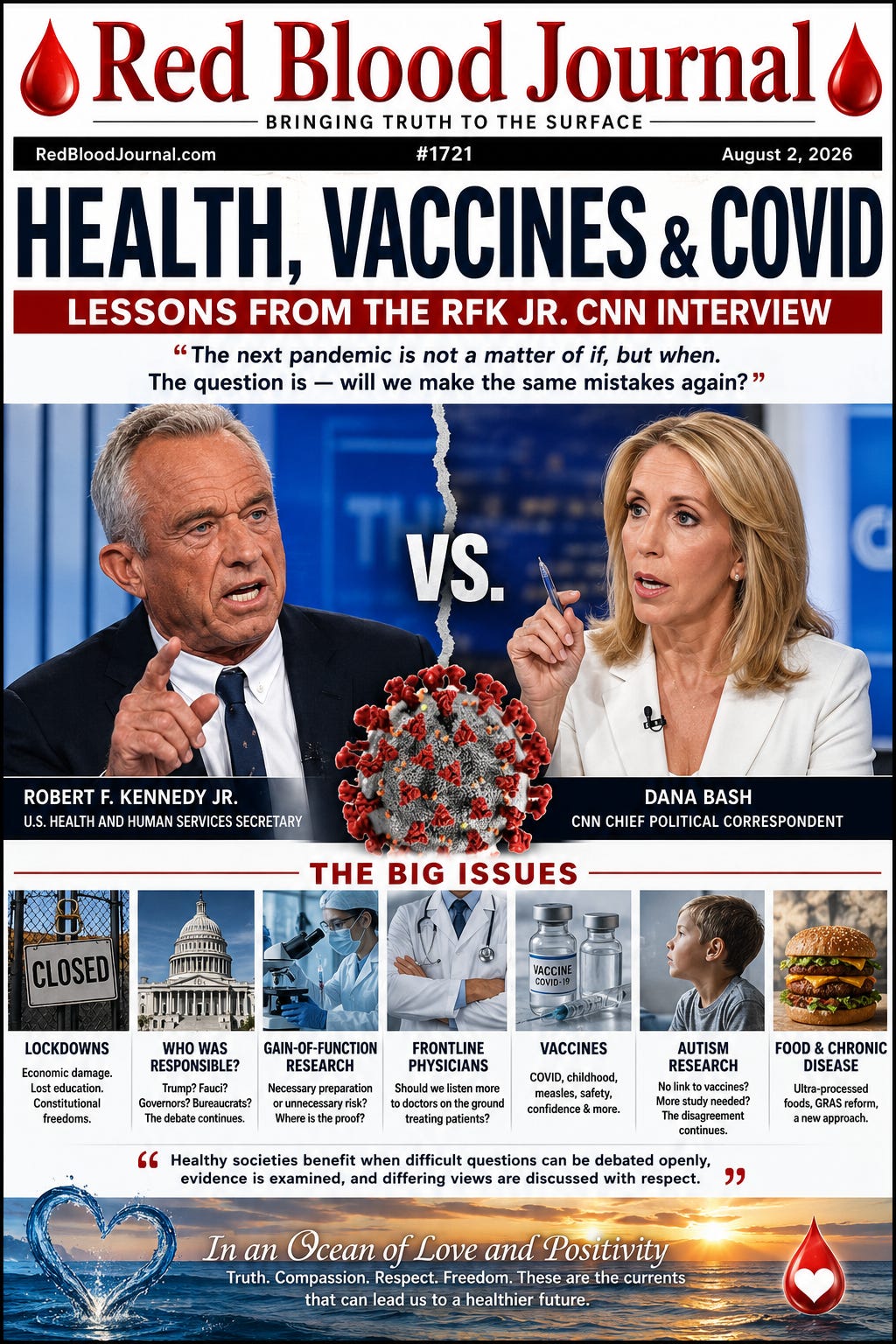
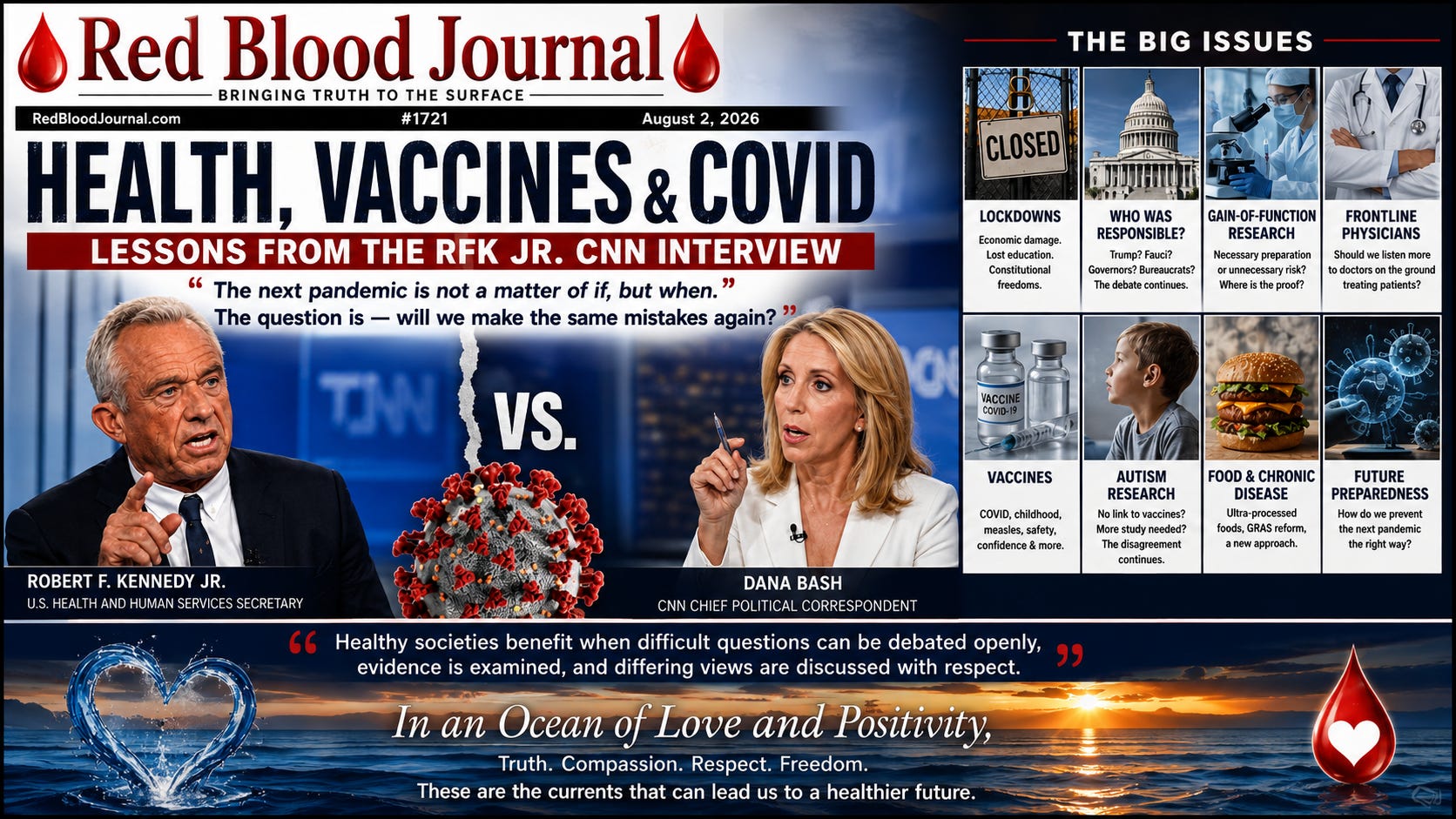
#1721 — Health, Vaccines & COVID
Lessons from the RFK Jr. CNN Interview
August 2, 2026
🩸 RedBloodJournal.com 🩸
The public discussion surrounding COVID-19 continues years after the peak of the pandemic.
An interview between U.S. Health and Human Services Secretary Robert F. Kennedy Jr. and CNN’s Dana Bash demonstrated that many of the central questions remain unresolved in the public mind.
The discussion moved beyond personalities and focused on several major issues that continue to shape public debate.
The Lockdowns
One of the primary disagreements centered on nationwide lockdowns.
RFK Jr. argued that lockdown policies caused enormous economic, educational, and constitutional damage while failing to produce better overall outcomes.
The interviewer questioned who ultimately held responsibility, noting that governors implemented many state-level restrictions while federal officials provided guidance.
The exchange highlighted how responsibility for pandemic decisions remains contested.
Who Was Responsible?
Another recurring question involved leadership.
RFK Jr. argued that President Donald Trump wanted to reopen the country while Anthony Fauci advocated continued restrictions.
The discussion reflected a broader debate over where decision-making authority truly existed during the pandemic.
Was it federal agencies?
The White House?
State governors?
Or some combination of all three?
Preparing for the Next Pandemic
The interview then shifted toward future preparedness.
A major point of disagreement involved gain-of-function research.
Supporters argue such research helps scientists prepare for future outbreaks by understanding how viruses evolve.
RFK Jr. argued that the risks outweigh the benefits and questioned whether this type of research has produced measurable public health advantages.
Frontline Physicians
Another recurring theme involved the role of practicing physicians.
RFK Jr. argued that frontline doctors treating patients should have received greater attention during COVID rather than relying primarily on centralized public health guidance.
The interviewer emphasized established scientific institutions and expert consensus.
The discussion reflected differing views about how medical knowledge should be evaluated during rapidly changing crises.
Constitutional Rights
The interview repeatedly returned to constitutional protections.
RFK Jr. argued that emergency measures resulted in restrictions on speech, public gatherings, businesses, schools, and religious institutions that should never be repeated.
The interviewer focused primarily on public health preparedness rather than constitutional questions.
The exchange illustrated the continuing tension between emergency authority and civil liberties.
Vaccines
Vaccines occupied a significant portion of the discussion.
Topics included:
COVID vaccines
Childhood vaccination
Measles
Vaccine confidence
Vaccine safety research
Public communication
Both participants challenged each other’s interpretation of scientific evidence while disagreeing about what conclusions current research supports.
Measles
The conversation also addressed the recent rise in measles cases.
The interviewer suggested vaccine hesitancy contributed significantly to the outbreak.
RFK Jr. rejected personal responsibility and argued that disruptions caused by COVID lockdowns reduced routine childhood vaccination rates.
He also stated that parents should vaccinate children against measles, describing the measles vaccine as effective.
Autism Research
Another contentious issue involved autism.
The interviewer cited numerous studies that found no evidence linking vaccines to autism.
RFK Jr. argued that additional research should continue and emphasized investigating environmental factors while questioning whether every relevant vaccine had been fully studied.
The discussion demonstrated that this issue remains one of the most polarizing subjects in modern public health.
Food and Chronic Disease
Toward the conclusion, the discussion moved away from vaccines.
RFK Jr. described efforts to reform food policy, including work related to ultra-processed foods and revisions to food ingredient regulations.
This represented one area where the conversation became noticeably less confrontational.
🩸 The Red Blood Perspective
Regardless of where individuals stand on vaccines or COVID policy, one lesson appears universal.
Public trust becomes increasingly difficult to maintain when institutions, political leaders, scientists, media organizations, and citizens lose confidence in one another.
Healthy societies benefit when difficult questions can be debated openly, evidence is continually examined, and differing viewpoints can be discussed without assuming disagreement alone determines credibility.
Whether future public health responses are viewed as successful may depend not only on scientific advances, but also on the ability to preserve transparency, accountability, and public confidence.
🌊 Ocean of Love and Positivity
Perhaps one of the greatest lessons from COVID is that humanity shares the same vulnerabilities.
Viruses do not recognize political parties.
Diseases do not recognize borders.
Fear does not recognize ideology.
The future may benefit most when scientific inquiry, open discussion, compassion, and respect for individual dignity work together rather than against one another.
History provides lessons.
How those lessons are applied remains a choice for every generation.
In an Ocean of Love and Positivity.
🩸🌊✨ Fantastic!
🏥
🏥 Pandemic Policy and the Future of Public Health Trust
Aug 2, 2026
The provided text outlines a 2026 interview between Robert F. Kennedy Jr. and CNN’s Dana Bash, focusing on the lingering debates surrounding COVID-19 policies and public health. The discussion highlights intense disagreements regarding the economic and constitutional impact of lockdowns, as well as the accountability of federal versus state leadership. Key topics include the risks of gain-of-function research, the importance of frontline physician autonomy, and the ongoing polarization over vaccine safety and autism research. While the dialogue addresses the rise in measles cases and the need for food policy reform, it ultimately emphasizes the fragility of institutional trust. The source concludes that future crisis management must balance scientific inquiry with transparency and the protection of civil liberties.


