


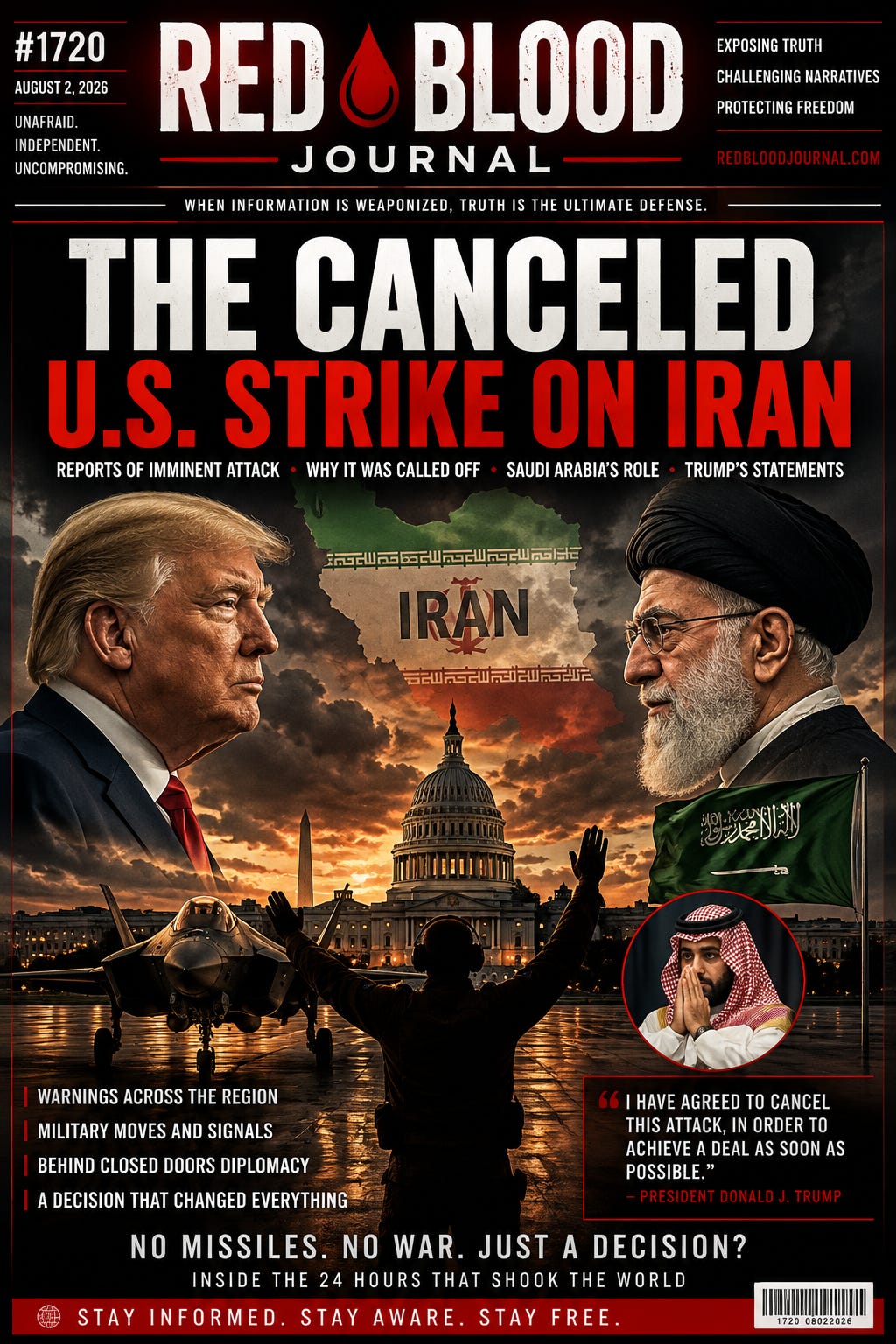
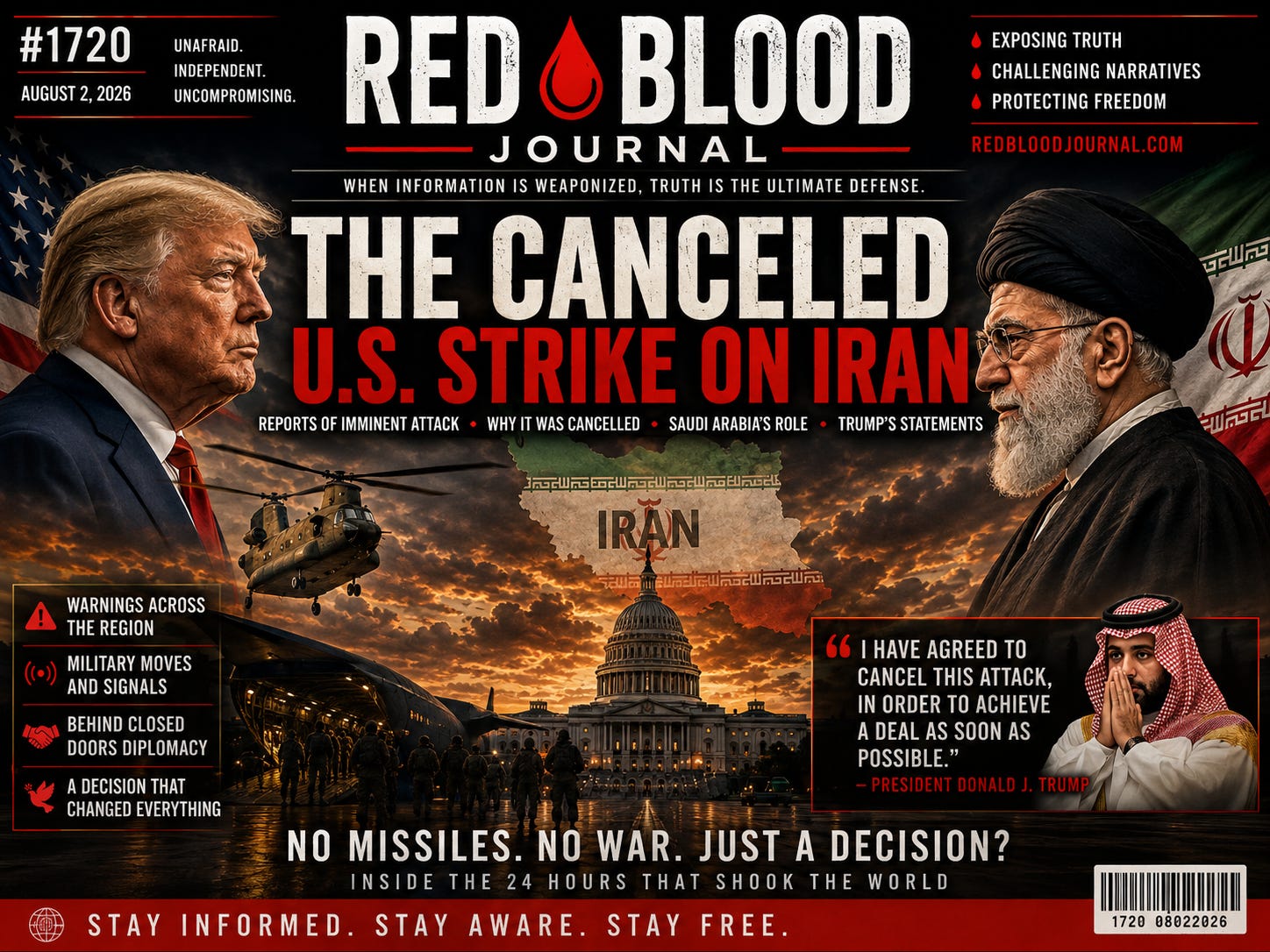
#1720 — The Canceled U.S. Strike on Iran
When Military Pressure Becomes Diplomatic Leverage
August 2, 2026
🩸 RedBloodJournal.com 🩸
For nearly twenty-four hours, reports circulated across American, Middle Eastern, and Iranian media that the United States was preparing a major military strike against the Islamic Republic of Iran. According to the uploaded transcript, numerous warnings suggested an attack could occur within hours, creating widespread anxiety both inside and outside Iran.
Fuel stations reportedly experienced increased demand as citizens prepared for the possibility of war. Social media became saturated with speculation, military imagery, and countdowns to what many believed would be the beginning of a new phase in the regional conflict.
Then the attack did not happen.
According to the transcript, this was described as another instance in which President Donald Trump reportedly decided not to authorize military action after it appeared imminent. The source claims that discussions with Saudi Crown Prince Mohammed bin Salman played a significant role in that decision, with the request framed as one intended to preserve regional stability and protect the future prosperity of Iran.
The transcript further states that Trump subsequently declared the United States possessed an unprecedented level of military readiness while also expressing a willingness to postpone military action if a rapid agreement could be reached.
Whether or not military action was ever truly imminent is impossible to determine from public information alone.
Military planning often involves preparing multiple options that may never be executed.
Political leaders frequently use uncertainty as part of strategic communication.
As a result, governments rarely reveal whether public military preparations are intended as genuine operational planning, diplomatic leverage, psychological signaling, or some combination of all three.
Throughout the period described in the transcript, observers interpreted various public actions differently.
Trump remained highly active on social media, publishing a series of unrelated AI-generated images and occasional military-themed posts rather than issuing direct warnings about an attack. At roughly the same time, U.S. Central Command reportedly released imagery of a CH-47 Chinook helicopter, leading some commentators to interpret it as a possible signal of military readiness.
Military analysts have long noted that visible troop movements and equipment deployments can serve multiple purposes.
They may support real operational preparations.
They may reassure allies.
They may deter adversaries.
Or they may increase diplomatic pressure without any intention of immediate combat.
The transcript presents one interpretation offered by former U.S. military member Joe Lambert, who argued that any future operation would likely resemble a rapid precision campaign rather than a prolonged ground war. He described the concept as a “surgical” effort focused on leadership and command capabilities rather than the occupation of Iran. These statements represent the interviewee’s analysis rather than independently verified military planning.
Regardless of whether an attack was ever actually scheduled, the events described illustrate how modern geopolitics increasingly unfolds through information as much as through military hardware.
Markets react.
Governments prepare.
Citizens change their behavior.
Media organizations amplify uncertainty.
Diplomatic negotiations continue behind closed doors.
Sometimes no missiles are launched.
Yet the strategic effects have already been achieved.
History contains many examples in which the credible possibility of force became more influential than force itself.
Whether this episode ultimately represented deterrence, negotiation, political theater, or genuine last-minute diplomacy remains a matter of interpretation.
Only those directly involved know exactly what decisions were made behind closed doors.
For everyone else, the distinction between preparing for war and using the possibility of war as leverage is often impossible to see in real time.
🩸 The Red Blood Perspective
Modern conflicts are no longer fought only with aircraft, missiles, and soldiers.
They are also fought through uncertainty.
When millions of people cannot distinguish between preparation, negotiation, and psychological signaling, uncertainty itself becomes a strategic instrument.
Perhaps one
🌊 Ocean of Love and Positivity
Beyond every military headline, political negotiation, or canceled strike are millions of ordinary human beings who simply wish to wake up in peace, raise their families, build meaningful lives, and look toward tomorrow without fear.
History reminds us that governments negotiate, leaders change, and strategies evolve, but the hopes of ordinary people remain remarkably constant across every nation. Americans, Iranians, Israelis, Saudis, and people throughout the world all share the same red blood, the same desire to protect those they love, and the same dream that tomorrow will be better than today.
Perhaps the greatest victory is not when one nation defeats another, but when wisdom prevents a battle that never needed to be fought.
If diplomacy succeeds where weapons could have spoken, humanity has already gained something precious. If conflict can be delayed long enough for understanding to grow, then every child who sleeps safely tonight is part of that victory.
The future has not yet been written.
Every decision made in moments of tension has the power either to deepen division or to open another path. History often celebrates the battles that were fought, but perhaps the greatest achievements are the wars that were quietly avoided.
May every nation one day measure its strength not only by the power of its military, but by its ability to preserve life, dignity, and hope for future generations.
In an Ocean of Love and Positivity.
🩸🌊✨ Fantastic!
🕊️
🕊️ The Strategic Brink:
Diplomacy Through the Threat of Force
Aug 2, 2026
This report examines a canceled military strike on Iran, highlighting how the credible threat of force can serve as a potent diplomatic tool. It details how President Trump reportedly opted for restraint after high-level discussions with Saudi leadership, choosing strategic uncertainty over immediate combat. The text explains that visible military preparations are often used for psychological signaling and to gain leverage during negotiations. While the public experienced significant anxiety and market shifts, the source suggests that the ultimate goal was achieving regional stability without actual bloodshed. Ultimately, the narrative emphasizes that avoiding conflict through wisdom and communication is a greater victory than any battlefield success.


