


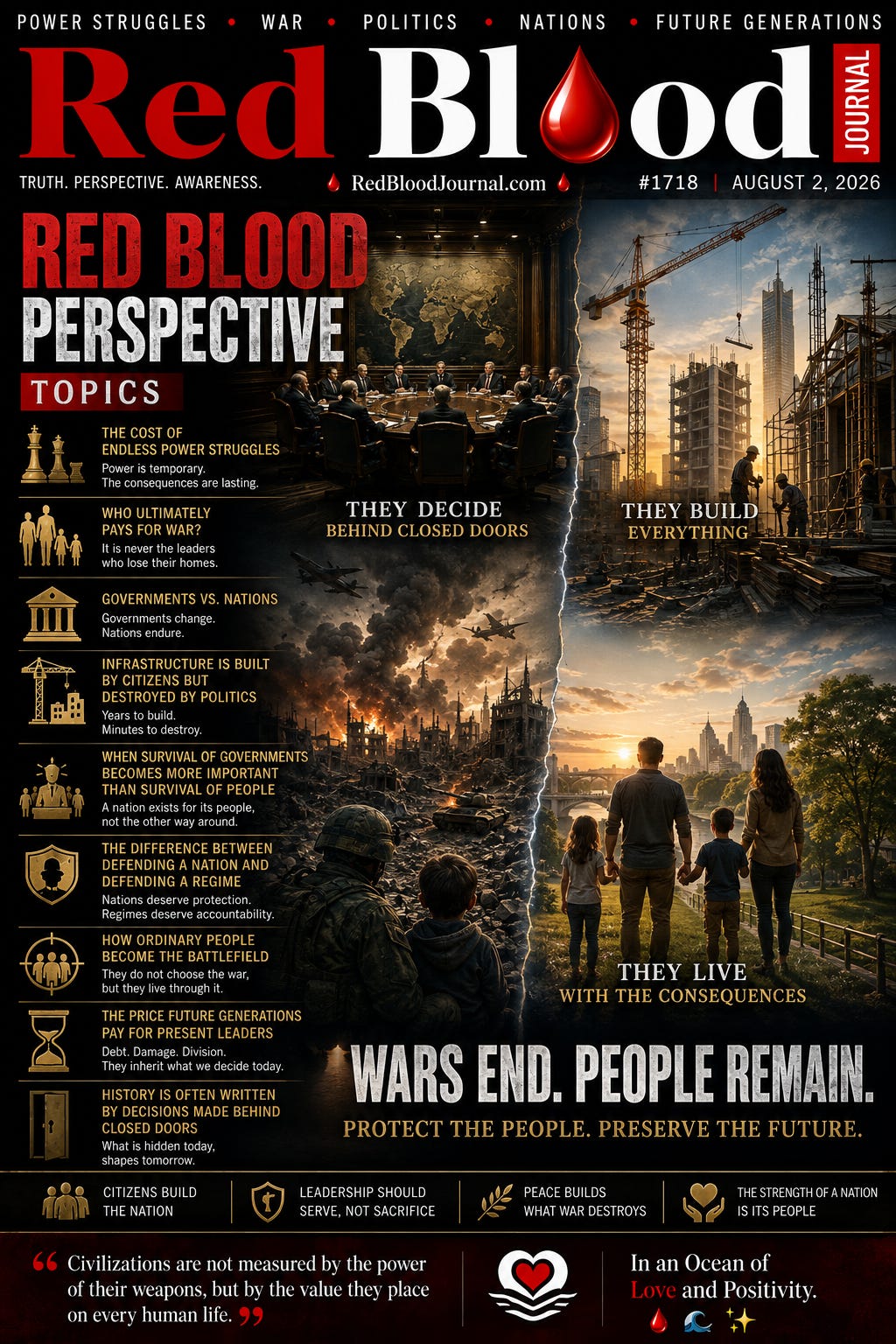

#1718 — Governments vs. Nations
The Cost of Endless Power Struggles
August 2, 2026
🩸 RedBloodJournal.com 🩸
History is often presented as a contest between nations.
Country against country.
Flag against flag.
Army against army.
But when the smoke clears, another question quietly remains.
Who actually paid the price?
Governments make decisions.
Generals develop strategies.
Politicians negotiate.
Intelligence agencies calculate.
Yet it is rarely those individuals who experience the greatest consequences.
Instead, the burden almost always falls upon ordinary citizens.
The factory worker.
The teacher.
The farmer.
The mechanic.
The nurse.
The student.
The child who has never voted in an election.
Throughout history, roads have been built by citizens.
Bridges have been built by citizens.
Power plants have been built by citizens.
Schools.
Hospitals.
Ports.
Railroads.
Entire civilizations are constructed through the labor of millions of ordinary people over generations.
Yet they can disappear within days.
A bridge that required five years to build may collapse in five minutes.
A power station representing decades of investment may become rubble before sunrise.
A city that took centuries to grow can become a battlefield in a single month.
Infrastructure has no political party.
Concrete does not vote.
Electricity does not choose sides.
Water systems do not declare allegiance.
Yet they often become targets because governments view infrastructure as strategic leverage.
The tragedy is that while governments fight each other, it is citizens who lose the hospitals.
Citizens who lose electricity.
Citizens who lose drinking water.
Citizens who lose transportation.
Citizens who lose employment.
Citizens who lose their future.
Wars are frequently described as conflicts between governments.
In reality, they often become struggles endured by entire populations.
Future generations inherit damaged economies.
Destroyed industries.
National debt.
Environmental damage.
Psychological trauma.
Political division.
And the rebuilding begins again.
History repeatedly demonstrates another distinction that is often overlooked.
A government is not the same as a nation.
Governments change.
Nations endure.
Administrations rise and fall.
Borders sometimes change.
Leaders come and go.
But families remain.
Communities remain.
Culture remains.
Language remains.
Future generations remain.
When the survival of a government becomes more important than the well-being of its own people, difficult moral questions naturally emerge.
Should every sacrifice be accepted?
Should every city become expendable?
Should every generation inherit the consequences of decisions they never participated in making?
These questions have appeared throughout every era.
Ancient empires.
European kingdoms.
Modern democracies.
Military dictatorships.
Revolutionary governments.
No political system has been completely immune.
Perhaps the greatest misunderstanding in geopolitics is believing that every military objective automatically serves the interests of the nation itself.
Sometimes they do.
Sometimes they do not.
Distinguishing between defending a nation and defending those temporarily governing that nation has challenged societies throughout history.
Meanwhile, ordinary citizens continue living their daily lives.
Going to work.
Raising children.
Building businesses.
Paying taxes.
Repairing homes.
Planning futures.
Most simply hope to live peacefully regardless of which politicians occupy government buildings.
History books often celebrate military victories and diplomatic agreements.
Far less attention is given to those who quietly rebuilt everything afterward.
The construction workers.
The engineers.
The farmers.
The doctors.
The teachers.
The families who began again after the cameras disappeared.
Perhaps they are the true architects of civilization.
Not because they commanded armies.
But because they rebuilt what armies destroyed.
The Red Blood Perspective
Power struggles eventually end.
Governments eventually change.
Political movements eventually evolve.
But every destroyed bridge, every damaged school, every displaced family reminds us that the true wealth of a nation has never been found inside government buildings.
It has always existed within its people.
The greatest measure of leadership is not simply protecting authority.
It is protecting the lives, opportunities, dignity, and future of those who entrusted that authority in the first place.
History may remember the leaders.
Civilization survives because of the citizens.
Ocean of Love and Positivity
Every child born into this world deserves to inherit bridges instead of battlefields.
Schools instead of shelters.
Opportunity instead of fear.
When humanity begins measuring success by how many lives are improved rather than how many victories are declared, civilization itself advances.
The strongest nation may ultimately be the one that preserves the most hope for the next generation.
In an Ocean of Love and Positivity.
🩸🌊✨ Fantastic!
🏘️
🏘️ The Architects of Civilization:
Governments vs. Nations
Aug 2, 2026
This text explores the profound disconnect between government actions and the well-being of the civilian population. It argues that while political leaders and military strategists initiate conflicts, it is the ordinary citizens who endure the destruction of their infrastructure, economy, and safety. The author highlights that nations are defined by their people and culture rather than temporary administrations or the pursuit of institutional power. By contrasting the labor of building civilization with the rapid devastation of war, the source suggests that true leadership should prioritize protecting human life and future opportunity. Ultimately, the narrative honors the resilience of common people who must rebuild what power struggles have dismantled.


