


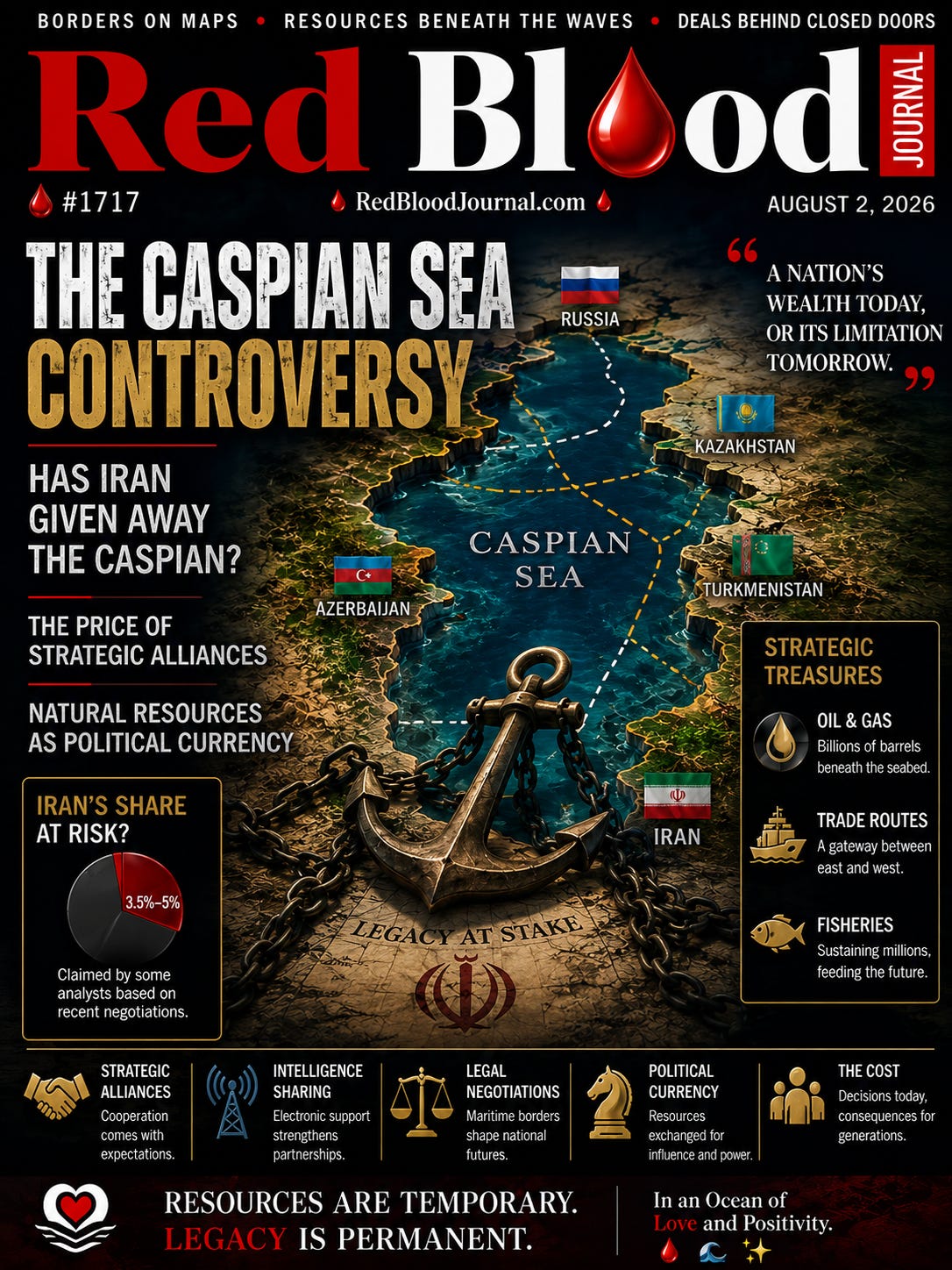
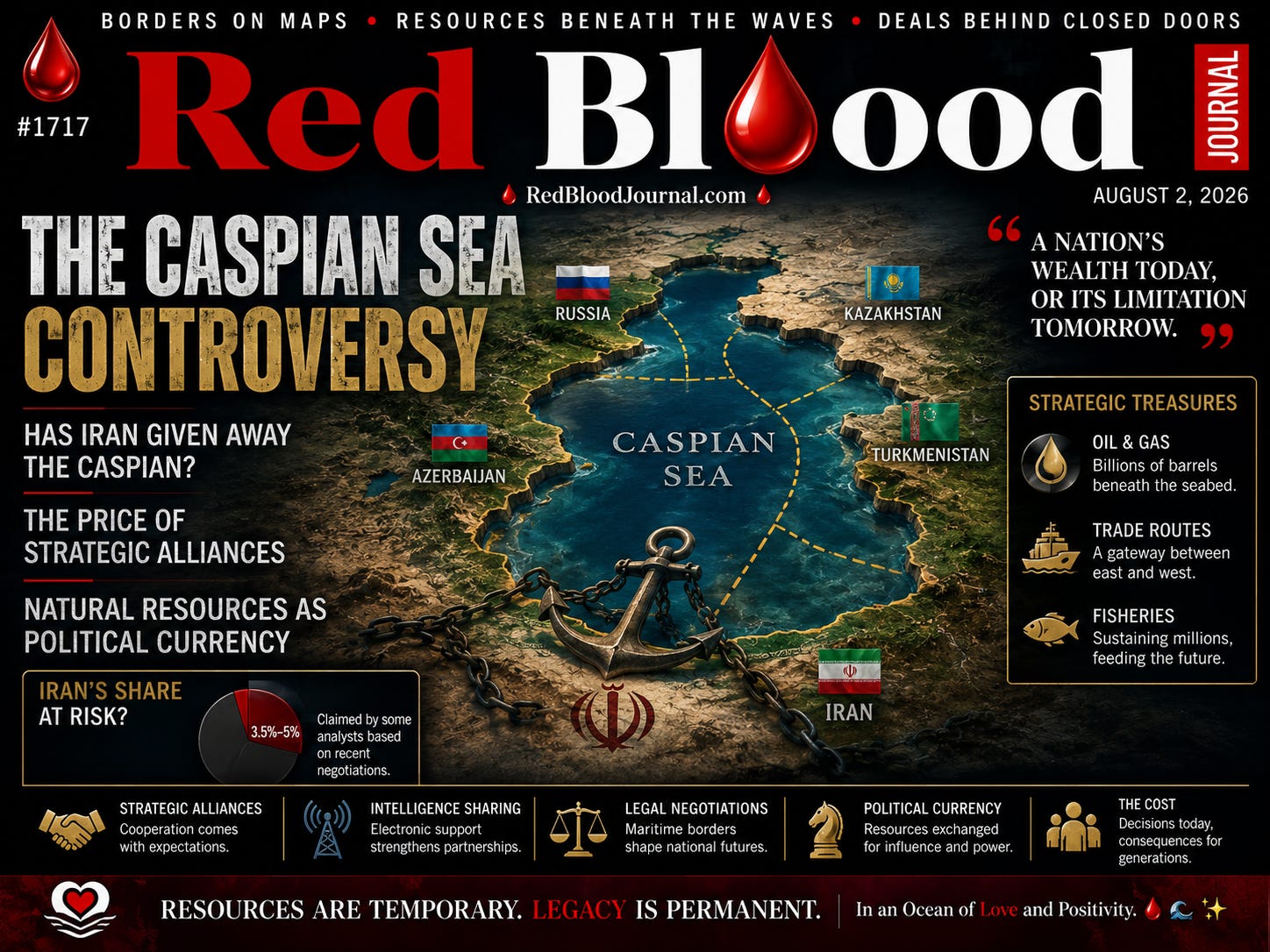
#1717 — The Caspian Sea Controversy
Has Iran Given Away the Caspian?
The Price of Strategic Alliances
Natural Resources as Political Currency
August 2, 2026
🩸 RedBloodJournal.com 🩸
The Caspian Sea has long been one of the world’s most strategically important bodies of water.
Beneath its surface lie significant reserves of oil and natural gas.
Its shores connect Europe, Central Asia, Russia, the Caucasus, and Iran.
Control over its waters has never been merely about geography.
It has always been about power.
Recent political debate inside Iran has once again placed the Caspian Sea at the center of national attention.
According to the uploaded transcript, several commentators and political figures argue that the Iranian government is moving toward accepting legal arrangements that could substantially reduce Iran’s effective share of the Caspian Sea.
Some speakers claim that Iran’s practical share could fall to between 3.5% and 5%, arguing that this would represent a dramatic reduction from previous expectations and would amount to a major strategic concession. These claims are presented within the transcript as the views of the commentators quoted and are part of an ongoing political controversy.
The transcript suggests that supporters of this view believe such concessions are connected to broader geopolitical considerations.
Their argument is that strategic cooperation with Russia has become increasingly important during a period of heightened regional tensions.
In this interpretation, access to natural resources and maritime boundaries becomes part of a larger geopolitical negotiation rather than an isolated legal issue.
Whether those conclusions ultimately prove correct remains a matter of political debate.
What is certain is that natural resources have repeatedly served throughout history as bargaining chips between nations.
Oil.
Natural gas.
Minerals.
Ports.
Shipping routes.
Waterways.
These assets frequently become intertwined with military alliances, economic agreements, and diplomatic negotiations.
The Caspian Sea is no exception.
The transcript also discusses reports that Russia has been sharing valuable electronic intelligence with Iran during a period of increasing military tension.
Some commentators cited in the transcript suggest that these developments should be viewed together with the Caspian negotiations, arguing that strategic support between allies often carries political or economic expectations.
Again, these interpretations are presented within the transcript as analysis rather than established fact.
History demonstrates that alliances rarely exist without mutual interests.
Every nation evaluates partnerships according to perceived national advantage.
Sometimes the exchange involves military cooperation.
Sometimes technology.
Sometimes economic investment.
Sometimes access to strategic territory.
Sometimes control over valuable natural resources.
For citizens, however, these negotiations often feel distant.
Most people are not present when treaties are negotiated.
They are not present when borders are discussed.
They are not present when maritime rights are debated.
Yet they may live with the consequences for generations.
The Caspian Sea controversy also highlights a broader lesson.
Natural resources are not simply economic assets.
They represent long-term national leverage.
Once rights are transferred or legally redefined, reversing those decisions can become extraordinarily difficult.
Whether discussing energy fields, shipping lanes, fishing rights, or territorial waters, governments frequently make decisions whose consequences extend far beyond the political careers of those making them.
Future generations inherit those choices.
Not only the benefits.
But also the limitations.
This is why debates surrounding maritime agreements often generate strong public emotion.
Citizens recognize that borders drawn on maps may ultimately determine future economic opportunity, national security, and geopolitical influence.
The transcript concludes that many Iranians view these developments with concern, believing that larger geopolitical calculations may be taking precedence over long-term national interests. Others may interpret the same events differently, emphasizing diplomacy, regional stability, or practical cooperation.
Regardless of perspective, the discussion illustrates how strategic geography remains one of the most valuable forms of political currency in international affairs.
The Red Blood Perspective
The Caspian Sea controversy reminds us that modern geopolitics is often negotiated through resources rather than rhetoric.
Energy.
Water.
Transportation.
Territory.
These are the currencies that nations frequently exchange in pursuit of security and influence.
Citizens benefit when important national decisions are transparent, openly debated, and carefully examined from multiple perspectives before becoming permanent.
History has shown that natural resources can enrich a nation for centuries—or become the subject of disputes that last just as long.
Ocean of Love and Positivity
The Earth’s oceans, seas, rivers, and lakes belong to a planet shared by all humanity.
While governments negotiate boundaries, nature itself recognizes none.
Perhaps the greatest wealth is not found beneath the seabed, but in the wisdom to preserve peace, protect future generations, and manage shared resources with fairness and responsibility.
When cooperation replaces fear, resources become bridges rather than battlegrounds.
In an Ocean of Love and Positivity.
🩸🌊✨ Fantastic!
🌊
🌊 The Caspian Sea Controversy:
Sovereignty and Strategic Alliances
Aug 2, 2026
The provided text examines the geopolitical tension surrounding the Caspian Sea, specifically focusing on allegations that Iran is sacrificing its maritime rights for strategic alliances. Critics within the country fear that national natural resources, such as oil and gas, are being used as political currency to secure military and intelligence support from Russia. This controversy highlights a broader historical pattern where territorial boundaries and economic assets are traded during high-stakes diplomatic negotiations. The article emphasizes that these decisions carry long-term consequences for future generations, who must live with the legal and economic limits established by current leaders. Ultimately, the source illustrates how strategic geography remains a vital tool for nations navigating complex international power dynamics.


