


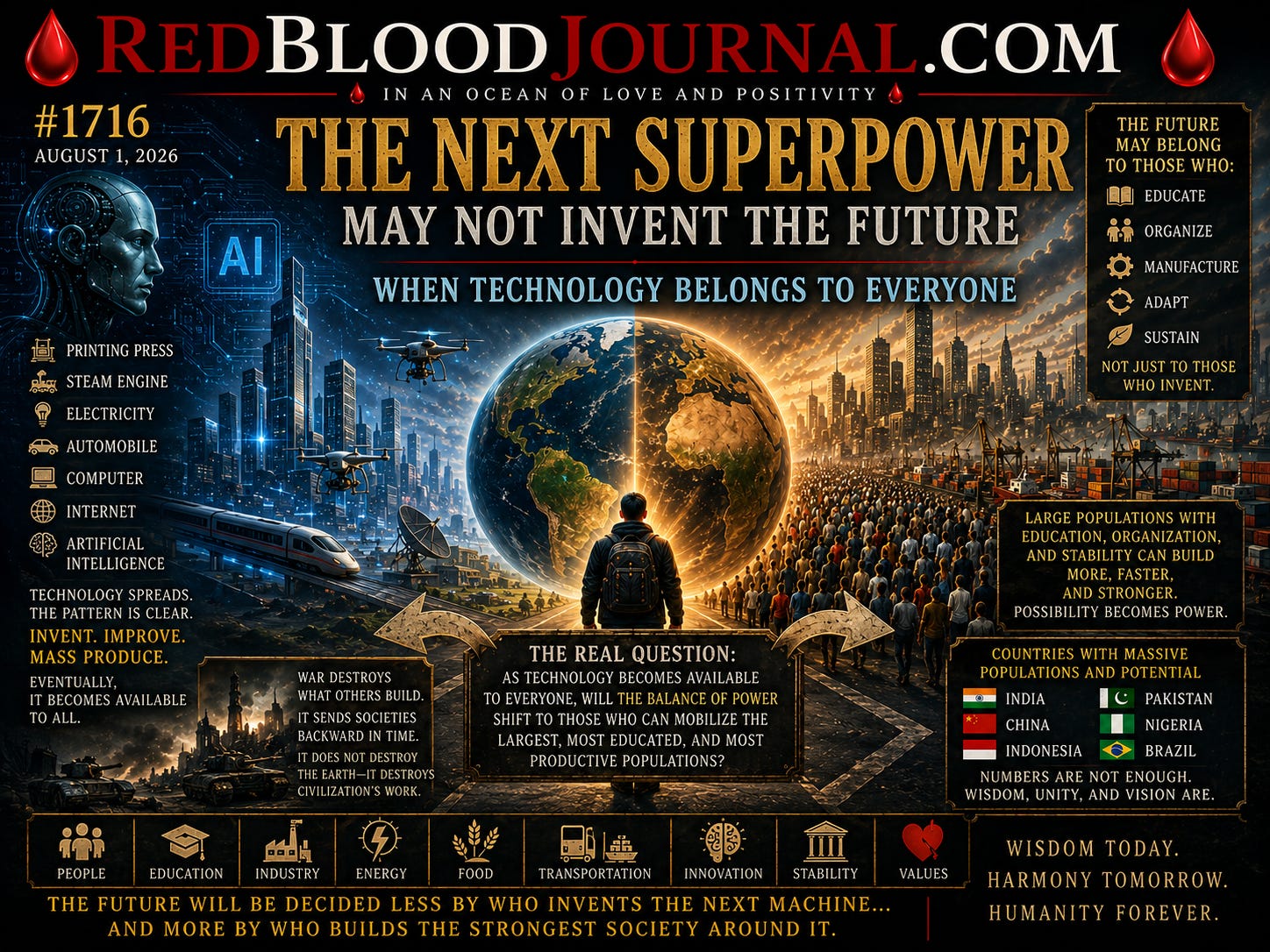
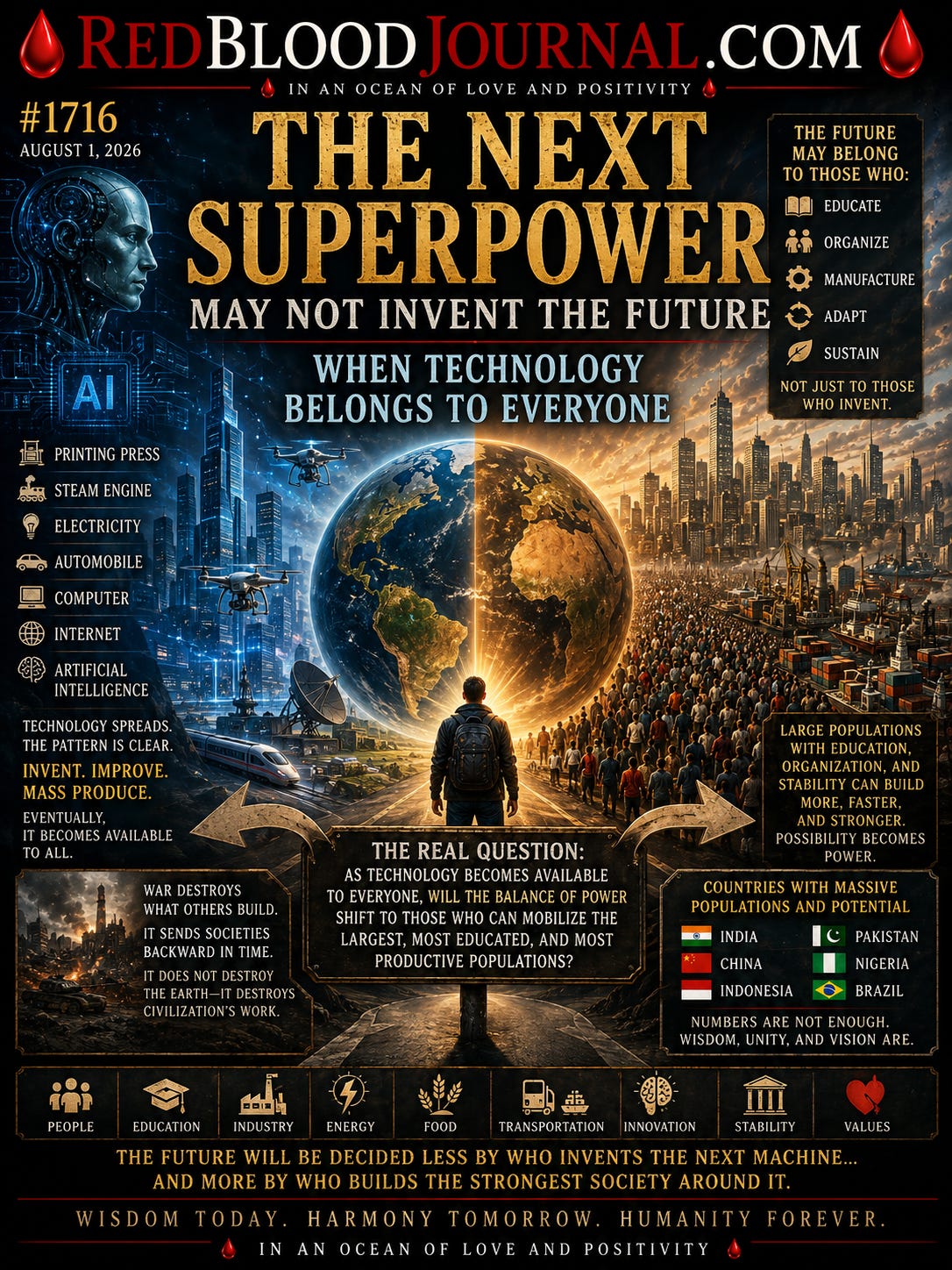
#1716 — The Next Superpower May Not Invent the Future
When Technology Belongs to Everyone
August 1, 2026
🩸 RedBloodJournal.com 🩸
For generations, nations have measured power by technological superiority.
The first to invent.
The first to build.
The first to deploy.
History often rewards those who reach the next breakthrough before everyone else.
But history also teaches another lesson.
Technology rarely remains exclusive forever.
The printing press spread.
Steam engines spread.
Electricity spread.
Automobiles spread.
Computers spread.
The internet spread.
Artificial intelligence is already spreading.
The pattern appears remarkably consistent.
The first generation invents.
The second improves.
The third mass-produces.
Eventually, what was once revolutionary becomes widely available.
If this pattern continues, then a new question emerges.
If technology eventually belongs to everyone...
What becomes the deciding factor?
Perhaps the future belongs less to those who invent and more to those who can organize, educate, manufacture, and sustain.
History shows that wars rarely destroy knowledge itself.
They destroy cities.
Factories.
Infrastructure.
Economies.
Human lives.
War often sends societies backward by destroying what previous generations spent decades building.
In that sense, war is not the destruction of the Earth.
It is the destruction of civilization’s accumulated work.
It pushes the defeated backward in time.
As advanced technologies become increasingly accessible, another possibility emerges.
If two nations possess similar technological knowledge, the determining factor may become the ability to mobilize people, industry, logistics, and resources on a massive scale.
Population alone does not guarantee success.
History demonstrates that leadership, education, industrial capacity, energy, food, transportation, and social stability all matter.
Yet population remains one of the most fundamental resources.
Every engineer.
Every scientist.
Every technician.
Every doctor.
Every builder.
Every farmer.
Every soldier.
Every innovator.
Must first be a human being.
A larger population creates the possibility of developing a larger pool of talent.
Whether that potential becomes reality depends upon education, organization, opportunity, and institutions.
This raises an interesting long-term question.
If technology becomes increasingly available around the world...
Could the balance of power gradually shift toward nations capable of organizing the largest educated and productive populations?
Countries with very large populations may possess advantages that become more significant as technological knowledge spreads.
Whether those advantages are realized depends not only on numbers, but on how effectively those human resources are developed and coordinated.
The future may therefore be decided less by who invents the next machine...
...and more by who builds the strongest society around it.
The Red Blood Perspective
Technology is a tool.
Human character determines how that tool is used.
The greatest inventions in history have built civilizations.
The same inventions have also been used to destroy them.
Perhaps humanity’s greatest challenge is no longer inventing faster.
Perhaps it is learning wisdom as quickly as it learns technology.
Without wisdom, every technological leap risks becoming another instrument of conflict.
With wisdom, the same technology can become a bridge between nations rather than a weapon against them.
Ocean of Love and Positivity
Imagine a future where the competition between nations shifts away from building larger armies toward educating wiser people.
Where the measure of greatness becomes the ability to reduce suffering rather than increase power.
Technology may one day belong to everyone.
The question that remains is whether love, compassion, wisdom, and cooperation will spread just as quickly.
The strongest civilization may ultimately be the one that learns to unite knowledge with humanity.
In an Ocean of Love and Positivity.
🩸🌊✨ Fantastic!
🌍
🌍 The Architecture of a Sustainable Superpower
Aug 2, 2026
This text explores a future where technological superiority is no longer the primary measure of a nation’s dominance. Because revolutionary inventions eventually become accessible to everyone, the author suggests that global influence will shift toward countries that can best organize and educate their citizens. Success will likely depend on a society’s ability to mobilize human resources, industrial capacity, and social stability rather than just being the first to innovate. The source emphasizes that a large, productive population serves as a fundamental asset when paired with effective leadership and infrastructure. Ultimately, the writing argues that civilizational survival requires balancing rapid technical progress with the wisdom to foster cooperation and compassion. Therefore, the next superpower may be defined by its social cohesion and humanity rather than its machines.


