


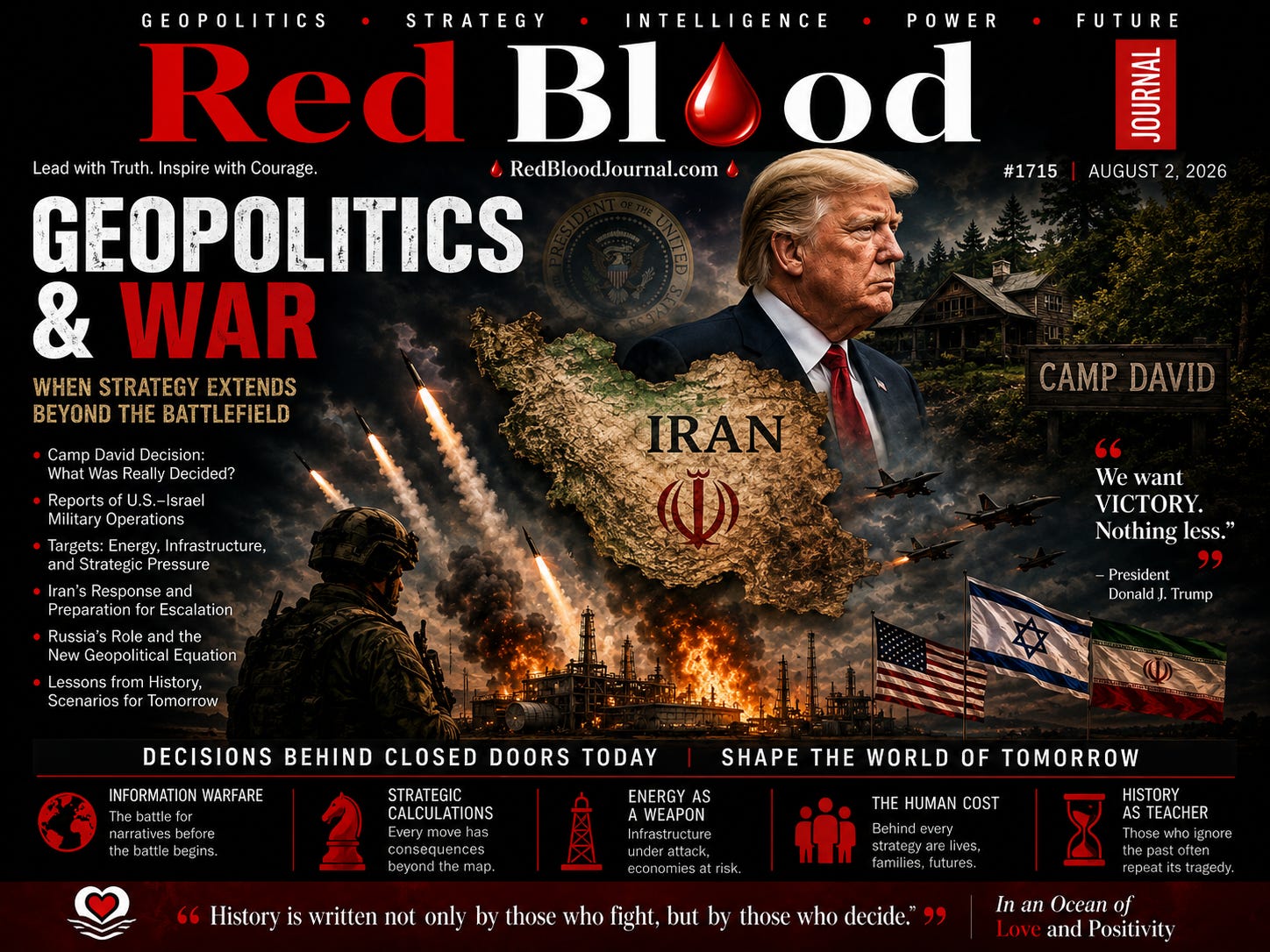
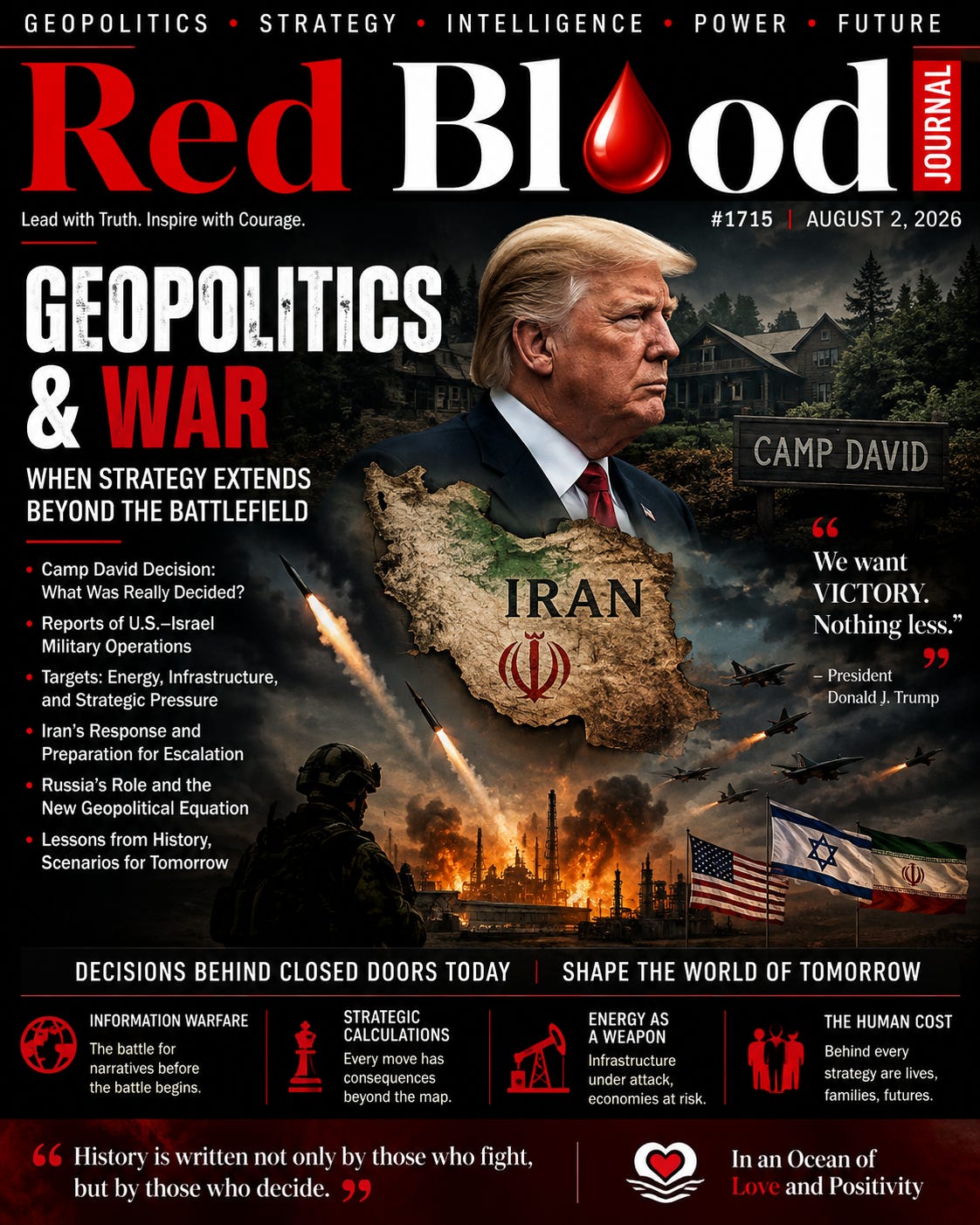
#1715 — Geopolitics & War
When Strategy Extends Beyond the Battlefield
August 2, 2026
🩸 RedBloodJournal.com 🩸
Throughout history, wars have rarely been decided solely by soldiers on the battlefield.
Long before the first missile is launched, decisions are made inside conference rooms, intelligence centers, diplomatic meetings, and military command posts.
The transcript reviewed for this report centers on events surrounding a meeting at Camp David, where President Donald Trump gathered senior officials while speculation intensified regarding possible new military operations involving Iran. The discussion highlights reports, commentary, and analysis surrounding these developments rather than providing official confirmation of future military action.
According to the transcript, public remarks made during the meeting largely repeated familiar themes.
Pressure.
Deterrence.
Victory.
Warnings toward Iran.
Yet shortly afterward, multiple media organizations reportedly published stories suggesting that decisions regarding potential military operations had already been made behind closed doors. The transcript presents this contrast as an example of how public messaging and private strategic planning may differ during periods of international tension.
If accurate, the discussion illustrates an enduring characteristic of geopolitics.
Governments often reveal only a portion of what they are considering.
Diplomacy and military planning frequently operate on separate timelines.
Public statements may be intended to reassure allies, influence adversaries, or preserve operational security while decisions continue behind the scenes.
The transcript also discusses reports that potential targets could include energy infrastructure, refineries, electrical systems, and other facilities considered strategically important. It notes commentary suggesting that such operations would seek to reduce military capability while increasing political pressure on Iranian leadership.
Whether such actions would achieve their intended objectives remains uncertain.
History provides examples supporting multiple outcomes.
Some governments have altered policy after sustained military pressure.
Others have become more determined.
Economic hardship does not always produce political change.
Sometimes it strengthens national resolve.
Sometimes it weakens public confidence.
Sometimes it produces entirely unexpected consequences.
The transcript further presents commentary from Iranian officials and analysts asserting that additional military pressure would not necessarily alter government policy and discusses arguments favoring continued resistance despite growing costs. It also describes debate regarding possible escalation from air campaigns toward broader regional conflict.
Another major theme concerns preparation.
The discussion includes proposals for constructing underground government facilities, reallocating public resources toward wartime infrastructure, and preparing for a prolonged confrontation rather than a short conflict. These proposals are presented within the transcript as evidence that some officials anticipate the possibility of an extended period of instability.
The report also examines how modern conflicts increasingly extend beyond conventional battlefields.
Military operations now involve:
• Cyber capabilities.
• Intelligence sharing.
• Economic sanctions.
• Energy systems.
• Supply chains.
• Information campaigns.
• Financial markets.
• Public opinion.
Victory is no longer measured solely by territory gained or lost.
It is increasingly measured by resilience.
Who can maintain production?
Who can maintain public confidence?
Who can sustain alliances?
Who can endure the longest?
The transcript also discusses reported intelligence cooperation between Russia and Iran and ongoing geopolitical calculations involving major powers. Whether these developments materially alter the balance of power remains uncertain, but they illustrate how regional conflicts increasingly attract broader international involvement.
Perhaps the greatest lesson from geopolitics is that every nation views the same event through a different strategic lens.
One government may describe an operation as defense.
Another calls it aggression.
Another calls it deterrence.
Another calls it liberation.
The terminology often depends upon perspective rather than universal agreement.
For ordinary citizens, however, the consequences are usually far less abstract.
Wars affect families.
Businesses.
Infrastructure.
Energy.
Food.
Healthcare.
Education.
Generations may spend decades rebuilding what only weeks of conflict destroyed.
The Red Blood Perspective
Geopolitics reminds us that nations compete, negotiate, cooperate, and sometimes fight in pursuit of security and influence.
Understanding these events requires separating confirmed facts from predictions, public statements from private strategy, and analysis from certainty.
History often becomes clearer only after decisions have already reshaped the world.
The responsibility of citizens is not merely to react to headlines, but to continue asking thoughtful questions, examining multiple sources, and recognizing that complex international events rarely fit into simple narratives.
Ocean of Love and Positivity
Beyond every map, border, and military strategy are human beings who hope for safety, dignity, and a better future for their children.
While governments pursue national interests, humanity continues to share one planet.
The greatest victories may ultimately be those that preserve life, encourage understanding, and reduce suffering without sacrificing truth or independent thought.
Every conflict reminds us how valuable peace truly is.
In an Ocean of Love and Positivity.
🩸🌊✨ Fantastic!
🌍
🌍 The Architecture of Modern Conflict
Aug 2, 2026
This text examines the complex interplay between public diplomacy and private military strategy during times of international tension, specifically regarding potential conflict with Iran. It highlights how modern warfare has evolved beyond physical battlefields to include cyber capabilities, economic sanctions, and psychological resilience. The source notes a significant disconnect between official government narratives and clandestine planning, emphasizing that strategic goals often involve targeting critical infrastructure to exert political pressure. Furthermore, it explores the global implications of regional instability, such as shifting alliances with powers like Russia and the long-term humanitarian costs of war. Ultimately, the report encourages readers to look past simple media narratives to understand the multifaceted reality of geopolitical competition.


