


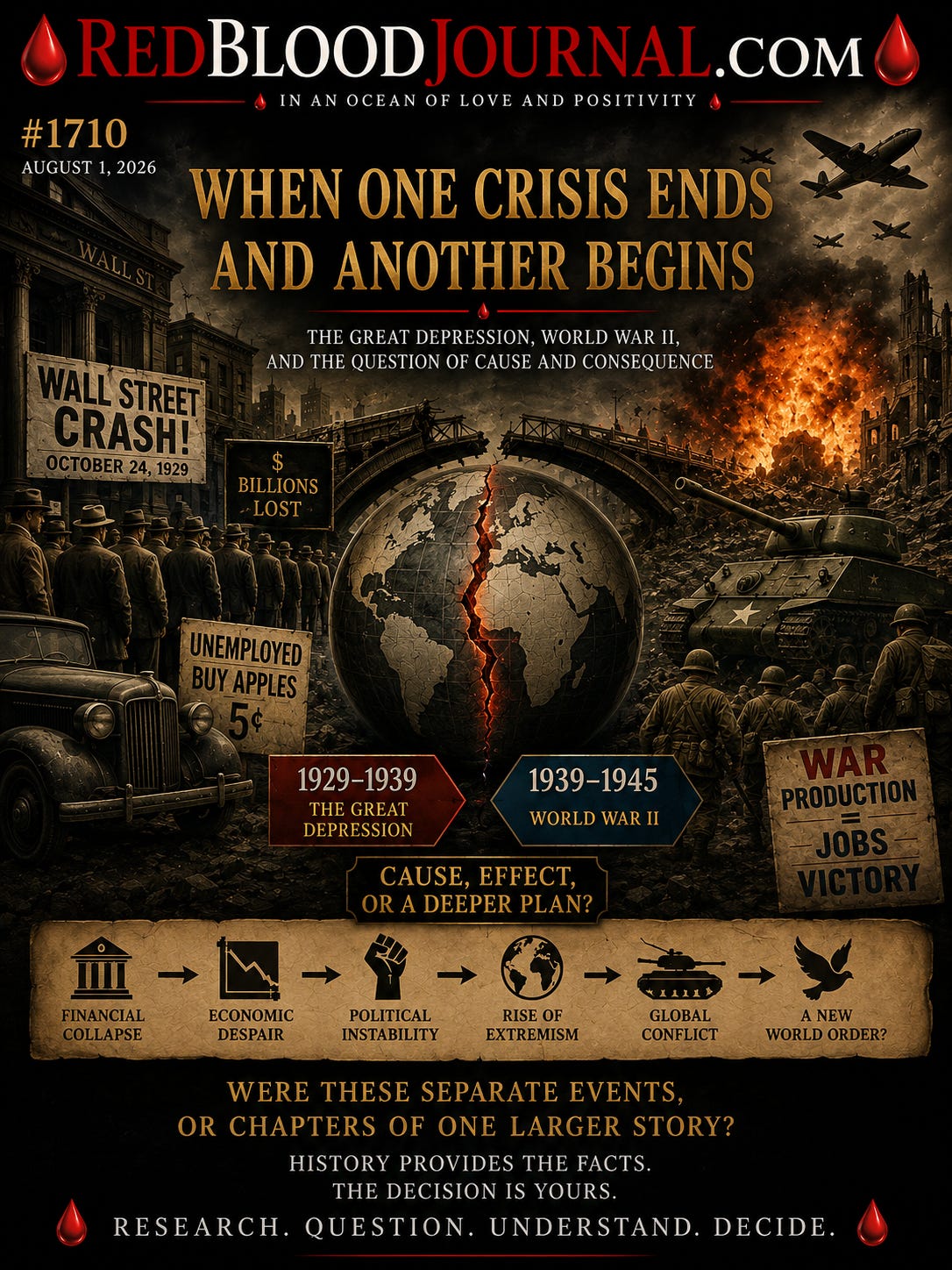
#1710 — When One Crisis Ends and Another Begins
The Great Depression, World War II, and the Question of Cause and Consequence
August 1, 2026
🩸 RedBloodJournal.com 🩸
History often presents major events as separate chapters.
The Great Depression.
Then World War II.
One economic.
One military.
Yet many historians view them as deeply connected.
The Great Depression officially began with the stock market crash of October 1929 and spread into a worldwide economic collapse.
Banks failed.
Businesses closed.
International trade contracted.
Unemployment reached levels previously unimaginable in many countries.
As governments searched for solutions, political landscapes changed dramatically.
Some nations expanded public works.
Others restructured their financial systems.
Still others experienced growing political extremism.
During the same decade, authoritarian governments gained strength in several countries.
Economic hardship created fertile ground for promises of rapid national renewal, stability, and restored prosperity.
By 1939, Europe entered another global war.
To some historians, the Depression did not directly cause World War II but created conditions that increased political instability and made conflict more likely.
Others place greater emphasis on ideology, territorial ambitions, unresolved consequences of World War I, and diplomatic failures.
There is also continuing debate about how the Depression ended.
One view holds that recovery had already begun before the war through policy reforms and economic adjustment.
Another argues that massive wartime industrial production, government spending, and military mobilization finally restored full employment and brought the Depression to an end in the United States.
These competing interpretations continue to be discussed by economists and historians.
The period from 1914 through 1945 can therefore be viewed not as isolated events but as one interconnected era:
World War I.
The rebuilding of the international financial system.
The Roaring Twenties.
The stock market crash.
The Great Depression.
The rise of new political movements.
World War II.
Whether these events were independent crises or successive chapters of one larger historical transformation remains an open question for readers to examine.
The Red Blood Perspective
History often appears to move in separate headlines.
In reality, today’s events frequently grow from yesterday’s decisions.
Understanding the links between economics, politics, diplomacy, and human behavior may reveal patterns that are not immediately visible when each event is studied alone.
The more humanity understands those connections, the better prepared future generations may be to recognize similar patterns before they become crises.
Ocean of Love and Positivity
The greatest lesson from history may not be to assign blame, but to deepen wisdom.
When societies learn from hardship instead of repeating it, suffering becomes a teacher rather than a permanent cycle.
The hope for every generation is that knowledge, compassion, and thoughtful leadership will reduce the need for future crises and open a path toward greater cooperation and peace.
In an Ocean of Love and Positivity.
🩸🌊✨ Fantastic!
📖
📖 The Interconnected Era:
From Depression to Global Conflict
Aug 1, 2026
The provided text explores the interconnected nature of the Great Depression and World War II, questioning whether they were isolated events or a singular, continuous era of transformation. It highlights how the global economic collapse of 1929 fostered political extremism and instability, creating a landscape conducive to international conflict. While some scholars argue that wartime industrialization finally ended the financial crisis, others emphasize the role of ideology and diplomacy in shaping these decades. Ultimately, the source encourages readers to recognize historical patterns to better prepare for future challenges. By understanding the links between economics and human behavior, the text suggests that society can transform past hardships into wisdom and cooperation.


