


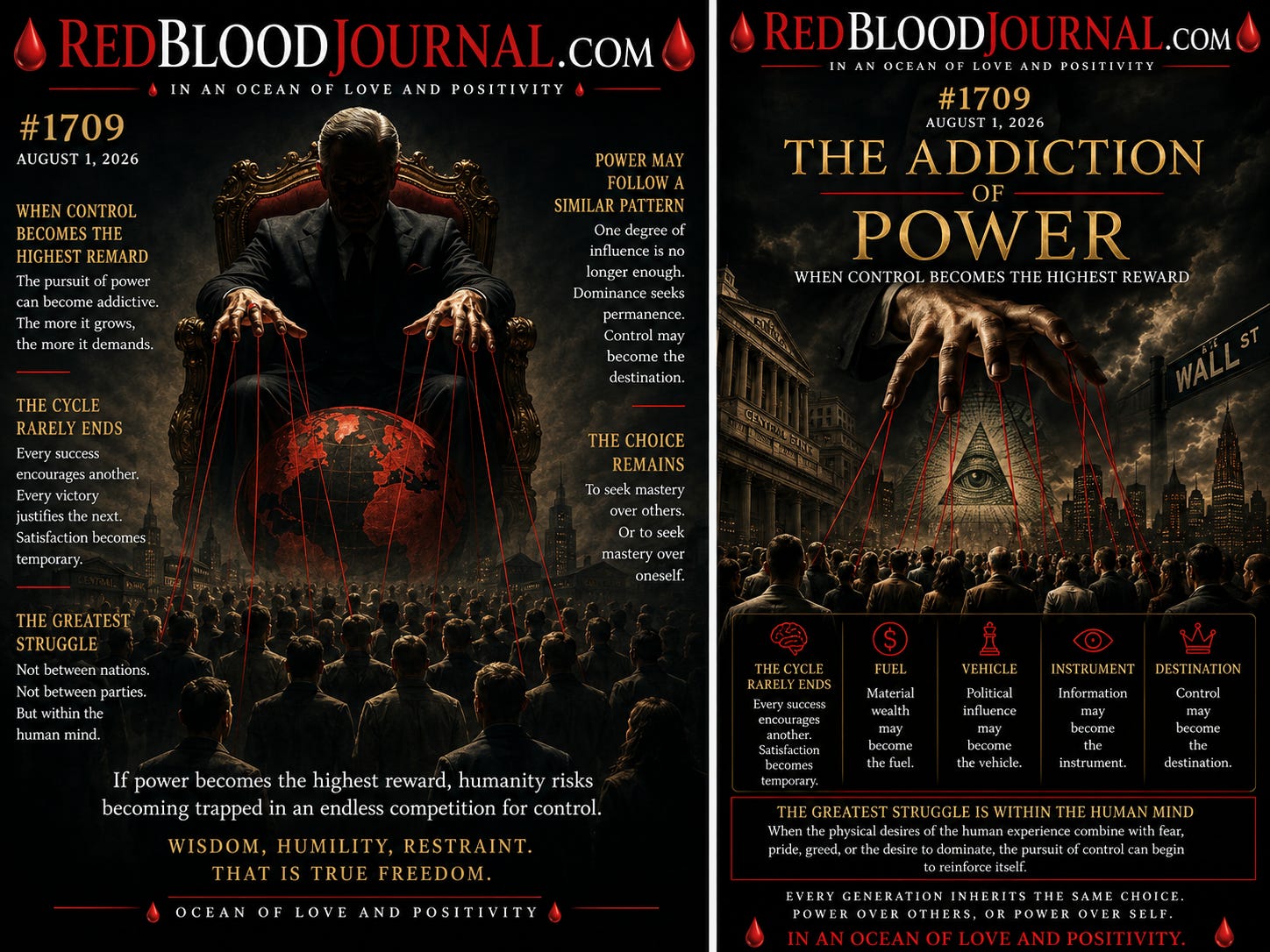
#1709 — The Addiction of Power
When Control Becomes the Highest Reward
August 1, 2026
🩸 RedBloodJournal.com 🩸
Throughout history, humanity has often measured success by material accumulation.
More wealth.
More territory.
More influence.
More authority.
Yet another possibility deserves consideration.
What if the pursuit of control over other human beings can itself become addictive?
Most addictions begin with a reward.
The first experience produces satisfaction.
The second seeks to repeat it.
Eventually, the pursuit becomes the purpose.
Power may follow a similar pattern.
One degree of influence is no longer enough.
A business becomes an empire.
An empire seeks dominance.
Dominance seeks permanence.
What originally served a practical purpose can evolve into an endless pursuit.
This report does not claim that everyone who holds power shares the same motivations.
Many leaders throughout history have genuinely sought to improve the lives of those they served.
Others have been driven primarily by security, ambition, ideology, or a sense of duty.
But history also records examples where individuals and institutions accumulated power beyond what was necessary for governance, suggesting that the pursuit of control itself can become an objective.
In that sense, power may resemble an addiction.
The more it grows, the more it demands.
Material wealth may become the fuel.
Political influence may become the vehicle.
Information may become the instrument.
Control may become the destination.
From this perspective, the greatest struggle is not between nations.
Nor between political parties.
Nor between economic systems.
It is the struggle within the individual mind.
When the physical desires of the human experience combine with fear, pride, greed, or the desire to dominate, the pursuit of control can begin to reinforce itself.
Every success encourages another.
Every victory justifies the next.
Every expansion appears to require another expansion.
Like many addictions, satisfaction becomes temporary.
The next achievement is always necessary.
The next acquisition.
The next position.
The next influence.
The cycle rarely ends on its own.
This possibility raises an important question.
If societies reward the accumulation of power without equally rewarding wisdom, humility, and restraint, what kinds of leaders are most likely to rise?
History offers examples of both restraint and excess.
Some individuals voluntarily surrendered power.
Others sought to retain it indefinitely.
Some institutions developed systems of checks and balances.
Others concentrated authority in fewer hands.
These contrasting examples suggest that the relationship between power and human character deserves continued examination.
Rather than beginning with the assumption that all powerful people are benevolent—or that all are malicious—it may be more useful to ask a different question:
Does the pursuit of greater control change the person pursuing it?
And if so, how can societies encourage leadership that serves rather than dominates?
The Red Blood Perspective
Every generation inherits the same fundamental choice.
To seek mastery over others.
Or to seek mastery over oneself.
Material achievements may build cities, companies, governments, and institutions.
But the greatest achievement may be learning when enough is enough.
If power becomes the highest reward, humanity risks becoming trapped in an endless competition for control.
If wisdom becomes the highest reward, power becomes a responsibility rather than an addiction.
The future may depend less on who holds authority and more on the character of those entrusted with it.
Ocean of Love and Positivity
Perhaps the greatest freedom is not the power to direct others, but the ability to govern one’s own thoughts, actions, and desires with compassion and humility.
A society that values character as highly as success may discover that its strongest leaders are not those who seek the most control, but those who inspire the most trust.
When people cultivate integrity within themselves, the need to dominate others naturally begins to diminish.
In an Ocean of Love and Positivity.
🩸🌊✨ Fantastic!
👑
👑 The Addiction of Power
Aug 1, 2026
This article explores the concept that the pursuit of authority can transform into a self-sustaining addiction to control. Rather than being a means to an end, the acquisition of influence often becomes an insatiable cycle where each success justifies further expansion. The text suggests that history is defined by the tension between those who seek dominance over others and those who practice self-mastery and restraint. By comparing power to a substance that demands ever-increasing doses, the author warns that material wealth and political status are often just tools for this psychological dependency. Ultimately, the source argues that a healthy society must prioritize character and wisdom over raw ambition to prevent leadership from becoming predatory. To break this cycle, the focus of progress should shift from external governance to the cultivation of personal integrity and humility.


