


#1708 — The Great Depression
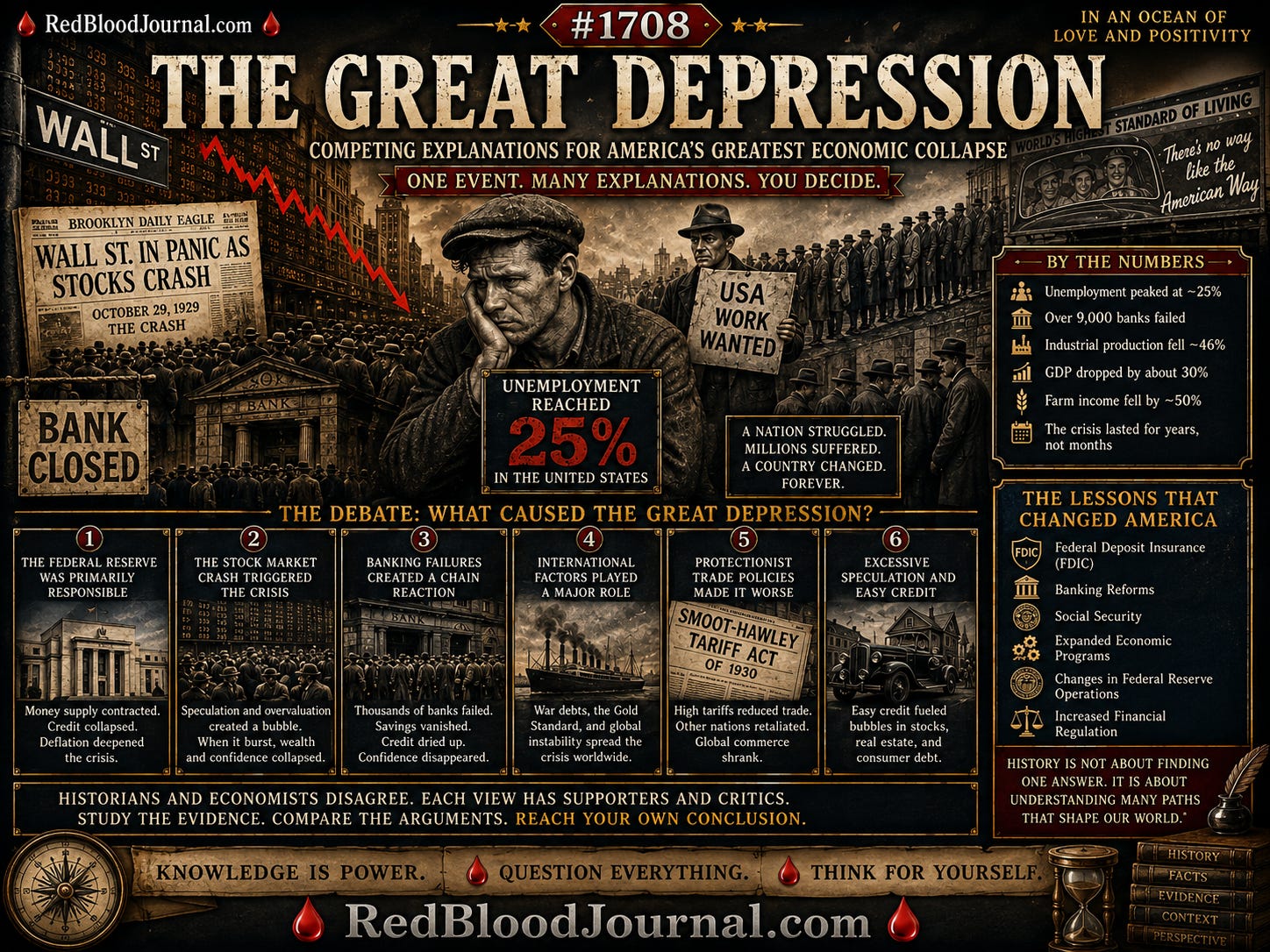
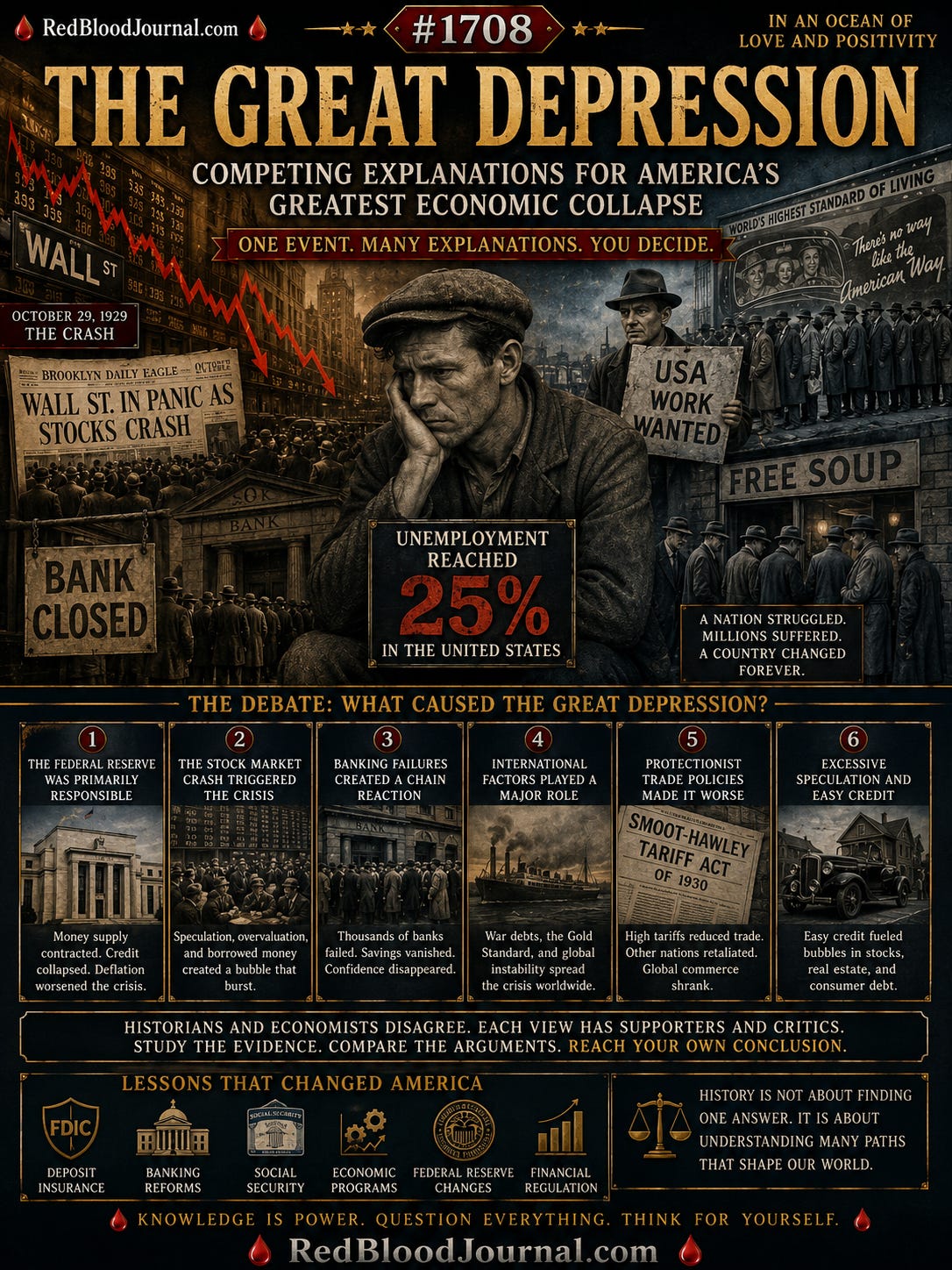
Competing Explanations for America’s Greatest Economic Collapse
August 1, 2026
🩸 RedBloodJournal.com 🩸
One Event. Many Explanations.
The Great Depression remains one of the most studied events in modern economic history.
Beginning with the stock market crash of 1929, it led to widespread bank failures, business closures, unemployment that reached approximately 25 percent in the United States, and years of severe economic hardship.
Nearly a century later, historians and economists continue to debate a fundamental question:
What caused it?
There is no single universally accepted answer.
Instead, several major schools of thought have emerged.
View 1 — The Federal Reserve Was Primarily Responsible
One influential interpretation argues that the Federal Reserve either caused or significantly worsened the Great Depression.
Economists such as Milton Friedman and Anna Schwartz argued that after the banking crises began, the Federal Reserve allowed the money supply to contract dramatically.
According to this view:
Banks failed in large numbers.
Credit disappeared.
Businesses could not obtain financing.
Consumer spending collapsed.
Deflation intensified the crisis.
Supporters of this interpretation contend that a more aggressive response by the Federal Reserve could have prevented much of the economic collapse.
View 2 — The Stock Market Crash Triggered the Crisis
Another interpretation focuses on the stock market crash of October 1929.
During the 1920s, stock prices had risen rapidly, fueled in part by speculative investing and purchases made with borrowed money.
When confidence collapsed:
Investors rushed to sell.
Wealth declined sharply.
Spending and investment fell.
Businesses reduced production and employment.
Many historians view the crash as an important catalyst, though not necessarily the sole cause.
View 3 — Banking Failures Created a Chain Reaction
Thousands of banks failed during the early 1930s.
Without federal deposit insurance, many Americans lost their life savings.
As confidence disappeared:
Bank runs increased.
Lending contracted.
Businesses struggled to survive.
Economic activity slowed further.
This view emphasizes the role of financial panic and the collapse of confidence.
View 4 — International Factors
Some historians point to global conditions.
Possible contributing factors include:
Debts left over from World War I.
International financial instability.
The Gold Standard limiting monetary flexibility.
Declining international trade.
Under this interpretation, the Depression became a worldwide event because national economies were closely connected.
View 5 — Protectionist Trade Policies
Another explanation highlights government policy.
The Smoot–Hawley Tariff Act of 1930 raised tariffs on thousands of imported goods.
Many trading partners responded with tariffs of their own.
Critics argue that shrinking international trade worsened an already fragile economy.
Others contend the tariff contributed to the downturn but was not its primary cause.
View 6 — Excessive Speculation and Credit
Some economists emphasize the rapid expansion of borrowing during the 1920s.
Easy credit encouraged:
Margin investing.
Real-estate speculation.
Rapid expansion of debt.
Financial bubbles.
When those bubbles burst, the correction became severe.
The Federal Reserve Debate
The role of the Federal Reserve remains one of the most debated aspects of the Depression.
Some scholars argue that the central bank’s monetary policies transformed a recession into a prolonged depression.
Others argue that the Federal Reserve faced unprecedented challenges and that multiple economic and international forces combined to create the crisis.
The disagreement continues today.
Lessons That Changed America
Regardless of the cause, the Great Depression led to major changes, including:
Federal deposit insurance (FDIC).
Banking reforms.
Social Security.
Expanded federal economic programs.
Changes in Federal Reserve operations.
Increased financial regulation.
Many institutions that exist today were shaped by the lessons learned during the 1930s.
The Red Blood Perspective
History is rarely explained by a single cause. The Great Depression demonstrates how complex events can produce competing interpretations based on the same historical record. Studying those different perspectives encourages independent thinking and a deeper understanding of the choices made by governments, financial institutions, businesses, and individuals.
The goal of learning history is not merely to repeat one explanation—it is to understand the evidence behind several explanations and decide which is most persuasive.
Ocean of Love and Positivity
Every generation inherits both knowledge and unanswered questions. By exploring history with curiosity, humility, and respect for differing viewpoints, people strengthen their ability to think critically and make informed decisions. Progress begins when we seek understanding before certainty and remain open to learning from the successes and mistakes of the past.
In an Ocean of Love and Positivity.
🩸🌊✨ Fantastic!
📉
📉 Anatomy of a Collapse:
Debating the Great Depression
Aug 1, 2026
This text examines the Great Depression by analyzing several competing economic theories regarding its origins and severity. It highlights how the Federal Reserve’s monetary policies and the 1929 stock market crash are often cited as primary catalysts for the collapse. The source also explores the role of mass bank failures, international trade barriers, and excessive debt speculation in deepening the crisis. Beyond identifying causes, the author describes the lasting institutional reforms that emerged to stabilize the modern financial system. Ultimately, the article encourages readers to practice critical thinking by evaluating these diverse historical perspectives rather than relying on a single explanation. This overview serves to illustrate how complex global events remain subject to ongoing academic and historical debate.


