


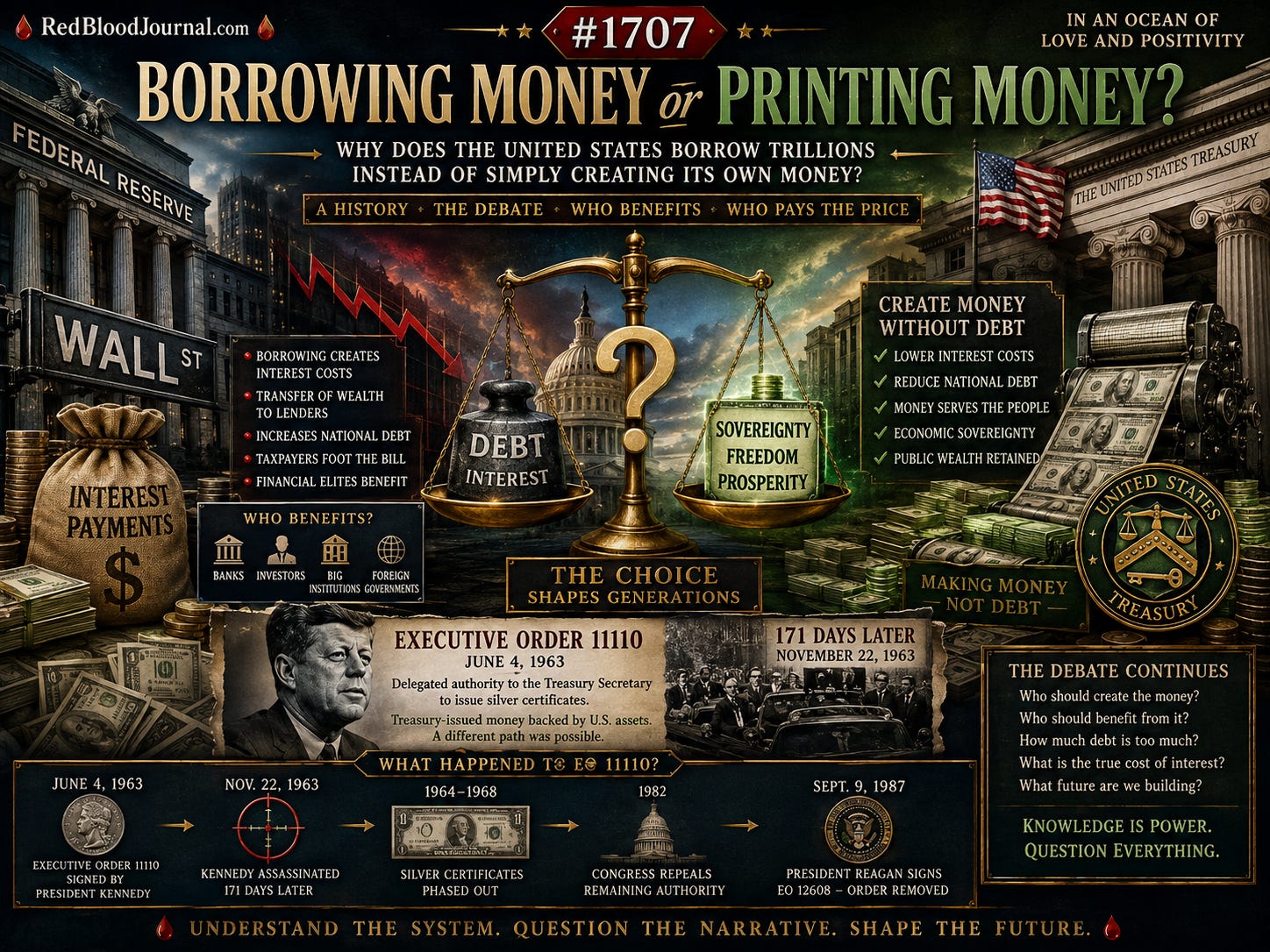
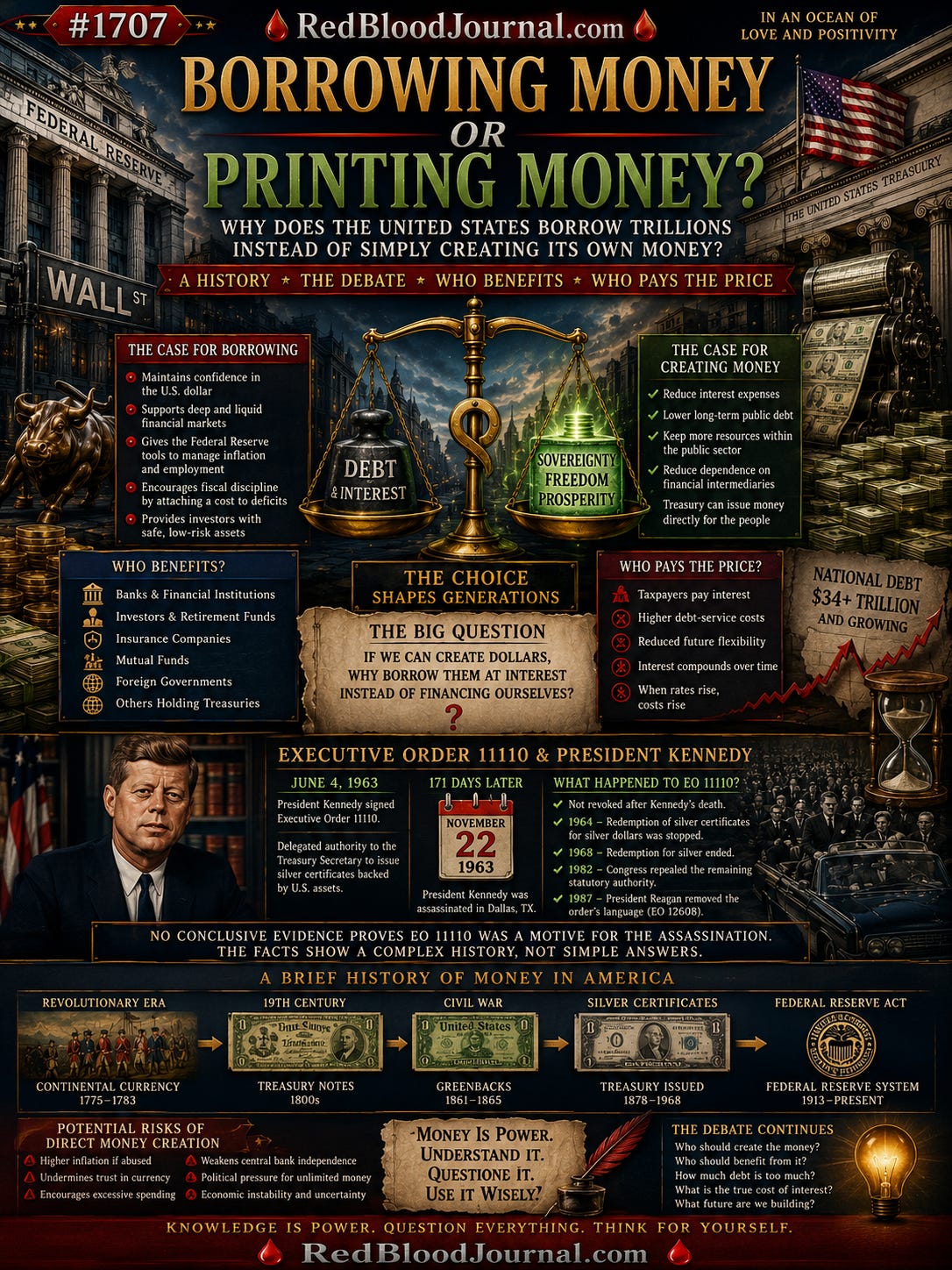
#1707 — Borrowing Money or Printing Money?
The American Monetary Debate:
Why Does the United States Borrow Trillions Instead of Simply Creating Its Own Money?
August 1, 2026
🩸 RedBloodJournal.com 🩸
For more than one hundred years, Americans have debated one of the most fundamental questions in economics.
If the United States issues the world’s reserve currency, why does it borrow money and pay interest instead of creating the money itself?
The answer depends on which economic philosophy one accepts.
This report examines both sides of that debate through history.
Before the Federal Reserve
The United States did not always operate under today’s monetary system.
Throughout American history, Congress authorized different forms of money.
Among them were:
Continental Currency during the Revolutionary War.
Treasury Notes.
United States Notes (”Greenbacks”) issued during the Civil War under President Abraham Lincoln.
Silver Certificates issued directly by the U.S. Treasury.
These examples demonstrate that, at different times, the federal government directly issued forms of currency. Those periods also experienced challenges, including inflation, changing public confidence, and debates over how much money should be created.
The Federal Reserve Act of 1913
In 1913, Congress passed the Federal Reserve Act.
The Federal Reserve System became the nation’s central bank.
Its stated objectives included:
Providing a more stable banking system.
Acting as lender of last resort during financial panics.
Managing the nation’s money supply.
Promoting stable prices and maximum employment.
Supporting financial-system stability.
The Federal Reserve is a unique institution created by Congress. Its Board of Governors is a federal agency, while the twelve regional Federal Reserve Banks have a distinctive legal structure that includes member-bank participation. It is therefore neither a purely private corporation nor a standard executive-branch agency.
How Government Spending Is Financed Today
When federal spending exceeds tax revenue, the Treasury generally finances the difference by issuing Treasury bills, notes, and bonds.
Those securities are purchased by a wide range of investors, including:
American citizens.
Pension funds.
Insurance companies.
Mutual funds.
Commercial banks.
Foreign governments.
The Federal Reserve, as part of its monetary policy operations.
Investors receive interest on those securities.
Over time, interest payments become part of the federal budget.
The Question
This arrangement raises an enduring question.
If the United States ultimately creates dollars, why borrow them through interest-bearing Treasury securities rather than finance government directly with newly created Treasury money?
Economists and policymakers have answered that question in different ways for generations.
President Kennedy and Executive Order 11110
On June 4, 1963, President John F. Kennedy signed Executive Order 11110.
The order delegated to the Secretary of the Treasury presidential authority concerning the issuance of silver certificates under existing law.
Because silver certificates were Treasury-issued currency, the executive order has become a focal point in public discussions about alternatives to the modern monetary system.
The historical record, however, is important.
Executive Order 11110:
Did not abolish the Federal Reserve.
Did not authorize unlimited debt-free money creation.
Did not replace Federal Reserve Notes.
Rather, it delegated existing authority related to silver certificates while the United States was transitioning away from silver-backed currency.
Exactly 171 days later, on November 22, 1963, President Kennedy was assassinated in Dallas, Texas.
Some writers have suggested a connection between Executive Order 11110 and the assassination.
To date, no conclusive historical evidence has established that the executive order was a motive for the assassination.
Following Kennedy’s death:
President Lyndon B. Johnson did not immediately revoke Executive Order 11110.
As silver-backed currency was phased out, the order became increasingly limited in practical effect.
Congress repealed the remaining statutory authority in 1982.
President Ronald Reagan removed the obsolete language in 1987 as part of a broader cleanup of outdated executive orders.
The Arguments for the Current System
Supporters argue that borrowing rather than directly creating money:
Helps preserve confidence in the U.S. dollar.
Reduces the risk of politically motivated money creation.
Gives the Federal Reserve tools to respond to recessions and inflation.
Supports deep and liquid Treasury markets used worldwide.
Encourages fiscal discipline because borrowing has a measurable cost.
The Arguments for Greater Treasury Money Creation
Critics ask a different question.
If taxpayers ultimately repay both the principal and interest on government debt, would it be more efficient for the Treasury to issue a larger share of the nation’s money directly?
Supporters of this view argue that direct issuance could:
Reduce long-term interest costs.
Slow the growth of public debt.
Keep more financial resources within the public sector.
Reduce dependence on borrowing.
Different proposals—including sovereign-money systems and Modern Monetary Theory—offer varying approaches, and they are not identical.
Who Benefits?
Under today’s system, interest on Treasury securities is paid to many different holders, including:
Individual investors.
Retirement funds.
Banks.
Insurance companies.
Mutual funds.
Foreign governments.
Other institutional investors.
Supporters argue these securities provide one of the world’s safest financial assets.
Critics argue that taxpayers ultimately finance the interest payments while financial institutions and investors receive the income.
Who Bears the Cost?
The costs of borrowing can include:
Annual interest payments from the federal budget.
Reduced flexibility for future government spending.
Greater debt-service costs when interest rates rise.
At the same time, supporters contend that these costs are part of maintaining a stable and credible financial system.
The Debate Continues
More than a century after the Federal Reserve’s creation, Americans continue to debate the proper balance between:
Treasury authority.
Central-bank independence.
Government borrowing.
Money creation.
Inflation control.
Democratic accountability.
Financial stability.
There is no universal agreement.
The discussion remains active among economists, historians, policymakers, and the public.
The Red Blood Perspective
Understanding how money enters circulation is one of the most important yet least discussed subjects in public life. Whether one favors the current system or believes it should be reformed, an informed opinion requires separating documented historical facts from speculation and examining the strongest arguments on all sides. The more citizens understand the institutions that shape their economy, the better prepared they are to participate thoughtfully in debates about the nation’s future.
Ocean of Love and Positivity
History invites curiosity rather than certainty. Exploring different economic ideas with an open mind encourages respectful dialogue, deeper understanding, and wiser decisions for future generations. Progress is strengthened when people ask thoughtful questions, evaluate evidence carefully, and continue learning together.
In an Ocean of Love and Positivity.
🩸🌊✨ Fantastic!
💵
💵 The Architecture of American Money:
Borrowing Versus Printing
Aug 1, 2026
The provided text explores the historical and ongoing debate regarding why the United States government borrows money at interest instead of directly issuing its own currency. It examines the transition from early American systems, like Treasury-issued Greenbacks, to the current model established by the Federal Reserve Act of 1913. The source highlights Executive Order 11110 and the surrounding theories regarding President Kennedy’s role in monetary policy before his assassination. By contrasting the perspectives of those who value central bank independence with critics who advocate for debt-free money, the article outlines the complexities of fiscal stability and public debt. Ultimately, it encourages readers to study the mechanics of money creation to better understand the forces shaping the national economy.


