


🩸 #1706
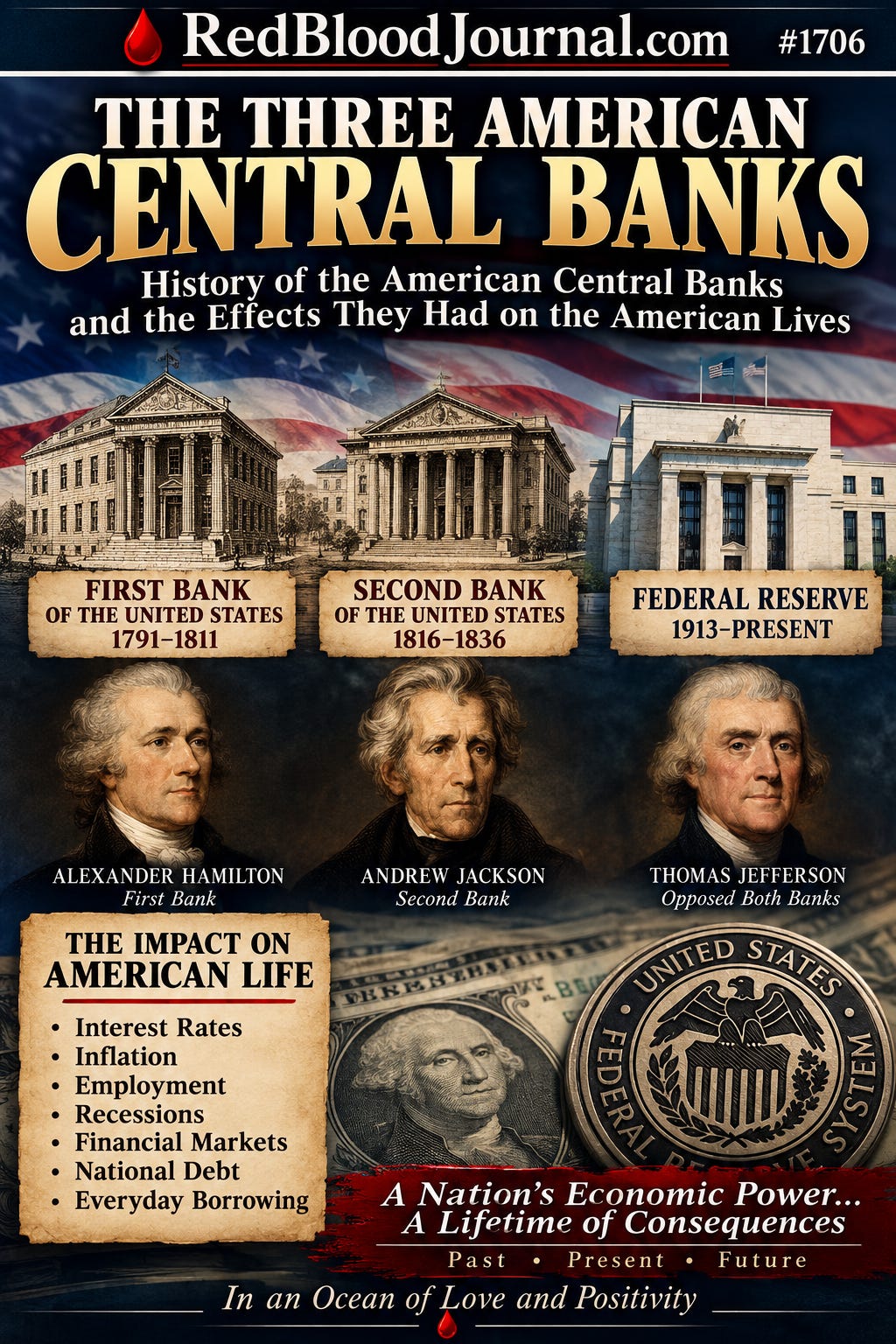
The Federal Reserve is generally considered the third major attempt at a central banking system in the United States.
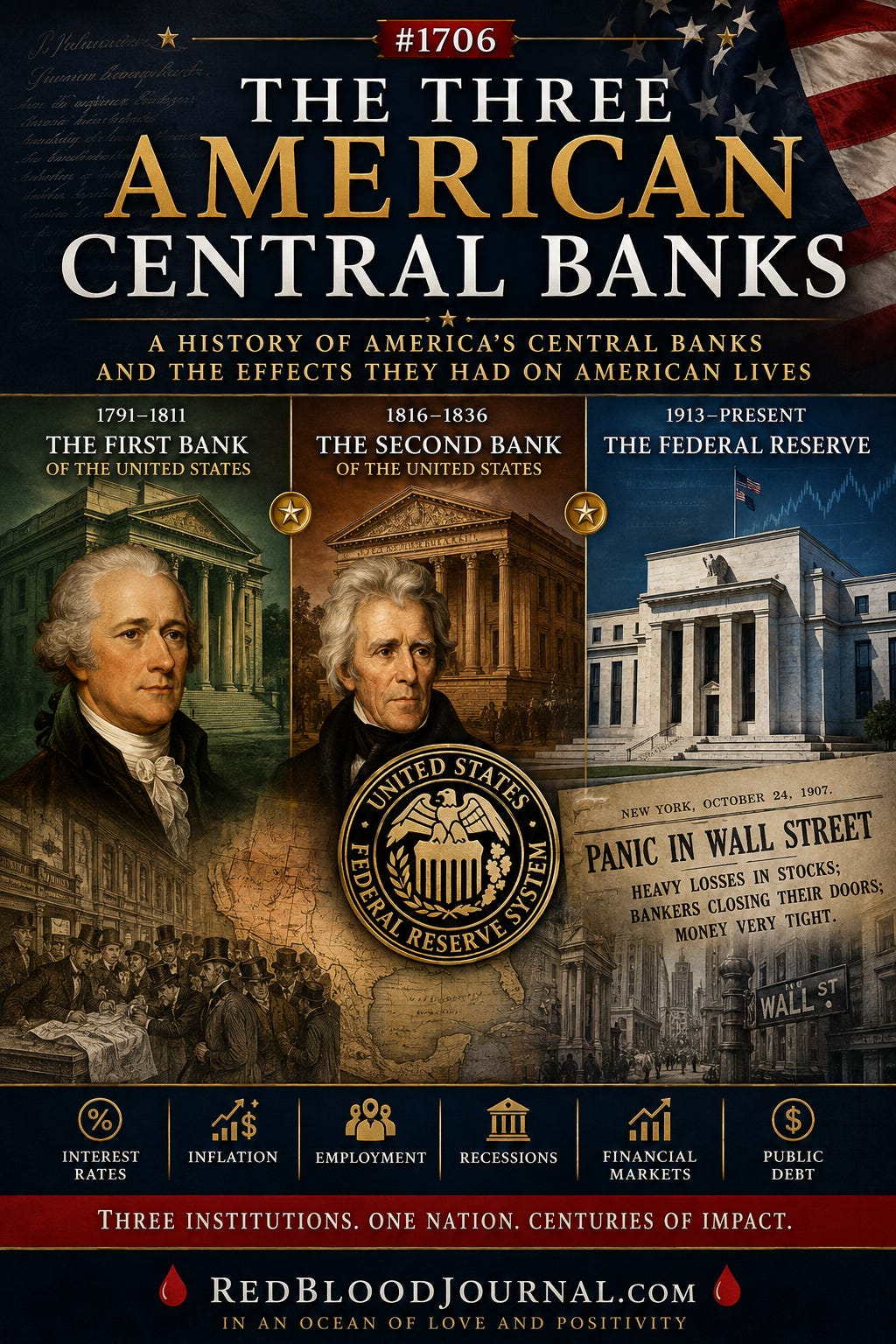
#1706 — The Three American Central Banks
How Three Banking Experiments Changed the Financial History of the United States
🩸 RedBloodJournal.com 🩸
The First Bank of the United States (1791–1811)
Created under President George Washington after Treasury Secretary Alexander Hamilton argued that the young nation needed a central financial institution.
Its purposes included:
Stabilizing the new nation’s finances.
Collecting federal taxes.
Managing government debt.
Issuing a stable national currency.
Supporting commerce and credit.
Opposition
Thomas Jefferson and James Madison opposed the bank, believing:
The Constitution did not explicitly authorize it.
It concentrated financial power.
It favored wealthy commercial interests over ordinary farmers.
Its charter expired in 1811 and Congress refused to renew it.
The Second Bank of the United States (1816–1836)
Following the financial disorder after the War of 1812, Congress created another national bank.
Its goals were to:
Stabilize the currency.
Regulate state banks.
Reduce inflation.
Finance government operations.
Andrew Jackson’s War Against the Bank
President Andrew Jackson became its greatest opponent.
He argued the bank:
Held excessive economic power.
Benefited wealthy elites.
Threatened democratic government.
Could influence politics through finance.
Jackson vetoed the renewal of its charter.
By 1836 the Second Bank ceased operating as the nation’s central bank.
The Era Without a Central Bank (1836–1913)
For nearly 80 years the United States operated without a permanent central bank.
The period saw:
Thousands of state banks.
Frequent banking failures.
Financial panics.
Credit shortages.
Rapid industrial growth alongside repeated recessions.
Major financial crises occurred in:
1837
1857
1873
1893
1907
The Panic of 1907 especially convinced many leaders that the nation needed a lender of last resort.
The Federal Reserve (1913–Present)
Congress passed the Federal Reserve Act in 1913.
The Federal Reserve System was designed to:
Provide a more elastic money supply.
Act as lender of last resort.
Reduce banking panics.
Supervise member banks.
Conduct monetary policy.
Today it consists of:
A Board of Governors.
Twelve regional Federal Reserve Banks.
The Federal Open Market Committee (FOMC).
Major Historical Effects on American Life
The Federal Reserve has influenced nearly every aspect of daily economic life.
Interest Rates
Its policies affect:
Mortgage costs.
Car loans.
Credit cards.
Student loans.
Business borrowing.
Inflation
Changes in the money supply and interest rates can influence inflation and purchasing power. Economists continue to debate the extent to which Federal Reserve policy versus other factors (such as supply shocks, fiscal policy, and global events) contribute to inflation.
Employment
One of the Federal Reserve’s statutory goals is to promote maximum employment alongside stable prices.
Recessions
During economic downturns the Federal Reserve often lowers interest rates or uses other monetary tools intended to stimulate lending and economic activity.
Financial Markets
Its announcements can significantly affect:
Stock markets.
Bond markets.
Currency markets.
Precious metals.
Real estate values.
Public Debt
The Federal Reserve participates in U.S. Treasury markets as part of monetary policy implementation. Debate continues among economists over how these actions interact with federal borrowing and long-term fiscal policy.
The Debate Continues
Since 1913, Americans have remained divided over the role of a central bank.
Supporters argue it has:
Helped reduce the frequency of severe banking panics.
Provided stability during financial crises.
Supported payment systems.
Helped manage inflation and employment.
Critics argue it has:
Concentrated significant financial influence.
Encouraged excessive debt.
Contributed to asset-price booms.
Reduced the purchasing power of the dollar over long periods through cumulative inflation.
Increased the distance between monetary decision-making and direct democratic oversight.
These differing views continue to shape debates over monetary policy and the future of the Federal Reserve.
The Red Blood Perspective
The history of America’s three central banks illustrates a recurring national question: How much financial authority should be centralized, and who should be accountable for decisions that affect the economy of every household?
Regardless of one’s position, understanding the evolution from the First Bank to the Federal Reserve helps explain why monetary policy remains one of the most consequential—and debated—areas of public policy. Studying that history encourages citizens to evaluate evidence, compare competing arguments, and form their own informed conclusions.
Ocean of Love and Positivity
History offers lessons rather than final answers. By examining how institutions have evolved, people can better understand the forces that shape their daily lives and participate more thoughtfully in discussions about the future. A society that values curiosity, respectful debate, and informed decision-making is better equipped to adapt to changing circumstances while preserving the well-being of future generations.
In an Ocean of Love and Positivity.
🩸🌊✨ Fantastic!
🏦
🏦 The Three American Central Banks
Jul 31, 2026
This text explores the historical evolution of central banking in the United States, beginning with the First and Second Banks and culminating in the current Federal Reserve System. The author outlines how early institutions were dismantled due to political opposition and fears of centralized power, leading to a chaotic period marked by frequent financial panics. With the establishment of the Federal Reserve in 1913, the nation gained a mechanism to regulate currency and manage interest rates, though these actions remain highly controversial. The source emphasizes that while the central bank aims to stabilize the economy, it faces ongoing criticism regarding inflation, debt, and its overall influence on democratic oversight. Ultimately, the passage encourages readers to study this financial history to better understand the forces shaping modern economic life.


