


July 31, 2026
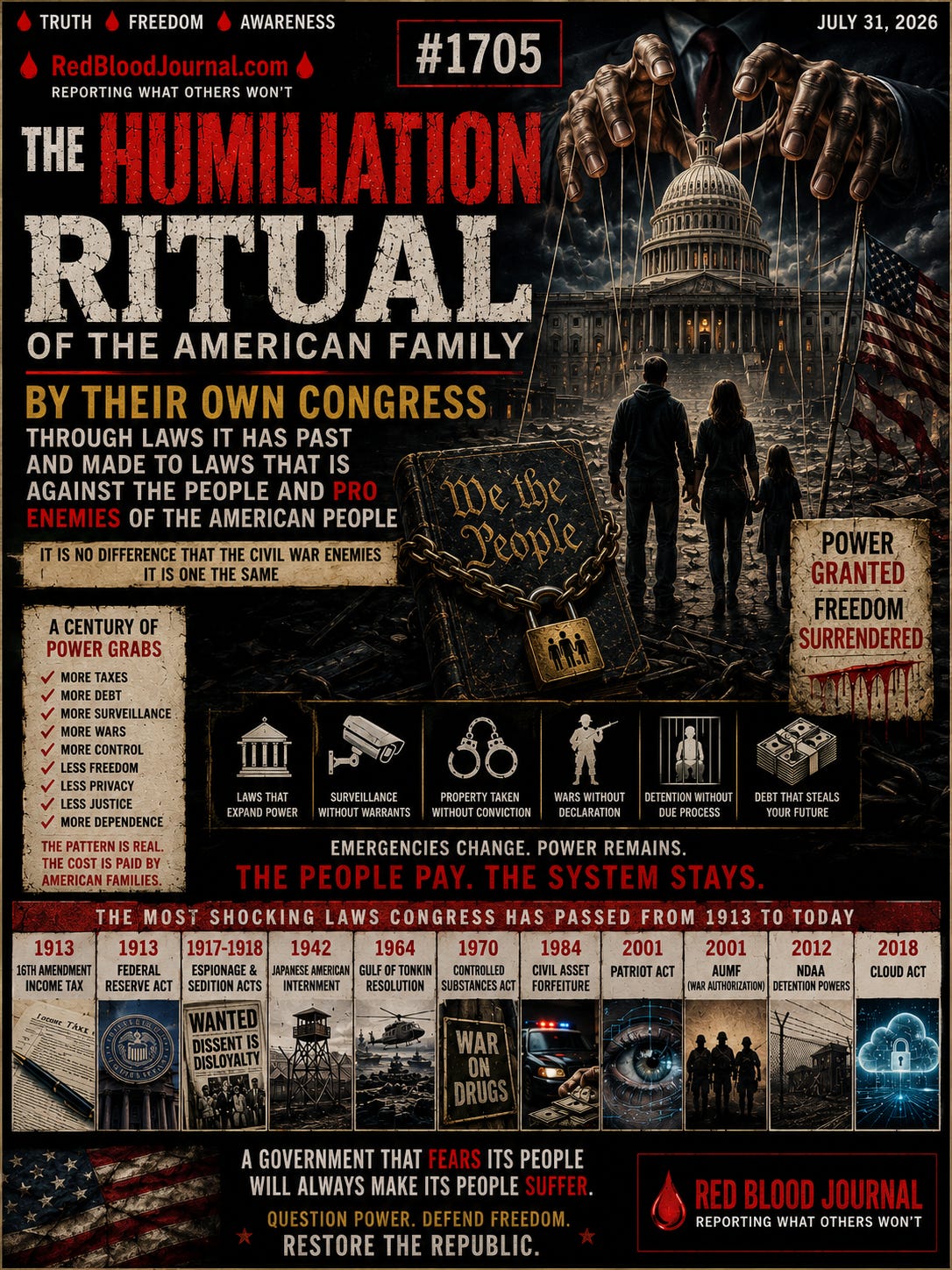
#1705 — The Humiliation Ritual of the American Family
When Congress Gives Government More Power Than the People Who Created It
🩸 RedBloodJournal.com 🩸
Editorial Note
This report examines federal laws, resolutions, and congressional authorizations that have been criticized for expanding government power, weakening constitutional protections, enabling war, increasing surveillance, confiscating property, or placing institutional interests above ordinary American families.
The phrase “humiliation ritual” is the interpretation of this report.
The historical laws and their documented effects are factual matters.
Not every member of Congress supported these measures, and some were later repealed, restricted, amended, or condemned. The argument presented here is that the repeated pattern matters more than any single political party.
For generations, Americans have been taught that Congress represents the people.
The House represents local communities.
The Senate represents the states.
The Constitution limits federal power.
War requires accountability.
Property cannot be taken without due process.
Citizens cannot be searched without cause.
Political disagreement is not treason.
Yet the history of the last century reveals another America.
It reveals moments when Congress handed extraordinary powers to presidents, banks, intelligence agencies, police departments, military institutions, bureaucracies, and private interests.
Each measure arrived with a justification.
A banking emergency.
A world war.
A communist threat.
A drug crisis.
A terrorist attack.
A foreign enemy.
A technological danger.
The emergency changed.
The solution remained the same.
Give the government more power.
The result has often been a humiliation ritual imposed upon the American family by the very institution elected to protect it.
The citizen works.
The citizen pays.
The citizen obeys.
The citizen sends children to war.
The citizen surrenders privacy.
The citizen proves innocence.
The government demands trust.
1913 — The Sixteenth Amendment and the Federal Income Tax
The Sixteenth Amendment gave Congress constitutional authority to tax income without apportioning the tax among the states according to population.
It was ratified on February 3, 1913. The Revenue Act of 1913 followed later that year.
At first, fewer than one percent of Americans paid the new income tax. Initial rates began at one percent and rose to six percent for the highest incomes.
What began as a limited tax on comparatively wealthy citizens eventually developed into a permanent system touching wages, investments, estates, businesses, retirement accounts, and nearly every stage of economic life.
The Red Blood concern is not simply that taxes exist.
Every functioning nation requires revenue.
The deeper issue is that a power introduced as narrow and limited became a permanent claim upon the productive labor of almost every family.
The federal government no longer needed to confront citizens directly for payment.
Eventually, money could be removed from wages before workers even received it.
The family became the collector of its own obligation.
1913 — The Federal Reserve Act
On December 23, 1913, President Woodrow Wilson signed the Federal Reserve Act, creating the Federal Reserve System as the central bank of the United States.
Its stated purpose included improving banking stability and addressing the recurring financial panics that had damaged the country.
Supporters view the Federal Reserve as essential to financial stability.
Critics see a system in which the power to influence credit, interest rates, currency conditions, asset prices, and purchasing power became concentrated far beyond the direct control of ordinary voters.
Congress created an institution capable of making decisions affecting every mortgage, car loan, savings account, pension, business, and grocery bill in America.
The public elects no Federal Reserve regional bank president.
The average family cannot vote on monetary policy.
Yet when inflation reduces purchasing power, the family pays the cost.
This is the first great pattern of the modern age:
The institution makes the decision.
The family absorbs the consequence.
1917 and 1918 — The Espionage and Sedition Acts
Congress enacted the Espionage Act in 1917 after the United States entered World War I.
The law criminalized certain activities involving national-defense information and interference with military operations or recruitment.
In 1918, Congress expanded the law through the Sedition Act, which prohibited certain forms of disloyal or abusive expression concerning the government, Constitution, military, or flag.
Hundreds of people were prosecuted during this era, particularly political dissidents, socialists, labor organizers, and antiwar speakers. Major portions of the 1918 Sedition Act were later repealed, while much of the original Espionage Act remains in federal law.
The shocking principle was not merely the punishment of espionage.
A nation has a legitimate interest in protecting true military secrets.
The danger appeared when opposition to government policy began to be treated as assistance to the enemy.
Once criticism becomes disloyalty, patriotism no longer means loyalty to the country.
It means obedience to whoever currently controls the government.
1942 — Congressional Support for Japanese-American Incarceration
President Franklin Roosevelt issued Executive Order 9066 in February 1942.
Congress then passed Public Law 503, making violation of military orders issued under the executive order a federal crime.
Another measure, the Second War Powers Act, temporarily weakened census confidentiality and allowed individual-level information to assist the forced removal of people of Japanese ancestry.
The result was the mass incarceration of Japanese Americans, including American citizens, without individualized proof of wrongdoing.
This was not the action of a foreign enemy.
It was the American government acting against American families.
Homes were lost.
Businesses disappeared.
Possessions were sold under pressure.
Citizens were confined because of ancestry.
The government later acknowledged the injustice and authorized reparations.
But compensation decades later could not restore the years, dignity, trust, property, or childhoods that had been taken.
The lesson is permanent:
A government frightened enough can redefine its own citizens as potential enemies.
1964 — The Gulf of Tonkin Resolution
In August 1964, Congress passed the Gulf of Tonkin Resolution with very little debate.
Only two senators voted against it.
The resolution gave President Lyndon Johnson broad authority to take “all necessary measures” in Southeast Asia and became the central congressional foundation for escalating American involvement in Vietnam. Congress repealed it in 1971 after the war had become deeply controversial.
Congress did not formally declare war.
Instead, it transferred enormous practical war-making authority to the executive branch.
The consequences were not paid primarily by the legislators who voted.
They were paid by young Americans drafted or enlisted into combat.
They were paid by parents receiving folded flags.
They were paid by veterans returning with injuries, trauma, addiction, disease, and memories they could not leave behind.
The resolution demonstrated how quickly elected representatives can surrender their own constitutional responsibility while still sending other families to bear the result.
1970 — The Controlled Substances Act and the Expansion of the Drug War
The Controlled Substances Act of 1970 established the modern federal system for classifying prohibited drugs and regulating controlled substances.
It became one of the legal foundations for the expanding War on Drugs.
The law was presented as an effort to regulate dangerous substances, organized trafficking, and public-health threats.
Over time, however, federal and state drug enforcement contributed to widespread incarceration, militarized policing, mandatory sentencing, family separation, property seizure, and permanent criminal records.
Entire communities experienced the government not as a protector but as an occupying enforcement structure.
The Red Blood concern is not that destructive drugs should be ignored.
The concern is that a public-health and social problem became a permanent domestic war.
And wars create budgets.
Budgets create agencies.
Agencies create careers.
Careers create institutional reasons for the war never to end.
1984 — The Comprehensive Crime Control Act and Federal Asset Forfeiture
The Comprehensive Crime Control Act of 1984 established the Department of Justice Assets Forfeiture Fund and greatly strengthened the federal forfeiture system.
Under civil forfeiture, property can become the defendant in a legal proceeding, and no criminal conviction is necessarily required before the government attempts to keep it.
Federal law also permits portions of forfeiture proceeds to be shared with participating state and local law-enforcement agencies.
This produced one of the strangest legal conditions in modern America.
A person may not be convicted.
A person may not even be charged.
Yet cash, a vehicle, a home, or other property may still be seized if the government alleges a connection to criminal activity.
The citizen then enters a costly process to recover his or her own property.
The normal principle is:
The government must prove the person guilty.
Civil forfeiture can make the experience feel reversed:
The person must prove the property innocent.
Congress later passed reforms, but the underlying power remains.
1996 — The Antiterrorism and Effective Death Penalty Act
Passed after the Oklahoma City bombing, the Antiterrorism and Effective Death Penalty Act restricted aspects of federal habeas corpus review, imposed tighter filing deadlines, and expanded government powers concerning terrorism and criminal procedure.
Supporters argued that it prevented endless litigation and strengthened the justice system.
Critics have argued that limiting federal review increases the risk that wrongful convictions, constitutional violations, inadequate counsel, or unreliable evidence will not receive meaningful reconsideration.
A justice system should punish the guilty.
But the dignity of a free nation is measured by what it does when the system may have convicted the wrong person.
Speed is not justice.
Finality is not truth.
Procedure should never become more important than innocence.
2001 — The Authorization for Use of Military Force
Three days after the September 11 attacks, Congress passed the 2001 Authorization for Use of Military Force.
It authorized the president to use necessary and appropriate force against those responsible for the attacks and those who harbored them.
The resolution was brief.
Its consequences were not.
It became the legal foundation for military operations far beyond the original battlefield and across multiple presidential administrations.
A congressional authorization written in the immediate trauma of September 2001 became a durable instrument of global military power.
The enemy could move.
The battlefield could expand.
The presidency could change.
The authorization remained.
American families were told that war was temporary.
For military families, it became generational.
Some parents deployed after September 11.
Years later, their children entered military service under the shadow of the same authorization.
2001 — The USA PATRIOT Act
Congress passed the USA PATRIOT Act shortly after the September 11 attacks.
The law expanded investigative authorities, information sharing, surveillance powers, search procedures, financial tracking, and access to certain records.
The Justice Department argued that the law modernized investigative tools and helped prevent terrorist attacks.
Civil-liberties critics warned that emergency powers written during national panic could be applied beyond their original justification.
The most controversial example involved Section 215 and bulk telephone-metadata collection.
Congress eventually passed the USA FREEDOM Act of 2015, which ended the NSA’s bulk collection program under that provision and replaced it with a different system for obtaining records held by providers.
But the precedent had already been established.
The government had created systems capable of examining the communication patterns of millions of people who were not accused of terrorism.
The American family was told:
To remain free, surrender more privacy.
To remain safe, accept more observation.
2006 — The Military Commissions Act
The Military Commissions Act established procedures for trying certain noncitizens accused of terrorism through military commissions.
Its most controversial provisions involved detention, treatment of alleged enemy combatants, evidentiary standards, and limits on access to federal courts.
Supporters described it as necessary for handling unlawful combatants in a new kind of war.
Critics warned that creating a separate justice system outside ordinary constitutional procedures could normalize detention without the protections traditionally associated with American courts.
The danger of exceptional law is that the exception rarely remains neatly contained.
A government first creates reduced protections for the most unpopular person.
Later, the reduced protection becomes precedent.
Civil liberty is easiest to defend before the government identifies someone who appears undeserving of it.
2008 — The FISA Amendments Act and Section 702
The FISA Amendments Act authorized surveillance targeting certain non-Americans located outside the United States.
Section 702 became an important intelligence authority.
Although Americans cannot legally be selected as the direct targets under that provision, their communications can be collected incidentally when they communicate with foreign targets.
The continuing controversy involves government searches of collected information for identifiers connected to Americans.
Supporters describe Section 702 as essential to national security.
Critics argue that the practical result can resemble warrantless access to Americans’ communications.
The law illustrates a recurring technique.
The government states that the power is aimed at foreigners.
But the communications network does not stop at the border.
The foreign target speaks with an American.
The American becomes part of the database.
The government receives the information.
The distinction between foreign surveillance and domestic privacy becomes increasingly thin.
2012 — The National Defense Authorization Act and Detention Fears
Sections 1021 and 1022 of the 2012 National Defense Authorization Act addressed military detention involving certain people connected to al-Qaeda, the Taliban, or associated forces.
The law included language stating that it did not alter existing law concerning the detention of U.S. citizens and lawful residents.
Nevertheless, critics argued that its broad language reinforced a dangerous theory of indefinite military detention without ordinary criminal trial.
Supporters maintained that it merely codified existing wartime authority.
The controversy revealed how far the legal framework of the War on Terror had moved.
A constitutional republic was now debating not only how to prosecute suspected terrorists, but whether some people could be held by the military without the normal structure of civilian justice.
When imprisonment becomes administrative rather than judicial, liberty depends upon the restraint of the imprisoner.
That is not a reliable foundation for freedom.
2018 — The CLOUD Act
Congress passed the CLOUD Act in 2018.
The law clarified government access to electronic data held by U.S.-based technology companies, including certain information stored abroad, and established a framework for agreements with foreign governments seeking digital evidence.
The Justice Department described it as a way to accelerate access to information needed for investigations of terrorism, violent crime, cybercrime, and child exploitation.
The stated objectives involve serious crimes.
But the structural issue is larger.
Personal communications are no longer stored in a desk drawer inside a home.
They exist on corporate servers distributed across countries.
Congress responded by extending legal authority across that digital environment.
The citizen may believe a private message belongs to the sender and recipient.
The modern state sees data held by an intermediary.
The private family conversation has become a potentially retrievable corporate record.
One Pattern, Many Emergencies
These laws did not emerge from one political party.
Democrats passed some.
Republicans passed others.
Many received bipartisan support.
Some were responses to genuine emergencies.
Some had legitimate purposes.
Some remain defended as necessary instruments of national security, finance, policing, or intelligence.
But the same pattern repeatedly appears:
A crisis frightens the population.
Congress acts quickly.
Government receives new authority.
Citizens are promised narrow use.
The authority expands or survives.
Oversight arrives years later.
The public is told the power cannot safely be surrendered.
This is why the Civil War comparison carries symbolic force.
The division is no longer simply North against South.
It is not Republican against Democrat.
It is not left against right.
It is the conflict between concentrated institutional power and the families expected to finance, obey, fight, and suffer beneath it.
The political parties may argue on television.
But when power is offered to the government, bipartisan agreement often arrives with surprising speed.
The people are divided into camps.
The institutions continue accumulating authority.
The Humiliation Ritual
The humiliation is not a single ceremony.
It happens repeatedly.
The family pays taxes before receiving wages.
Savings lose purchasing power.
Children are sent into wars authorized by officials whose children may never see combat.
Private communications become searchable.
Property may be seized before conviction.
Emergency laws remain after the emergency.
Citizens are told that questioning these powers assists the enemy.
The ritual is completed when the people begin defending the powers used against them.
One political side excuses surveillance because its preferred president controls it.
The other excuses censorship because its preferred institutions define the threat.
One side supports military power when its party occupies the White House.
The other side supports the same power four years later.
The government changes hands.
The machinery remains.
The Red Blood Perspective
The enemy of the American family is not automatically a foreign nation.
It is any institution—foreign or domestic—that treats human beings as resources to tax, monitor, manipulate, recruit, imprison, or sacrifice.
Congress is not meant to be the ruling class.
It is meant to be the temporary representative of the people.
A law is not moral simply because Congress passed it.
A policy is not patriotic simply because the government calls it national security.
An emergency does not erase the Constitution.
And a citizen who questions power is not the enemy of the nation.
The nation belongs to the people.
The government is only its employee.
The American Civil War divided families through geography and political allegiance.
The modern conflict can divide families through propaganda, fear, party loyalty, debt, surveillance, war, and dependence.
Different uniforms.
Different vocabulary.
The same ancient struggle:
Who serves whom?
Does the government serve the family?
Or has the family become material for the government?
Ocean of Love and Positivity
The purpose of examining these laws is not to create hatred toward Congress, government employees, soldiers, police officers, judges, or fellow citizens.
Many entered public service with honorable intentions.
Many laws were passed during genuine fear.
Many officials believed they were protecting the country.
But love for a nation does not require blindness to its mistakes.
True patriotism allows correction.
True freedom requires memory.
True unity does not demand obedience.
An Ocean of Love and Positivity asks Americans to reject the manufactured division that keeps families fighting while institutions quietly accumulate power.
The answer is not another civil war.
The answer is a civil awakening.
A population that understands history cannot be frightened as easily.
A population that protects the rights of opponents protects its own future.
A population that refuses to worship political parties can once again demand that government serve human dignity.
The country does not heal by replacing one master with another.
It heals when the people remember they were never meant to have masters.
In an Ocean of Love and Positivity.
🩸🌊✨ Fantastic!
⚖️
⚖️ The Humiliation Ritual:
Institutional Power vs. The American Family
Jul 31, 2026
This text presents a critical analysis of American legislative history, arguing that Congress has systematically expanded federal authority at the expense of individual liberties and family stability. Through a chronological review of landmark policies—ranging from the establishment of the federal income tax to modern surveillance and detention acts—the author illustrates a recurring pattern where national crises are used to justify increased government control. The source contends that these measures have created a “humiliation ritual” in which citizens are forced to finance, obey, and fight for an institutional machine that no longer represents their interests. Ultimately, the narrative rejects partisan division, suggesting that the true conflict lies between concentrated bureaucratic power and the fundamental dignity of the American people. It concludes with a call for a “civil awakening” rooted in historical awareness and a collective refusal to let emergency powers supersede constitutional protections.


