


July 31, 2026
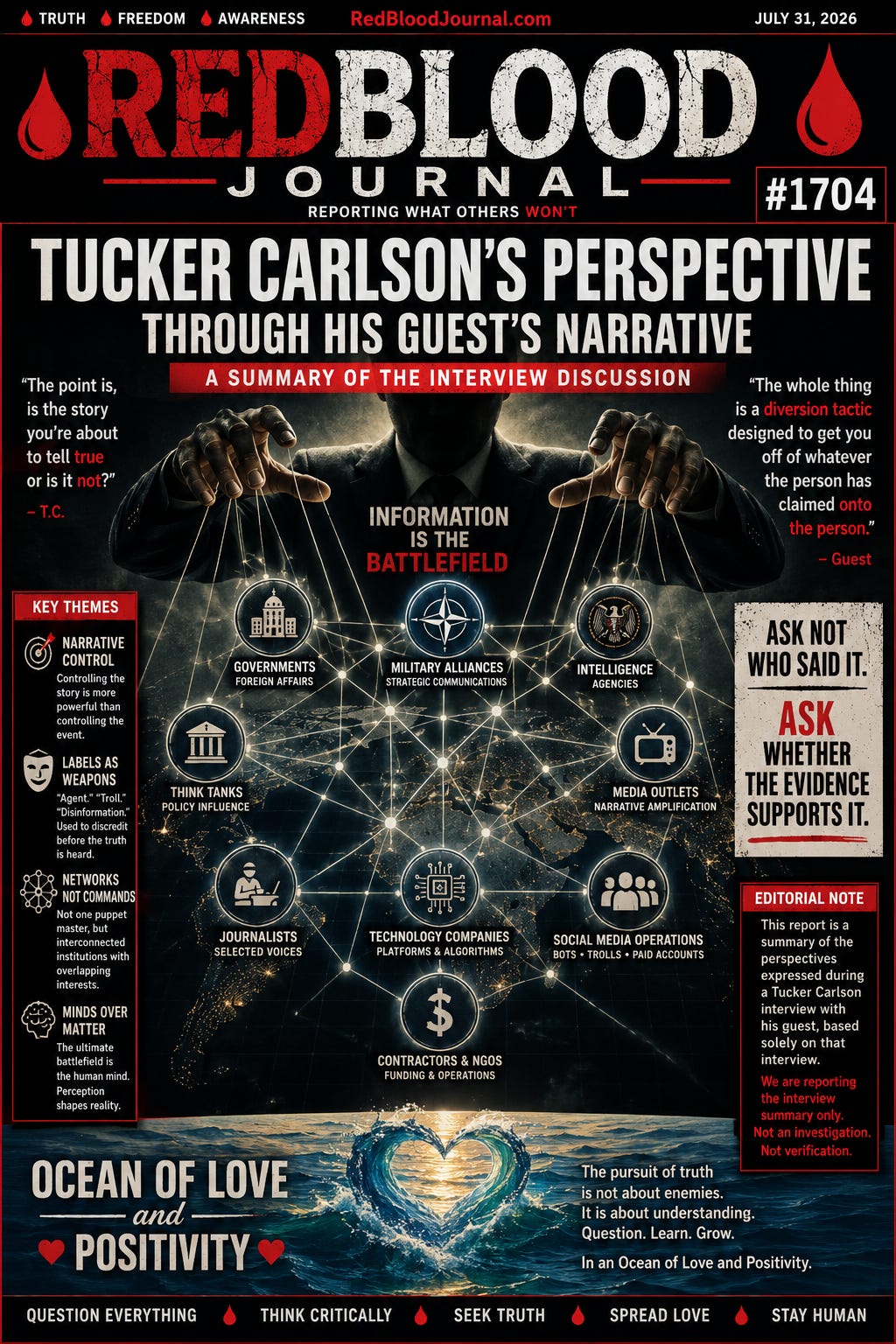
#1704 — Tucker Carlson’s Perspective Through His Guest’s Narrative
A Summary of the Interview Discussion
🩸 RedBloodJournal.com 🩸
Editorial Note
This report is not an independent investigation or verification of the claims discussed.
It is a summary of the perspectives expressed during a Tucker Carlson interview with his guest, based solely on the contents of that interview. The purpose is to summarize the narrative presented, not to determine whether the claims are true or false.
Throughout the interview, Tucker Carlson repeatedly encourages viewers to focus less on the individual making the claims and more on examining the evidence presented.
His guest argues that modern information warfare extends far beyond governments issuing press releases.
Instead, the guest describes what she believes is an interconnected ecosystem consisting of governments, military organizations, think tanks, intelligence professionals, journalists, technology companies, and organized online influence campaigns.
According to the narrative presented in the interview, these organizations do not necessarily function as one centralized command but as a network of institutions with overlapping interests that influence public discussion across many countries.
The Network Described in the Interview
According to the guest’s presentation, the principal components include:
Government foreign affairs departments.
Military alliances involved in strategic communications.
Intelligence and security professionals.
Policy think tanks.
Major media organizations.
Selected journalists.
Technology companies.
Social media influence operations.
Coordinated online accounts, including both automated bots and human-operated accounts.
The interview suggests that these components reinforce one another through shared narratives, funding, institutional relationships, and coordinated communication.
Information as a Battlefield
One recurring theme is that the battlefield of the twenty-first century is no longer limited to land, sea, air, or cyberspace.
It is the human mind.
According to the interview, shaping public perception has become a strategic objective.
Rather than changing events themselves, the greater objective is described as influencing how those events are interpreted by the public.
The discussion suggests that controlling narratives may influence elections, foreign policy debates, public opinion, and the reputations of individuals more effectively than traditional military means.
Labels as Political Weapons
Another major argument presented is that certain labels can become powerful political tools.
The interview discusses accusations such as:
“Russian agent.”
“Foreign operative.”
“Disinformation.”
“Propagandist.”
The guest argues these labels are sometimes used to discredit individuals before their evidence is evaluated.
Tucker Carlson repeatedly emphasizes that he prefers asking whether a claim is true rather than dismissing it based on who presents it.
The Importance of Networks
Rather than identifying one nation or one organization as controlling everything, the interview argues that influence is exercised through networks.
According to the guest, the public often searches for one simple explanation, while reality consists of many institutions interacting across government, media, policy, technology, and communications.
The interview suggests that understanding these relationships is more important than focusing on any single organization.
The Interview’s Overall Perspective
Taken as a whole, the interview presents a worldview in which information has become one of the most valuable strategic resources.
According to the discussion, influence over narratives can affect politics, diplomacy, elections, public trust, and international relations as much as conventional forms of power.
Whether one agrees with these conclusions or not, the interview consistently returns to one central question:
Rather than asking who said it, ask whether the evidence supports it.
The Red Blood Perspective
Regardless of one’s political views, the interview raises a broader philosophical question.
If information itself has become a battlefield, then every individual carries a responsibility to think independently, compare multiple sources, question assumptions, and separate evidence from rhetoric.
Critical thinking is not the rejection of institutions, nor is it blind acceptance of them.
It is the willingness to examine claims carefully before reaching conclusions.
Whether discussing governments, media, corporations, or independent voices, the strongest defense against manipulation is an informed and thoughtful public that values evidence, curiosity, and open inquiry.
Ocean of Love and Positivity
An Ocean of Love and Positivity reminds us that truth should never be feared.
The pursuit of understanding is not about creating enemies but about becoming wiser together.
Every conversation, every investigation, and every question offers an opportunity to grow in knowledge while treating others with respect and humanity.
A world where people seek understanding before judgment is a world with greater potential for peace, cooperation, and genuine progress.
In an Ocean of Love and Positivity.
🩸🌊✨ Fantastic!
🌐
🌐 The Human Mind as the Information Battlefield
Jul 31, 2026
This source summarizes an interview from Tucker Carlson’s program regarding the complex nature of modern information warfare. The guest describes a vast, interconnected network of governments, military entities, media outlets, and technology firms that cooperate to steer public perception. According to the text, the human mind has become the primary battlefield where controlling the interpretation of events is more vital than the events themselves. The narrative warns that labels like “disinformation” are often used as strategic weapons to silence dissent before evidence can be weighed. Ultimately, the report encourages audiences to prioritize independent critical thinking and objective evidence over the reputation of the speaker. This perspective suggests that maintaining an informed public is the only defense against sophisticated global narrative manipulation.


