


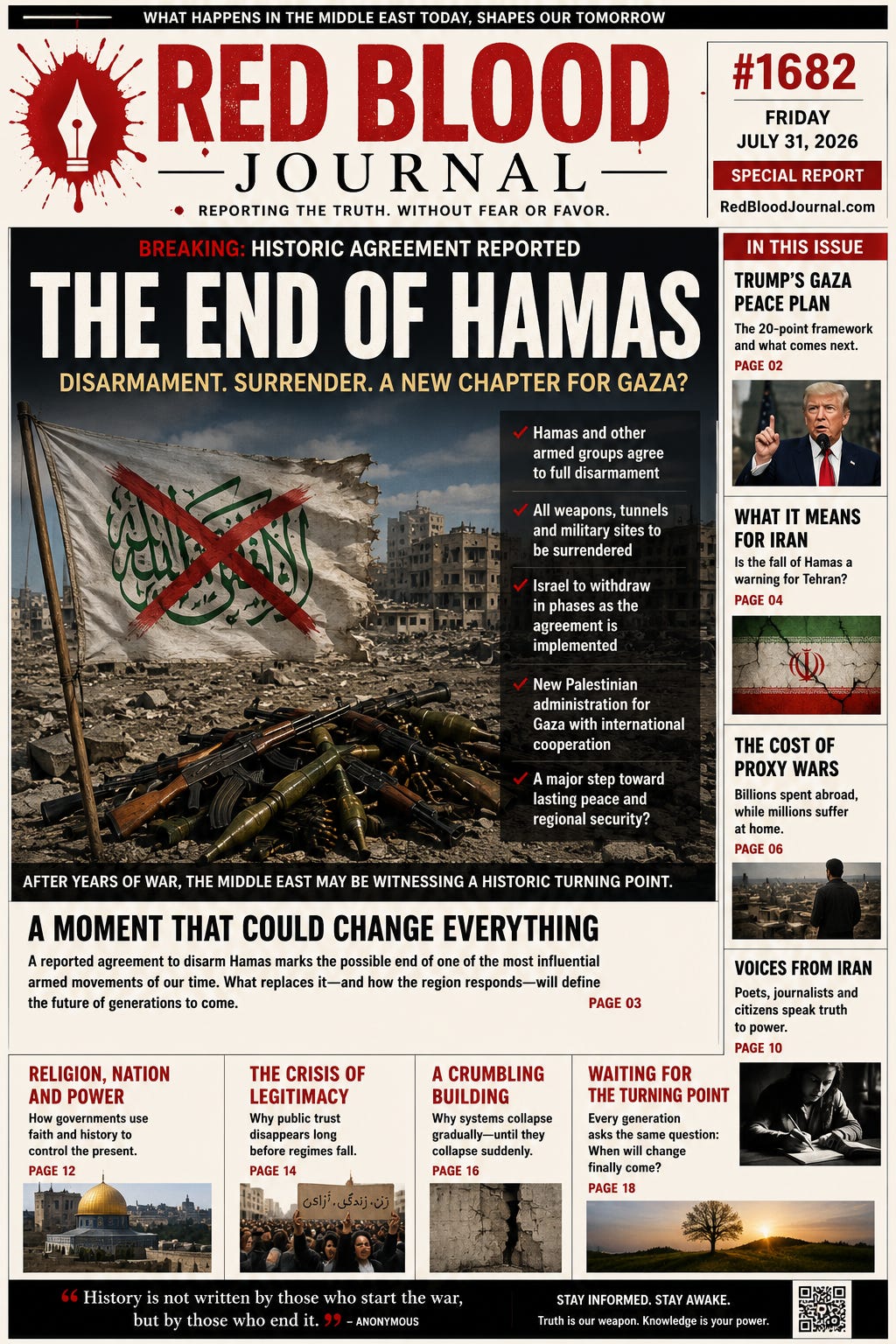
#1682 — The End of Hamas
A Turning Point in the Middle East?
July 31, 2026
🩸 RedBloodJournal.com 🩸
Among the many developments discussed in recent weeks concerning the Middle East, one reported event stands apart for its potential historical significance.
According to the source transcript, Hamas has reportedly agreed to a framework that includes the phased surrender of its weapons, alongside the creation of a new governing structure for Gaza. The transcript further states that this arrangement would involve international oversight and a gradual restructuring of security responsibilities within the territory.
If these developments unfold as described, they would represent one of the most consequential political transformations in Gaza since Hamas assumed control nearly two decades ago.
Whether viewed as a military defeat, a diplomatic breakthrough, or a strategic realignment depends largely upon one’s perspective.
Regardless of political viewpoint, the possibility itself deserves careful examination.
More Than the End of an Organization
History rarely changes in a single day.
Instead, history often changes after years of pressure that suddenly become visible through one defining event.
Empires do not disappear overnight.
Neither do political movements.
The visible ending usually represents the conclusion of forces that have been building for years.
If Hamas is indeed entering a new phase through disarmament and political transition, future historians will likely examine not merely the agreement itself, but the military, economic, diplomatic, and regional pressures that gradually made such an outcome possible.
History remembers the final chapter.
Understanding requires reading the entire book.
A Region in Transition
The transcript portrays this reported agreement as extending beyond Gaza itself.
It argues that Hamas has long represented part of a broader regional network supported politically and militarily by Iran’s present leadership. From that perspective, any fundamental change affecting Hamas naturally raises questions about the future of other regional alliances.
Whether those broader conclusions ultimately prove accurate remains uncertain.
History reminds us that political alliances constantly evolve.
The weakening or transformation of one regional actor frequently causes others to reassess their own positions.
No government or movement exists entirely in isolation.
The Human Cost
Geopolitical discussions often revolve around governments, military organizations, and strategic interests.
Far less attention is given to ordinary people.
For decades, families in Gaza have lived through repeated cycles of conflict.
Families in Israel have experienced fear from attacks and insecurity.
Families throughout the region have lived with uncertainty, displacement, and economic hardship.
Political strategies are debated by leaders.
The consequences are carried by ordinary citizens.
Regardless of political opinions, every conflict leaves behind generations that inherit its emotional, economic, and humanitarian costs.
Lessons from History
Many institutions once believed permanent eventually disappeared.
The Soviet Union.
The Berlin Wall.
Numerous governments throughout history.
Their collapse appeared impossible—until it happened.
Political legitimacy is never permanent.
It depends upon public confidence, economic stability, leadership, international relationships, and the ability to adapt to changing circumstances.
History repeatedly demonstrates that no political structure remains unchanged forever.
The Question Beyond Victory
Supporters and critics will naturally interpret these reported developments differently.
Some will view them as a major victory.
Others will regard them as a tragic defeat.
Still others may see only another chapter in a conflict that has lasted for generations.
Perhaps the larger question is neither who won nor who lost.
Perhaps the more enduring question is:
What comes next?
Removing one organization does not automatically remove the underlying political, economic, historical, or social conditions that allowed it to emerge.
Peace is sustained not only through security.
It also depends upon opportunity, justice, reconstruction, dialogue, and the willingness of societies to move beyond perpetual conflict.
History has shown that peace agreements create opportunities.
Only people can transform those opportunities into lasting peace.
The Red Blood Perspective
Every generation witnesses moments that appear to divide history into a “before” and an “after.”
Whether this reported agreement ultimately becomes one of those moments will be determined not by today’s headlines, but by tomorrow’s reality.
At Red Blood Journal, we believe the most important question is never simply whether an organization survives or disappears.
The deeper question is what humanity learns from the experience.
Throughout history, political movements have risen and fallen.
Governments have come and gone.
Borders have changed.
Flags have been replaced.
Yet ordinary people continue searching for the same things:
Safety.
Freedom.
Opportunity.
A better future for their children.
If this truly marks the end of one era, then the greatest success will not be measured by military achievements or political declarations.
It will be measured by whether fewer children grow up hearing explosions instead of laughter.
Whether fewer families lose loved ones to endless conflict.
Whether future generations inherit hope instead of hatred.
History does not ask who shouted the loudest.
History remembers who changed the course of human lives for the better.
Ocean of Love and Positivity
Perhaps the greatest lesson from every conflict is that no victory is complete if humanity itself loses.
Wars eventually end.
Governments eventually change.
Leaders eventually leave the stage.
But compassion, understanding, and wisdom can continue growing long after political headlines are forgotten.
No child enters this world carrying generations of hatred.
Those burdens are inherited.
That also means they can be set down.
Imagine a future where today’s enemies become tomorrow’s trading partners.
Where children learn each other’s languages instead of fearing each other’s flags.
Where rebuilding schools becomes more important than rebuilding arsenals.
History has shown that humanity possesses extraordinary intelligence.
The next challenge is proving we possess equal wisdom.
May every ending become the beginning of greater understanding.
May every lesson purchased through suffering help prevent future suffering.
May peace become stronger than fear.
May wisdom become stronger than pride.
May love become stronger than division.
Only then can history truly say that something greater than a military victory was achieved.
A victory for humanity itself.
In an Ocean of Love and Positivity.
🩸🌊✨ Fantastic!
🕊️
🕊️ The End of Hamas: A Turning Point for Gaza
Jul 31, 2026
This report examines a potential historical turning point involving the reported disarmament and surrender of Hamas in exchange for a new governing structure in Gaza. The text emphasizes that such a transition would likely shift the geopolitical landscape of the Middle East, potentially weakening established regional alliances and Iranian influence. Beyond the strategic implications, the narrative highlights the profound humanitarian impact on families who have endured decades of violence and instability. The author argues that true peace requires addressing underlying social conditions rather than merely dismantling a single organization. Ultimately, the source suggests that the success of this transition should be measured by the long-term safety and prosperity of ordinary citizens. This perspective frames the event as a rare opportunity to replace generational conflict with a future built on wisdom and mutual understanding.


