


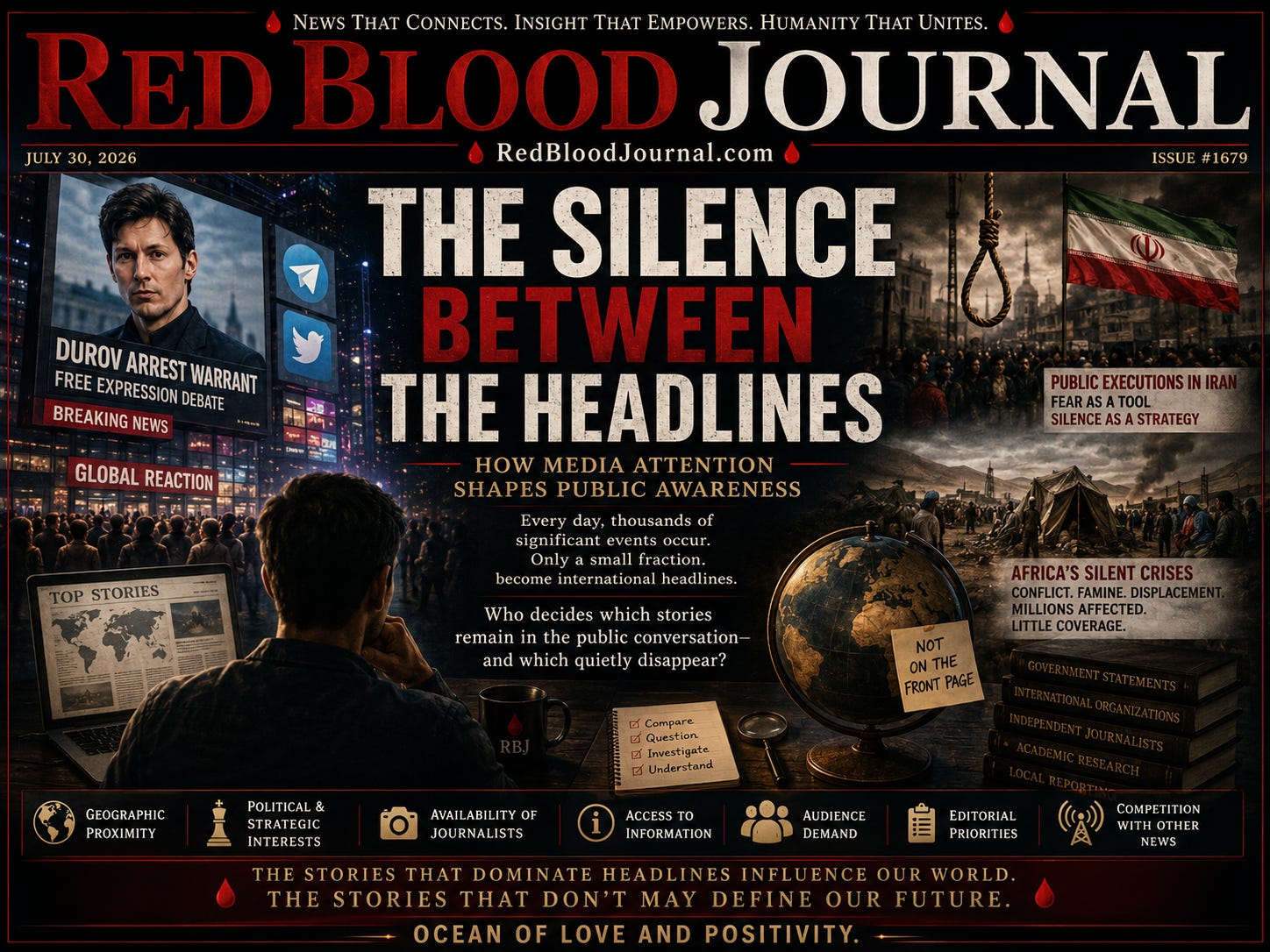
#1679 — The Silence Between the Headlines
July 30, 2026
How Media Attention Shapes Public Awareness
🩸 RedBloodJournal.com 🩸
Every day, thousands of significant events occur around the world.
Only a small fraction become international headlines.
This raises an important question.
Who decides which stories remain in the public conversation—and which quietly disappear?
Recent attention surrounding the international arrest warrant sought by Russia for Telegram founder Pavel Durov illustrates how quickly discussions about free expression, national security, and digital communication can become intertwined.
Some observers expected stronger reactions from governments, media organizations, and civil liberties advocates.
Others viewed the response as consistent with the complexity of the legal and geopolitical issues involved.
Regardless of one’s interpretation, the event highlights a broader phenomenon.
Public attention is not distributed equally.
The same observation has been made regarding reports of public executions in Iran.
Human rights organizations have documented executions, including cases involving individuals connected to protests, while critics argue that public executions can have an additional psychological effect by discouraging future dissent through fear.
At the same time, many humanitarian crises across Africa—including armed conflicts, famine, displacement, and political instability—receive far less sustained international coverage than conflicts in other regions, despite affecting millions of people.
This pattern is not unique to any one country or conflict.
History shows that media attention often varies according to several factors:
Geographic proximity to major audiences.
Political and strategic interests.
Availability of journalists on the ground.
Access to reliable information.
Audience demand.
Editorial priorities.
Competition with other major news events.
These realities do not necessarily imply coordination or deliberate suppression.
However, they do influence what much of the public ultimately sees.
For many citizens, news becomes reality.
Events that receive constant coverage can dominate public discussion.
Events that receive little coverage may remain largely unknown outside the regions where they occur.
The result is an inevitable imbalance in public awareness.
The modern information environment has therefore created a new challenge.
Citizens no longer face a shortage of information.
Instead, they face an overwhelming abundance of information that is unevenly distributed.
This makes comparison increasingly important.
Government statements.
International organizations.
Mainstream media.
Independent journalists.
Academic research.
Local reporting.
Each contributes a different perspective.
None provides a complete picture on its own.
The search for understanding therefore becomes less about finding a single perfect source and more about examining multiple sources, identifying areas of agreement and disagreement, and recognizing where important questions remain unanswered.
In an interconnected world, the stories that dominate headlines influence public opinion, public policy, and historical memory.
Equally important, however, are the stories that receive little attention.
Sometimes the greatest insight comes not only from examining what is being reported—but also from asking what is not.
Ocean of Love and Positivity.
📰
📰 The Architecture of Public Attention
Jul 30, 2026
This text examines how media priorities and geopolitical factors determine which global events receive widespread attention and which remain ignored. By highlighting specific examples like the legal pursuit of Pavel Durov, executions in Iran, and humanitarian crises in Africa, the author illustrates an inherent imbalance in public awareness. The article argues that news coverage is often dictated by strategic interests and geographic proximity rather than the objective severity of an event. Consequently, citizens are urged to consult diverse sources to overcome the limitations of mainstream editorial choices. Ultimately, the source suggests that true understanding requires looking beyond the headlines to discover the significant stories that are frequently left in the shadows.


