


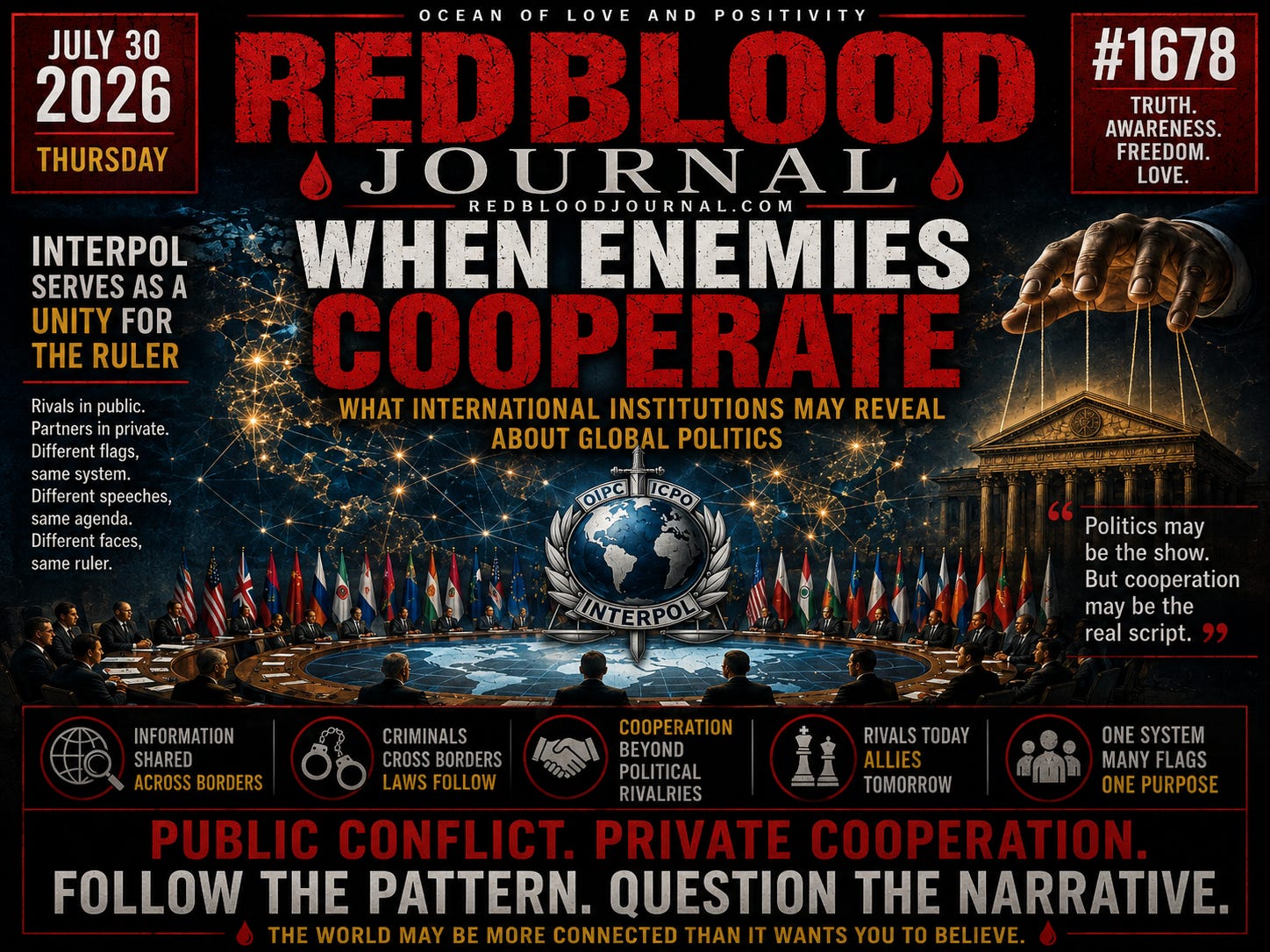
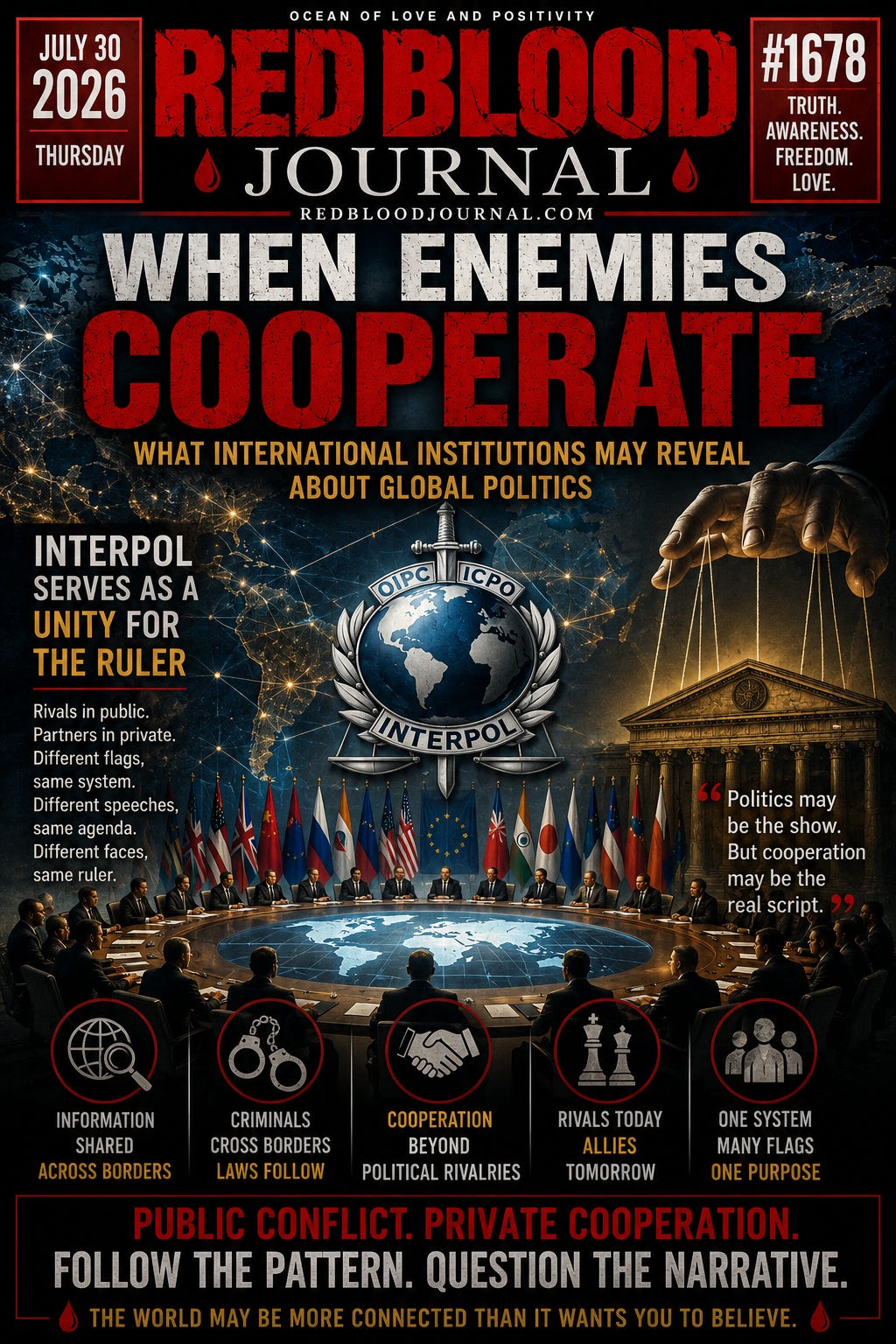
#1678 — When Enemies Cooperate
July 30, 2026
What International Institutions May Reveal About Global Politics
🩸 RedBloodJournal.com 🩸
Politics is often presented as a world divided into opposing camps.
East versus West.
Capitalism versus communism.
Democracy versus authoritarianism.
Nation against nation.
Election after election.
Speech after speech.
Conflict after conflict.
Yet there is another way to interpret world events.
When an international arrest warrant is issued, many people naturally focus on the individual involved.
Others look at the institution behind the action.
Organizations such as Interpol exist because governments have agreed that some forms of international cooperation are necessary.
Supporters argue that this cooperation is essential for pursuing fugitives who cross borders, combating organized crime, terrorism, human trafficking, and cybercrime.
From that perspective, international cooperation strengthens the rule of law.
Others draw a different conclusion.
They ask a philosophical question.
If nations are truly permanent adversaries, why do they maintain institutions that require ongoing collaboration?
Why do countries with competing political systems continue to share information through international organizations?
Why do governments that publicly criticize one another still participate in common legal and diplomatic frameworks?
One answer is simple.
Even rivals often share practical interests.
History shows that competing nations have cooperated on issues such as aviation, maritime navigation, disease control, postal systems, scientific research, and criminal investigations.
Another interpretation is more skeptical.
Some observers believe these institutions demonstrate that political competition is, at least in part, accompanied by a deeper layer of international coordination.
In this view, public disagreements and private cooperation exist simultaneously.
The debate is not whether cooperation exists.
It clearly does.
The debate concerns what that cooperation means.
Does it represent responsible coordination between sovereign nations?
Or does it suggest a degree of centralized international influence that many citizens underestimate?
Reasonable people can reach different conclusions.
Perhaps the more important lesson is to recognize that international politics is rarely as simple as permanent enemies on one side and permanent allies on the other.
Relationships evolve.
Interests change.
Competitors cooperate in some areas while confronting one another in others.
Understanding that complexity may be more valuable than assuming every headline tells the entire story.
Rather than accepting any single narrative without question, citizens benefit from examining institutions, incentives, and historical patterns for themselves.
The strongest conclusions are often those reached through careful observation, evidence, and independent thought.
Ocean of Love and Positivity.
🩸🌊✨ Fantastic!
🤝
🤝 The Paradox of Global Cooperation
Jul 30, 2026
This source explores the complex relationship between global adversaries and their shared participation in international institutions. While public narratives often emphasize political conflict and ideological divides, the text highlights how rival nations consistently engage in cross-border cooperation regarding crime, health, and infrastructure. This ongoing collaboration suggests that practical interests often override public hostility, leading to various interpretations of how much centralized influence actually exists. Ultimately, the author encourages readers to look beyond simplistic headlines of permanent enmity to recognize a more nuanced reality of simultaneous competition and coordination. By examining these diplomatic frameworks, citizens can better understand the underlying incentives that drive global governance.


