


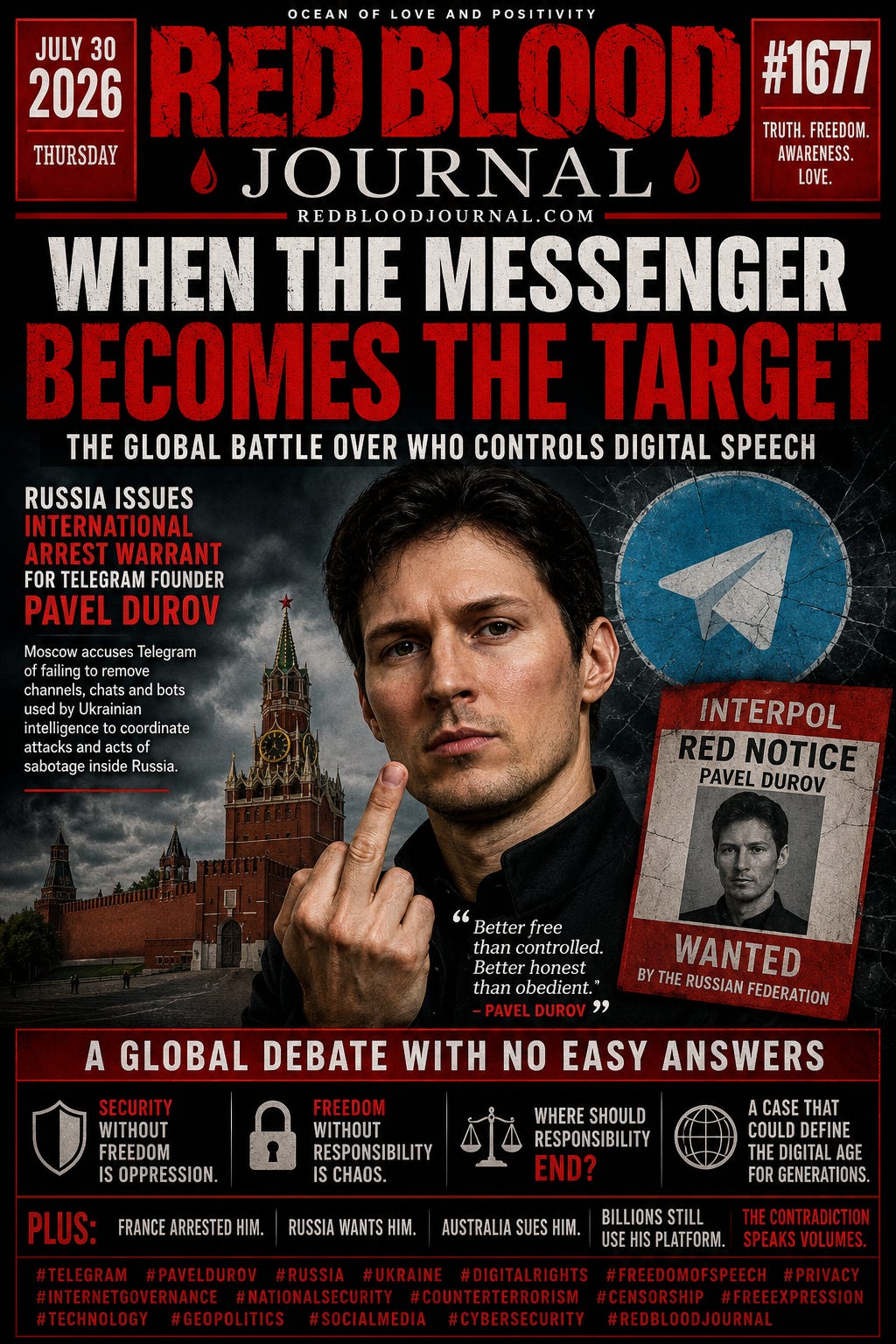

#1677 — When the Messenger Becomes the Target
July 30, 2026
The Global Battle Over Who Controls Digital Speech
🩸 RedBloodJournal.com 🩸
Russian authorities have announced that they have issued an international arrest warrant for Telegram founder Pavel Durov, accusing him of facilitating terrorist activities.
According to Russian officials, Telegram failed to remove channels, chats, and automated bots allegedly used by Ukrainian intelligence services to coordinate attacks and acts of sabotage inside Russia.
The allegations represent one of the most significant legal actions ever taken against the founder of a major global communications platform.
Yet the story extends far beyond one individual.
It raises a much larger question.
Who is responsible for what billions of users say and do on a communications platform?
For more than a century, telephone companies have generally not been held responsible for every conversation taking place over their networks.
Postal services are not held responsible for every letter.
Road builders are not held responsible for every destination drivers choose.
The internet has challenged those traditional distinctions.
Modern communication platforms have become far more than simple carriers of information.
They host public conversations.
Private conversations.
Communities.
Media.
Political movements.
Businesses.
Governments.
Military personnel.
Journalists.
And unfortunately, criminal and terrorist organizations as well.
As these platforms have grown, governments around the world have increasingly argued that technology companies should remove illegal content and cooperate with investigations involving terrorism, organized crime, and national security.
Supporters of stronger regulation argue that platforms have both the ability and the responsibility to reduce harm.
Others argue that making platform founders personally liable for user activity risks transforming private communication networks into systems of continuous surveillance and censorship.
The debate is no longer limited to Russia.
In recent years, Telegram has faced legal pressure from multiple countries over allegations that it failed to remove illegal or extremist content quickly enough.
Each government has presented different legal arguments.
Yet they all point toward the same underlying issue.
Where should responsibility end?
Should the creator of a communications platform be treated like a publisher?
A utility?
A technology provider?
Or something entirely new?
The answers remain unsettled.
The outcome of cases involving Telegram may help define how governments regulate global digital communication for years to come.
Whatever one’s position may be, the questions extend far beyond one application or one individual.
They concern the future relationship between privacy, security, free expression, and governmental authority in the digital age.
As communication increasingly moves online, societies continue searching for the balance between protecting public safety and preserving the freedoms that open communication was originally designed to provide.
History may ultimately remember these legal battles not simply as cases against a technology company, but as defining moments in the evolution of digital rights and governmental power.
Ocean of Love and Positivity.
⚖️
⚖️ The Liability of the Digital Messenger
Jul 30, 2026
This source examines the legal and ethical conflict surrounding digital communication through the lens of an arrest warrant issued for Telegram’s founder. Russian authorities allege that the platform’s refusal to moderate specific content facilitated terrorist activities and sabotage, sparking a debate over corporate liability. The text questions whether technology executives should be held personally responsible for the illegal actions of their users, much like publishers or utilities. It contrasts the need for public safety and government cooperation with the risks of mass surveillance and censorship. Ultimately, the narrative suggests that these legal battles represent a pivotal moment in defining the boundaries of digital privacy and state power. This situation highlights the global struggle to balance unrestricted speech with the necessity of national security.


