


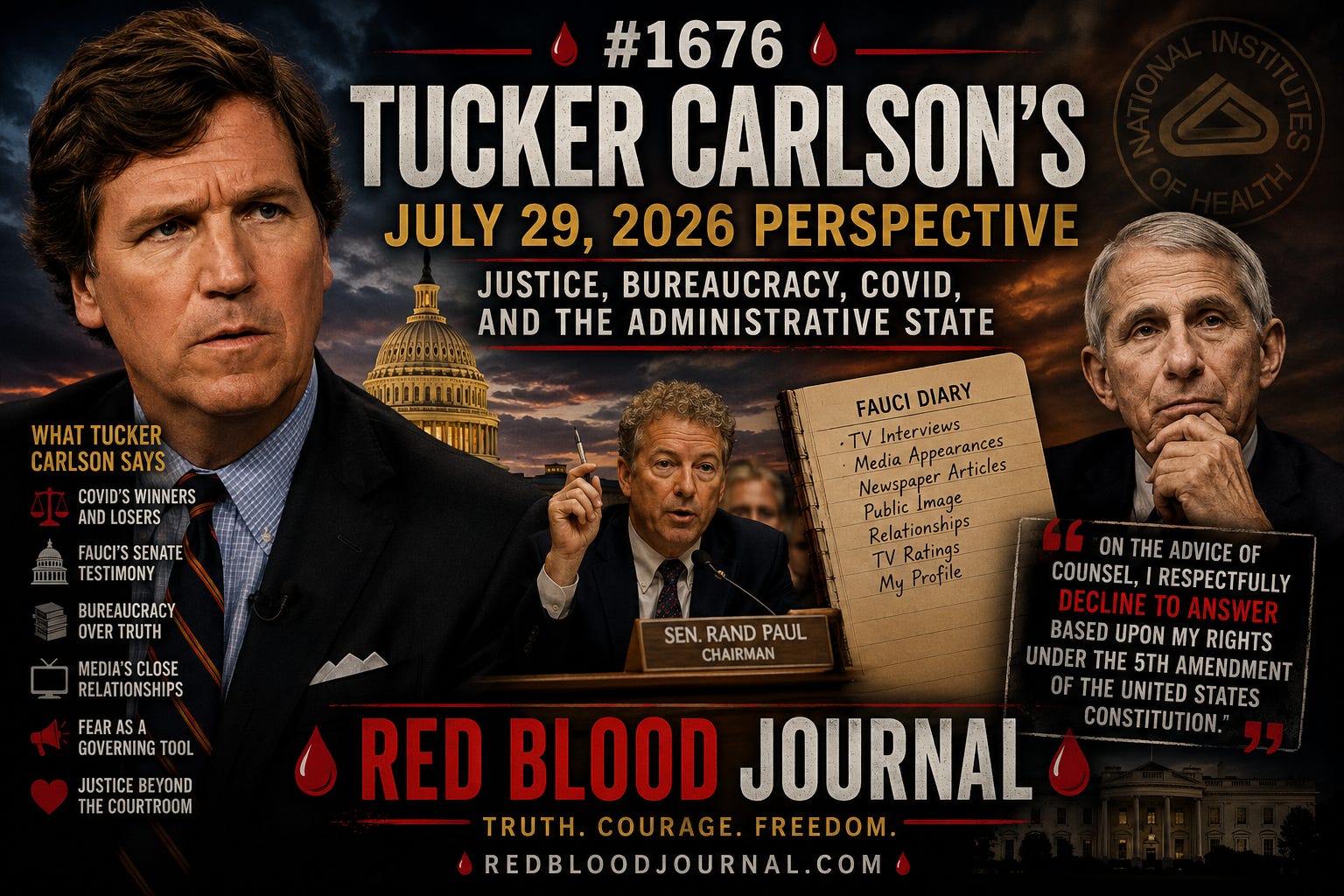
🩸 #1676 — Tucker Carlson’s July 29, 2026 Perspective
Subtitle:
Justice, Bureaucracy, COVID, and the Administrative State
July 29, 2026
Tucker Carlson on Fauci, COVID, and the Search for Justice
A Summary of Tucker Carlson’s July 29, 2026 Commentary
🩸 RedBloodJournal.com 🩸
On July 29, 2026, Tucker Carlson devoted much of his program to Dr. Anthony Fauci’s appearance before the Senate Homeland Security Committee chaired by Senator Rand Paul.
Throughout the commentary, Carlson presented his own interpretation of the COVID era, Fauci’s testimony, and what he believes it reveals about power, bureaucracy, justice, and modern government.
The following is a summary of Carlson’s opinions and arguments as expressed in the broadcast.
Justice Appears Delayed
Carlson begins with a philosophical observation.
He argues that one of the greatest frustrations in life is watching people who have caused harm appear to prosper while those who acted honorably suffer the consequences.
Referencing the Book of Ecclesiastes, he suggests that history often appears to reward the wicked while punishing the righteous.
He uses this idea as the foundation for his discussion of the COVID period.
COVID’s Winners and Losers
According to Carlson, the pandemic produced clear winners and losers.
He argues that:
Small businesses were devastated.
Many workers who refused vaccine mandates lost careers and pensions.
Large corporations expanded dramatically.
Government authority increased.
Anthony Fauci became one of the most influential public officials in America.
Carlson views these outcomes as evidence that the pandemic fundamentally reshaped both the economy and the relationship between governments and citizens.
Fauci Before the Senate
Carlson focuses heavily on Fauci’s Senate testimony.
He emphasizes that Fauci repeatedly invoked his Fifth Amendment rights rather than answering questions posed by senators.
Rather than concentrating solely on the legal implications, Carlson describes Fauci’s demeanor.
He portrays Fauci as fearful, nervous, and personally shaken during the hearing.
Carlson argues that the testimony revealed not an all-powerful figure, but someone he believes appeared deeply insecure.
Bureaucracy Over Individual Leadership
A recurring theme throughout Carlson’s commentary is his criticism of bureaucracy.
He argues that modern institutions increasingly elevate administrators rather than independent thinkers.
In his view, bureaucracy encourages conformity, committee decision-making, and obedience instead of personal responsibility.
Carlson suggests that Anthony Fauci became the public face of this broader administrative culture.
Fauci’s Government Diary
A major portion of the program discusses entries from what Carlson describes as Fauci’s personal diary stored on government servers.
Carlson argues that the diary contains numerous references to:
media appearances,
public recognition,
newspaper coverage,
television interviews,
relationships with journalists,
and Fauci’s own growing public profile.
Carlson concludes that the diary reflects a strong focus on personal reputation rather than scientific questions or public health.
The Role of the Media
Carlson argues that many major media organizations became unusually close to government officials during the pandemic.
He points to diary references involving journalists and television personalities as evidence of what he believes was an unhealthy relationship between the press and government officials.
Rather than serving as adversarial watchdogs, Carlson argues that portions of the media became supportive participants in promoting official messaging.
Science and Authority
One of Carlson’s strongest themes concerns the relationship between science and authority.
He distinguishes between:
science as a method of questioning and testing ideas, and
science as an appeal to authority.
He criticizes the notion that disagreement with particular public officials should automatically be viewed as opposition to science itself.
Carlson argues that healthy scientific inquiry depends upon debate rather than unquestioning acceptance.
Constitutional Rights
Carlson also discusses constitutional freedoms during the pandemic.
He argues that:
freedom of speech was restricted,
dissenting viewpoints were suppressed,
government pressure influenced social media moderation,
and constitutional protections were weakened during the public health emergency.
He contrasts these concerns with Fauci’s decision to invoke Fifth Amendment protections during the Senate hearing.
Fear as a Tool
Another recurring idea is Carlson’s belief that fear became a central mechanism of public policy during COVID.
He argues that fear influenced:
public behavior,
government messaging,
institutional compliance,
and acceptance of extraordinary policies.
Carlson suggests that fear can become an instrument through which governments expand authority.
Justice Beyond the Courtroom
Although Carlson expresses frustration that many public officials have not faced criminal penalties, he ultimately argues that justice extends beyond legal systems.
He suggests that personal insecurity, fear, damaged reputations, and inner turmoil can themselves become forms of punishment.
In Carlson’s view, legal accountability is only one form of justice.
Human character eventually reveals its own consequences.
Conclusion
Throughout the broadcast, Tucker Carlson presents a broad philosophical interpretation of the COVID era rather than limiting his discussion to Anthony Fauci alone.
His central belief is that COVID exposed deeper problems within modern society:
expanding bureaucracy,
concentration of institutional power,
close relationships between government and media,
public fear,
erosion of constitutional freedoms,
and the elevation of administrative authority over open scientific debate.
Carlson concludes that history ultimately judges individuals not only by legal outcomes, but by character, integrity, and the lasting consequences of their actions.
Whether one agrees with his conclusions or not, the July 29 broadcast presents a worldview in which the pandemic became a defining moment for understanding the relationship between government, institutions, and individual liberty.
Subjects
Tucker Carlson
Anthony Fauci
Senate Hearing
Rand Paul
COVID-19
Bureaucracy
Government Accountability
Media
Constitutional Rights
Justice
Public Trust
Science
Free Speech
Administrative State
Leadership
🩸 RedBloodJournal.com 🩸
In the Ocean of Love and Positivity, every opinion, every institution, and every individual eventually meets the same quiet shoreline: the search for truth. The strongest societies are not those that fear questions, but those willing to examine them with honesty, humility, and compassion. Whatever conclusions history ultimately reaches, may they move humanity toward greater wisdom, greater understanding, and a future guided by both reason and kindness. 🌊✨
Subjects
Tucker Carlson
Anthony Fauci
Senate Hearing
Rand Paul
COVID-19
Fifth Amendment
Government Accountability
Bureaucracy
Administrative State
Public Health Policy
COVID Response
Vaccine Mandates
Constitutional Rights
Free Speech
Media Influence
Government and Media
Bureaucratic Leadership
Justice
Public Trust
Science and Authority
Institutional Power
Political Commentary
Tags
Tucker Carlson, Anthony Fauci, Rand Paul, Senate Hearing, COVID-19, Fifth Amendment, Bureaucracy, Administrative State, Government Accountability, Public Health, Vaccine Mandates, Constitutional Rights, Free Speech, Media, Journalism, Government, Politics, Public Trust, Science, Leadership, Red Blood Journal, RedBloodJournal, RedBloodJournal.com
⚖️
⚖️Tucker Carlson on Fauci and the Administrative State
Jul 30, 2026
This text outlines a 2026 commentary by Tucker Carlson regarding Dr. Anthony Fauci’s testimony before the Senate. Carlson critiques the COVID-19 era, arguing that the pandemic allowed for an unprecedented expansion of bureaucratic power and the erosion of constitutional freedoms. He specifically highlights Fauci’s use of the Fifth Amendment and personal diary entries as evidence of a leader more focused on media reputation than public health. The source further explores themes of government overreach, the suppression of scientific dissent, and the close relationship between the administrative state and the press. Ultimately, Carlson suggests that while legal accountability may be delayed, the moral consequences of one’s actions serve as a higher form of justice.


