


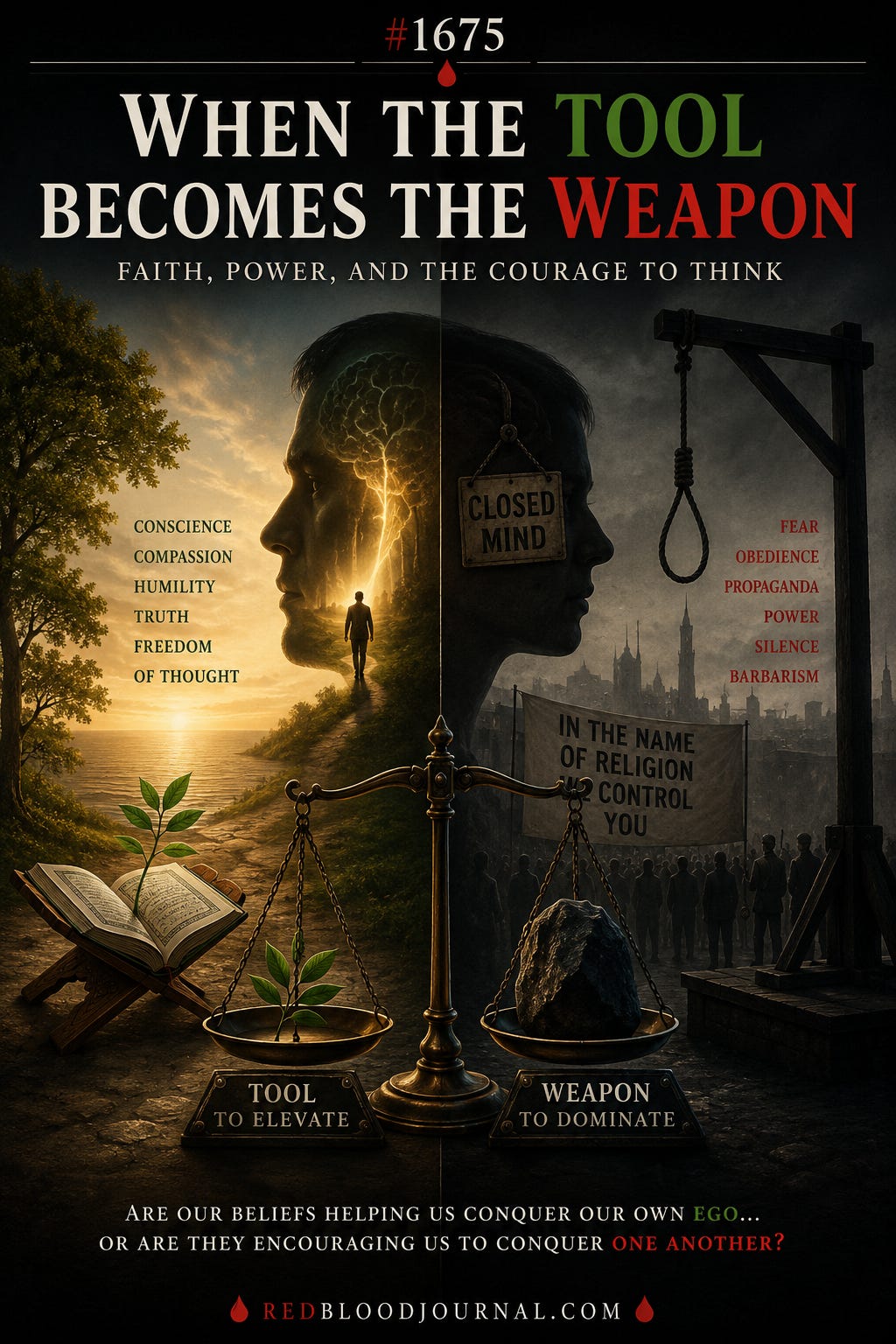
#1675 — When the Tool Becomes the Weapon
Faith, Power, and the Courage to Think
🩸 RedBloodJournal.com 🩸
Throughout history, almost every invention created by humanity has carried two possible purposes.
A hammer can build a home.
The same hammer can become a weapon.
Fire can prepare food.
The same fire can destroy a city.
Words can inspire hope.
The same words can spread fear.
The object itself is often neutral.
Its purpose depends upon the hands that use it.
Perhaps the same principle applies to ideologies and religions.
At their highest ideals, religions seek to answer humanity’s oldest questions.
Who am I?
Why am I here?
How should I live?
How do I become a better human being?
These are deeply personal questions directed toward the individual conscience.
A genuine spiritual path encourages the conquest of one’s own anger, greed, pride, and fear before seeking to conquer anyone else.
History, however, also contains many examples in which religious language, symbols, and institutions have been used by governments and political authorities to justify punishment, persecution, war, or the suppression of dissent.
When public executions, imprisonment, or violence are accompanied by religious justification, a profound question emerges.
Is the faith being practiced...
...or is the faith being used?
The distinction matters.
If a belief helps a person become more compassionate, wiser, more honest, and more humble, it functions as a tool for inner development.
If that same belief is employed primarily to frighten populations into obedience through violence or the threat of violence, it has become an instrument of power.
Throughout history, rulers have understood that fear can silence opposition more effectively than persuasion.
Public executions have therefore often served two purposes.
The first is punishment.
The second is communication.
The audience is not only the condemned.
It is everyone watching.
When executions are conducted publicly and repeatedly, observers often interpret them as carrying a broader message intended to discourage future resistance.
This pattern has appeared in different countries, cultures, and political systems throughout history.
The ethical question remains the same regardless of place or ideology.
Can fear ever become the foundation of genuine faith?
When supporters celebrate the execution of fellow citizens because they believe they are defending a sacred cause, another question arises.
What is truly being defended?
Justice?
Or power?
If compassion disappears while slogans remain...
If mercy disappears while rituals remain...
If humanity disappears while authority grows...
Perhaps the form of religion has survived while its spirit has quietly departed.
One of humanity’s greatest gifts is the ability to think.
Parents teach children.
Teachers teach students.
Books teach readers.
Religious leaders teach followers.
Scientists teach researchers.
Learning itself is not the problem.
The question is whether learning becomes the beginning of thought...
...or the end of it.
The moment a person believes another human being must permanently think on their behalf, something precious begins to disappear.
Curiosity becomes certainty.
Questions become forbidden.
Discovery becomes repetition.
Perhaps the greatest prison is not built from stone or steel.
Perhaps it is built the moment someone hangs a “Closed” sign upon their own conscience.
History’s greatest advances rarely came from people who merely repeated accepted ideas.
They came from individuals willing to ask,
“What if everyone—including my own side—is mistaken?”
Independent thought does not require rejecting every authority.
It requires remaining willing to examine evidence, question assumptions, and revise conclusions with honesty and humility.
No human being possesses a monopoly on wisdom.
Every philosopher.
Every prophet.
Every scientist.
Every inventor.
Every reformer.
Began as another human being asking difficult questions.
The strength of a civilization is not measured by how effectively it silences disagreement.
It is measured by how confidently it allows ideas to be examined without fear.
Likewise, the strength of a religion is not measured by the severity of punishments carried out in its name.
It is measured by the compassion, justice, humility, and integrity it inspires within those who embrace it.
Perhaps every generation must ask itself one final question.
Are our beliefs helping us conquer our own ego...
...or are they encouraging us to conquer one another?
The answer may reveal whether we are holding a tool...
...or a weapon.
Subjects
Faith and Power • Religion and Government • Independent Thought • Conscience • Political Philosophy • Public Executions • Ethics • Human Rights • Psychology • History • Freedom of Thought • The Nature of Belief
Tags
religion, conscience, philosophy, ethics, independent thinking, human rights, political power, public executions, history, spirituality, RedBloodJournal
🩸🌊 Fantastic!
Every generation inherits beliefs.
Wisdom is not found merely in preserving them, nor in rejecting them, but in examining them honestly.
The greatest teacher is not the one who creates the most followers.
It is the one who leaves behind the greatest number of compassionate, thoughtful, and independent human beings, each capable of navigating the ocean of life with love, humility, and respect for the dignity of others.
⚖️
⚖️ The Dual Nature of Belief: Tool or Weapon
Jul 29, 2026
This text examines how neutral tools like inventions and ideologies can be transformed into instruments of control depending on human intent. While genuine faith focuses on internal growth and compassion, the author warns that religion is often co-opted by political authorities to justify violence and enforce obedience through fear. The narrative argues that public executions and the suppression of dissent serve to protect institutional power rather than sacred justice. Ultimately, the source emphasizes the vital importance of independent thought and a free conscience as safeguards against tyranny. It concludes that the true value of any belief system is measured by its ability to foster human dignity and humility rather than its capacity to silence others.


